In this article
To secure a garage door, cover the emergency release so it cannot be hooked from outside, take back control of every remote and keypad code, and pin the big door to its tracks with a slide latch at night and before a trip. Then lock the side service door every single time, because it is often the easier way in.
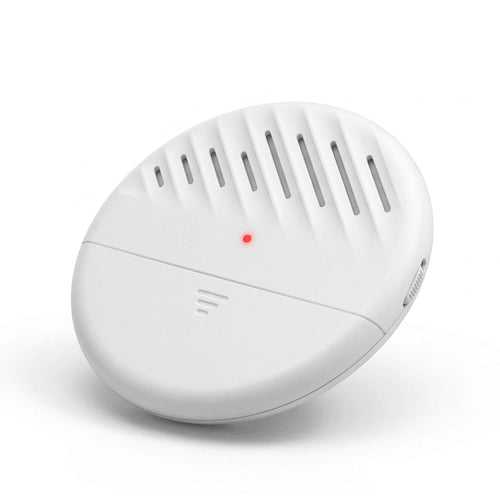
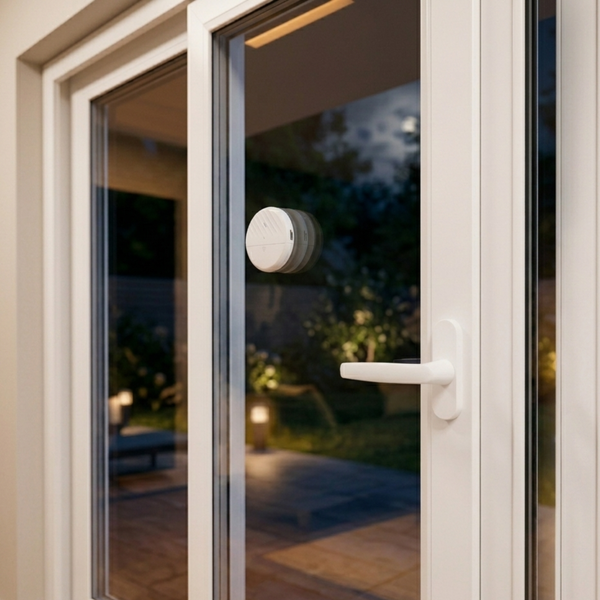
None of it needs a contractor or wiring. For the side door's window, or its solid panel, a stick-on vibration alarm covers the part a lock cannot: it sounds 125 dB the moment that surface is struck or pried.
How does a closed garage door get opened?
Forcing a heavy sectional door out of its tracks is awkward and noisy. The three routes below are quieter.
- The release cord, fished from outside. The red handle hanging from the opener rail disconnects the door so it can be lifted by hand in a power cut. Widely shared demonstration videos show a bent wire reaching it from outside the closed door and popping the opener loose in a matter of seconds.
- A remote or code you no longer control. A clicker clipped in a car on the driveway, a spare from the last owner, a keypad code given to a contractor years ago. The opener obeys all of them the same way.
- The door left open, or the one beside it left unlocked. The least dramatic route, and the one with numbers behind it.
In Bureau of Justice Statistics interviews, unlawful entry without force was behind 63 percent of completed household burglaries. When nobody was home and no force was used, an unlocked door or window was the way in about 40 percent of the time, and an open one a further 17 percent. The Department of Justice's problem-oriented policing guide to burglary of single-family houses reports no consensus on one entry point, though it calls side or back entries the most common access point, and it names exterior and interior garage doors among the openings burglars walk through when left unlocked or open.
Lock the big door itself
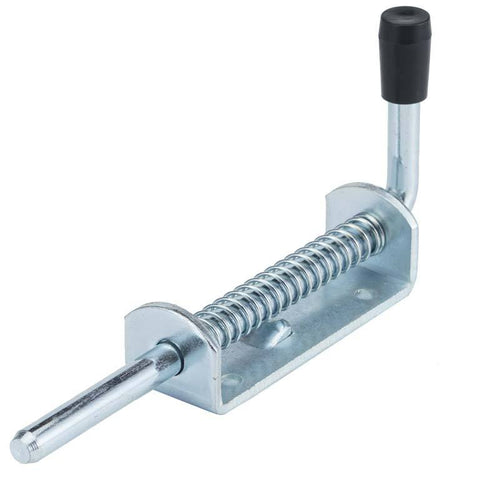
On most homes the big door has no lock at all. The opener holds the door down, and that is the whole system. A garage door slide latch adds a real one: a galvanized steel bolt on a spring, in a steel housing, screwed to the end stile (the vertical edge of the door on the inside). Slide the handle and the bolt runs sideways through a slot in the vertical track, so the door is pinned to the rail it rides in and cannot be lifted.
The pair is $29.99, one for each track. It fits sectional doors, whose panels roll up inside two vertical tracks, and it drills in: self-tapping screws come in the box, so it is an owner's fitting.
Throw the bolts only on a manual door, or after pulling the emergency release so the opener is out of the loop. An opener that tries to lift a latched door can damage the door, the opener or both. Before you drive out, slide both bolts back by hand and reconnect the opener. So most owners latch at bedtime and before a trip.
It does nothing about the release cord and covers only the big door. No drill today? The opener's vacation or lock setting does part of the job with no hardware: many wall consoles have one that silences every remote until you switch it back, and unplugging the opener does the same. Neither stops the door being lifted once the release is pulled.
Shield the emergency release
The release is a required safety feature. A purpose-made release shield plate blocks the reach from outside and leaves the handle free to pull.
A cheaper trick is a single light zip tie through the hole in the release lever. DASMA, the garage door industry's trade group, cautions that a tie can need more force to break than the release is designed to need, so the shield is the better choice.
Two hard rules. Never remove the handle, and never tie the release rigid: it has to work from inside during a fire or a power outage. Once the shield is on, stand inside, give the cord one firm pull to confirm it still disconnects, then reconnect the door.
Take the remotes and codes back
- Move the remote onto your keychain. A clicker on the visor of a car parked outside is a garage key left in the driveway. If a remote has to live in a car, make it the car that sleeps inside.
- Check that the opener uses rolling code. Rolling-code openers change their signal on every press; if a model-number search shows yours sends one fixed code, it is due for replacement.
- Reset the keypad if a code ever went to a cleaner, a contractor or a neighbor.
- Lost a clicker or just moved in? Clear the opener's memory and pair back only the remotes you hold.
- Lock out the remotes for trips. Vacation setting on, or the opener unplugged. Our pre-trip checklist covers the rest of the house.
Then the doors beside it
The side service door and the door into the house
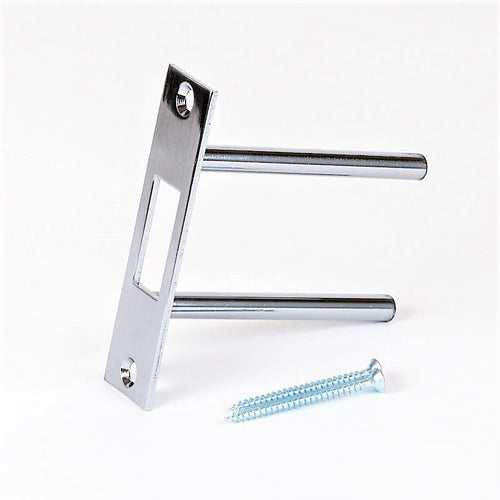
Treat both as front doors. Lock the service door whenever the garage is empty, and lock the house door whenever you lock up for the night: it is an exterior door that only feels like an inside one. For the frame, an anti-kick strike plate kit ($24.99) replaces the thin factory plate with heavy-gauge steel and six 3-inch screws long enough to bite the stud behind the jamb. On an in-swinging door, a door reinforcement lock ($24.99) braces it shut from inside, separate from the deadbolt. Why doors get kicked in explains the frame.
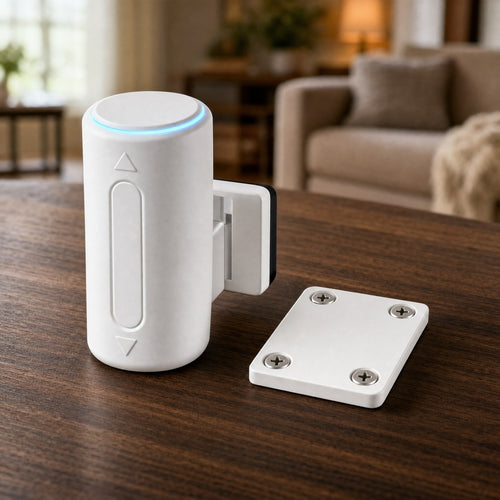
Add a magnetic entry alarm to each one. The 4-pack is $19.99 and sounds up to 125 dB when the door opens and the halves part. On the house door, anyone coming in from the garage is heard the moment it opens.
The glass
A clear garage window shows whether the car is home and what is on the shelves. Frosted film from a hardware store lets light in and keeps that view out. If the window opens, a sash lock holds it shut. The pane itself is the alarm's job: the TremShield Vibration Alarm sticks to the inside of the glass, or to the solid panel of the service door, and sounds 125 dB at a strike, a pry or a rattle, while whoever is doing it is still outside. More in burglar-proofing windows without bars.
The approach
Garages often sit in the lot's darkest corner. A solar motion light ($49.99) over the side door lights the step the moment something moves, with no wiring. A driveway alarm ($34.99) chimes inside when someone walks up the drive. Both are in the garage security collection. More on what deters burglars.
The garage lock-up routine
Every night, and before every trip
- Side service door locked, deadbolt thrown.
- Door from the garage into the house locked.
- No garage remote in a car parked outside.
- Big door fully down. Look, do not assume.
- Trips: opener on vacation lock, or unplugged.
- Slide latches thrown after pulling the release, only if nobody needs to drive out before you free them.
- Release shield in place and the cord still pulls freely from inside.
- Light over the side door works.
- Garage window covered, so the car's absence does not show.
Every gap, one fix each
| Gap | Fix | Effort |
|---|---|---|
| Emergency release cord | Release shield plate, cord still pullable from inside | 5 minutes |
| Garage remotes and keypad | Remote on the keychain, keypad code changed, rolling code checked | 5 minutes |
| Big sectional door at night and on trips | Slide latch on each track, thrown only with the opener disconnected | One install, then a slide each night |
| Garage door left open | Check it is fully down every night | A glance |
| Side service door and door into the house | Lock both every night; strike plate kit, reinforcement lock on an in-swinging door, entry alarm | Under an hour per door |
| Garage window | Frosted film, sash lock if it opens, vibration alarm on the glass | Half an hour |
| Dark approach | Solar motion light over the side door, driveway alarm on the drive | A morning |
Tonight, do the free part: lock the side door, bring the remote in, check the big door is down. Then cover the glass and the side door panel. One TremShield Vibration Alarm is $29.99, and a garage window, a side door and the house add up fast, so the 6-pack at $99.00 brings each alarm to $16.50 and saves $80.94 against six singles. It comes with two free no-drill window locks, the Home Security Guide arrives by email as a PDF, shipping is free to the US, Canada, the UK, Australia and New Zealand, and you have 30-day returns.
Garage door security questions
How do you secure a garage door from the outside?
The locking happens inside: the slide latch mounts on the inside of the door. Before leaving, set the vacation lock or unplug the opener, throw the latches after pulling the release if no car must drive out, check the service door's deadbolt, and leave through the house.
Can a garage door be opened with the release cord from outside?
Yes, if the release is unshielded: widely shared demonstration videos show a bent wire hooking the handle from outside the closed door. A release shield plate blocks that reach and keeps the cord usable from inside. Never remove the handle or tie the release rigid.
What is the best lock for a garage door?
For a sectional door, a slide latch on each side: a steel bolt passes through a slot in the vertical track, so the door cannot be lifted. Throw it only on a manual door or after pulling the emergency release, and free it by hand before driving out. It does not protect the release cord.
Does a stick-on alarm work in a garage?
A vibration alarm works on a clean, dry, smooth, solid surface such as a garage window or a solid door panel, and sounds 125 dB when that surface is struck or pried. In an unheated garage where the glass fogs or frosts, fit it on a dry day and check it is still firmly stuck after the first cold spell.
What does it cost to secure a garage door?
The habits are free. Hardware, per piece: the slide latch pair $29.99, the entry alarm 4-pack $19.99, the door reinforcement lock and the strike plate kit $24.99 each, the solar motion light $49.99 and the driveway alarm $34.99. One vibration alarm is $29.99, or six for $99.00, which is $16.50 each.
Back to all articles