In this article
There's a small ritual almost everyone performs with their first door alarm: you stand at your own front door, device in hand, and wonder whether something lighter than your phone can matter against a person willing to force this door. It feels like asking a whistle to do a wall's job.
So here's the answer before any evidence: door alarms work, on one condition. You have to give them the right job. A door alarm can't hold a door shut and can't strengthen a weak frame. What it does is take the quiet out of an attempt, and quiet is the one thing every way through a door depends on.
The evidence for that claim comes largely from convicted burglars themselves. Below: how door attacks differ from window attacks, what the research shows, the three alarm types in plain English, a table matching each type to the door you have, and an equally plain section on what no alarm can do.
The short version, by door: a magnetic entry alarm for a door you use every day, a door stop alarm for an apartment, hotel or dorm door, and a vibration alarm on the door or its glass for a back door or a French door you want to hear being forced. For the driveway, the shed and the walk to the car, see which alarm you need.
Doors are attacked differently than windows
Almost every door burglary is one of two stories, and neither looks like a movie. The first story is an unlocked door being opened like any other door. In a large share of burglaries, nobody forces anything. Among no-force entries where someone was home, the Bureau of Justice Statistics found 28.0 percent came through a door or window that was just unlocked, and another 27.0 percent through one standing open. Nothing was defeated. The house was never asked to object.
The second story is force. When a door is beaten, the target is not the lock but the frame: a kick lands beside the knob and tears the strike plate, held by short factory screws that grip only the soft jamb, away from the wood. The Department of Justice's problem-oriented policing guide on residential burglary adds that side and back entries are the most common access point for burglars, though in some areas it is the front door. We cover the frame problem, and the inexpensive hardware that fixes it, in our guide to why doors get kicked in.
Windows are a different psychology, quiet prying and patient latch work, which is why we answered that version of the question separately in Do Window Alarms Actually Work? For doors, notice what both stories require: silence that holds. The unlocked door is only useful if it opens without a sound. The kick is loud, but only for a second, and a single thud gets explained away as a truck door or a dropped box. A door alarm exists to make sure neither kind of silence survives.
What the evidence says about alarms on doors
Burglars report that alarms change their decisions at every stage: choosing a target, approaching it, and deciding whether to continue. In a University of North Carolina at Charlotte survey of 422 incarcerated burglars held in North Carolina, Kentucky and Ohio, about 83% said they would try to find out whether a home had an alarm, and 60% said an alarm would send them looking for a different target. Among those who discovered an alarm only mid-attempt, half said they'd stop and another 31 percent said they'd sometimes retreat. Worth knowing: the Alarm Industry Research and Educational Foundation paid for the study, and university researchers carried it out.
The same study also asked about planning. Only about 12 percent of the burglars typically planned a burglary in advance; 41 percent described their crimes as spur of the moment. Spur-of-the-moment burglars outnumbered planners more than three to one, which is why taking away the easy opportunity matters. A separate five-year analysis of Newark police data by a Rutgers researcher found the outside view matches: neighborhoods with more residential alarms had fewer burglaries, without pushing crime onto nearby homes.
One more finding belongs in a door article specifically. When Portland television station KGW asked 86 convicted burglars how they chose houses, every one who wrote back said they'd knock on the front door first. The answers came from the inmates who chose to reply, so it is not a scientific sample, but unanimity like that is hard to wave off. The knock is a test for an empty house. An armed door changes what passing the test is worth: even when nobody answers, entry goes loud the moment the door moves, which is exactly the outcome the knock was supposed to rule out.
The three types of door alarm, explained
Door alarms come in three forms, and the real difference between them is the moment they trigger: when the door opens, when the door is pushed against, or when the door or the glass in it is struck.
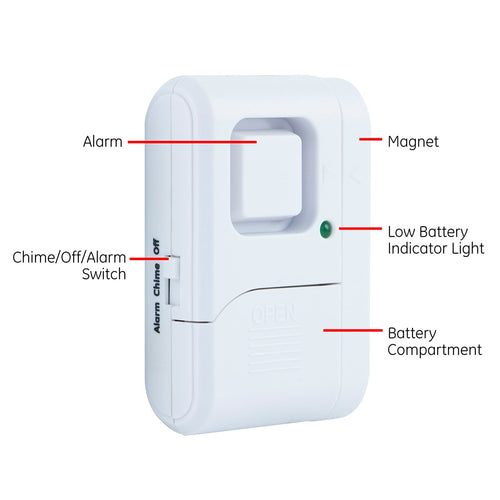
- Magnetic entry alarms. Two small pieces, one on the door and one on the frame, joined by a magnetic contact. When the door opens and the pieces separate, the siren fires. Installation is peel-and-stick tape, about a minute per door, and a four-pack covers the front, back, and side doors in one pass. This is the type that answers the unlocked-door story: whether or not anyone remembered the deadbolt, the door can no longer open silently.
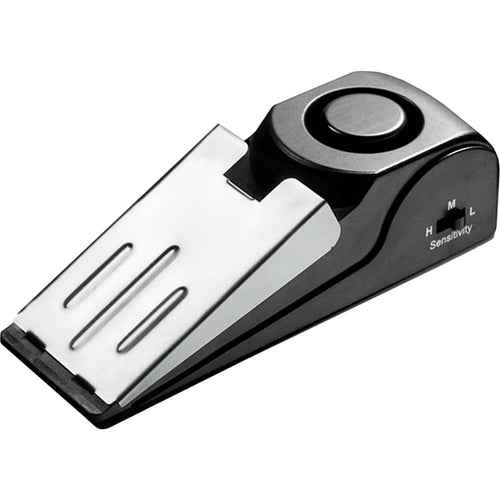
- Door stop alarms. A wedge with a pressure sensor inside, placed on the floor behind an inward-opening door. It does two jobs at once, which no other alarm type can claim: the wedge physically resists the swing while a 120 decibel siren fires the moment the door presses into it. Nothing is drilled, taped, or installed, so it works on doors you don't own, tonight.
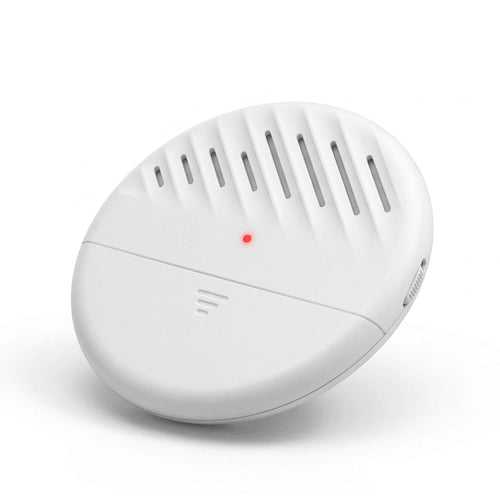
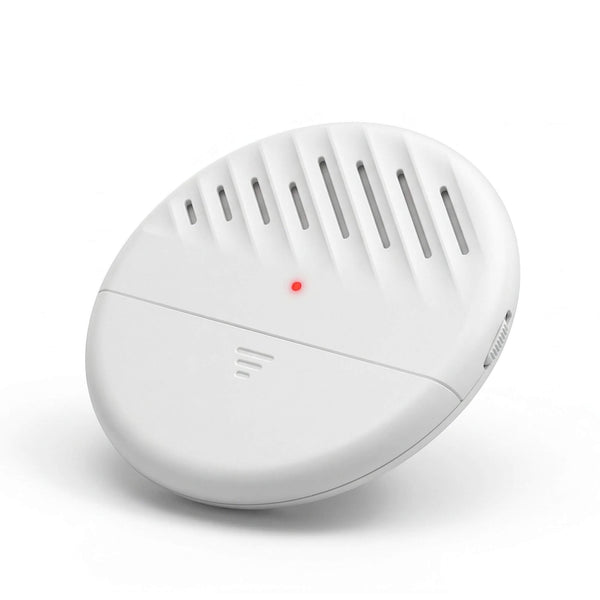
- Vibration alarms. A pocket-sized unit that sticks to the door or its glass and reads that surface itself. TremShield's version fires a 125 decibel siren at the rattle and impact of tampering, with adjustable sensitivity, before anything opens. On a French door or a half-glass back door the pane is the weak point, and this is the only type that puts the trigger directly on it.

All three share the same quiet virtues: battery powered, nothing to connect, nothing to renew. They don't want Wi-Fi or a hub or an app or a subscription, and they keep working through an internet outage.
Which door alarm for which door
Match the alarm to the door's likely failure, not to the loudest number on the box. This table covers the five situations readers ask about most.
| Your situation | Best alarm | Why it fits |
|---|---|---|
| Front or back door you use daily | Entry alarm 4-pack | Arms with a switch at bedtime or when you leave, sounds the instant the door swings, and one pack covers up to four openings. |
| Apartment with landlord rules | Door stop alarm (120 dB) | Rests on the floor, so nothing is drilled or stuck on. It braces the door, sirens under pressure, and moves out when you do. |
| Glass-paned or French door | Vibration alarm (125 dB) | Mounts on the pane and reacts to impact and prying, so it sounds before a hand can reach any latch through the glass. |
| Sliding glass door | Vibration alarm, on the pane | The door is mostly glass, so the sensor belongs on the glass. Add the track fixes from our sliding door guide. |
| Hotel, dorm, or short-term rental | Door stop alarm | Fits any inward-swinging door, packs into a carry-on, and needs no tools or permission. Wedge it, switch it on, done. |
If you'd rather have this matching done for your whole home at once, the interactive alarm finder gets there in about a minute, and the door security collection gathers everything mentioned here. Renters can go deeper with our apartment door security guide, which works entirely within a standard lease.
What a door alarm cannot do
An alarm is a voice, not a muscle, and pretending otherwise is how people end up disappointed. A door alarm can't hold a door closed. It can't thicken a jamb or lengthen the screws in a strike plate, so it has no say in whether a kick succeeds. It can't summon the police; a self-contained siren counts on humans, you or a neighbor, to act on what they hear. And it has one failure mode of its own, a dead battery, which is why a ten-second test on the first of the month is part of owning one.
That's why alarms pair so naturally with reinforcement instead of replacing it. A door reinforcement lock installs in about five minutes and braces the door across the frame, and an anti-kick strike plate kit swaps the thin factory plate and its short screws for a heavy-gauge steel plate and six 3-inch screws driven through the jamb into the stud. The hardware decides whether the door gives. The alarm decides whether anything about the attempt stays quiet. Together they cover both of the stories this article started with.
None of this asks for vigilance. The hardware is installed once. The alarm arms with a switch as part of locking up. After that, the door handles its own negotiations, and your evening belongs to you.
Door alarms for kids, handles and travel
Can a door alarm tell me when a child opens the door?
Yes. A magnetic entry alarm sounds the instant the door opens past about half an inch, at up to 125 dB, loud enough to carry through the house. It warns rather than locks, so it does not replace a lock or supervision on a door a child should never open.
What is a door handle alarm?
A touch alarm that hangs from the inside knob or lever by a cord; a hand on the handle sets off its 120 dB siren before the latch turns. Plastic, rubber-coated or painted-over handles may not register a touch, so try it on your door the night it arrives.
Which door alarm is easiest to travel with?
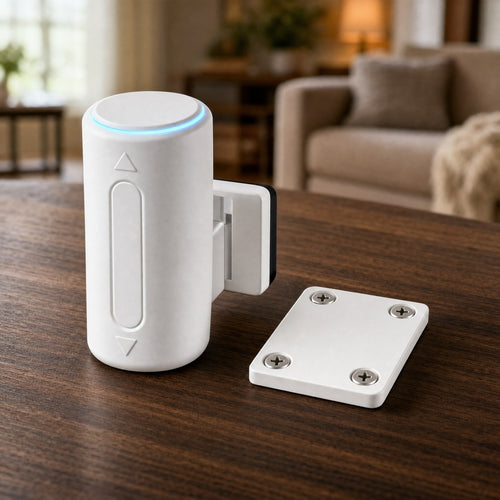
The door stop alarm and the door knob alarm, because neither needs tools and both fit a bag. The wedge goes under an inward-opening door with about a 0.75 inch gap and runs on one 9V battery, sold separately, while the knob alarm hangs from the handle and leaves the door as it was.
Does the vibration alarm work on a door with no glass?
Yes. It sticks to any smooth, solid surface, so a painted or metal door takes it as well as a pane, and it sounds at 125 dB when the door is struck or pried. Clean the spot first, and skip rough or textured areas where it can't sit flat.
Start with the door that has glass in it
A French door, a half-glass back door or a sidelight is where a TremShield Vibration Alarm earns its $29.99: it goes on the pane, the part of the door a hand can reach through. Count the panes around your doors and ground-floor windows, and the 6-pack at $99 covers six of them at $16.50 per alarm, saves $80.94, and brings two free no-drill window locks and the Home Security Guide with it. Free shipping to the US, Canada, the UK, Australia and New Zealand, with 30-day returns.
Back to all articles