In this article
Ask five security companies what deters burglars and you will get five answers that match five catalogs. If that has left you unsure whether anything short of a fortress makes a difference, the doubt is reasonable. It is also fixable, because offenders have been asked directly, many times, and their answers are strikingly consistent.
What actually deters burglars? The evidence points to a short list: an alarm they might set off, a home that looks and sounds occupied, a dog, clear sightlines that let neighbors see the approach, and lighting paired with those layers. Burglars avoid attention, not obstacles, and most decide from the sidewalk in seconds.
The stakes are smaller than they feel, too. Burglary has been declining for decades, and in the Bureau of Justice Statistics' national victimization survey, about 99% of US households got through 2024 with no burglary at all. (The full numbers are in our home burglary statistics guide.) Deterrence is not about repelling a siege; it is about taking your home off an opportunist's short list of easy options.
Here is the plan: what offenders told researchers, the common deterrents ranked by evidence strength, an honest section on what barely works (including two things we sell), and a starter stack that takes about five minutes.
What burglars told researchers
The most useful evidence comes from asking the people who did it. In a University of North Carolina at Charlotte survey of 422 incarcerated burglars across three states, about 83% said they would try to find out whether a home had an alarm before attempting a burglary, and 60% said an alarm would send them looking for a different target. One disclosure worth making: the study was funded by an alarm-industry research foundation. The methods were academic, and the findings match what offenders tell everyone else who asks.
The same survey dismantles the movie image of the patient professional. Only about 12% of burglars said they typically planned a burglary in advance, while 41% said it was most often spur of the moment. That is the real opponent: not a mastermind studying your habits, an opportunist scanning for the path of least attention. You do not need to out-plan anyone. You need to be a less inviting option than the next street.
Journalists hear the same story. When Portland TV station KGW surveyed 86 convicted burglars by mail (an informal project, not a scientific sample), every respondent said they would knock on the front door first to check whether anyone was home. A knock is not a threat; it is a question, and any sign of life answers it. The survey's recurring advice was blunt: get a camera and make sure people can see it.
Notice what never comes up in these answers: lock brands, glass ratings, gadget specs. The decision happens outside, in seconds, on signals. That is a contest any household can afford to win.
Burglar deterrents, ranked by the evidence
The table ranks the usual candidates. Strong means multiple independent sources point the same way, including offender reports and at least one real-world study. Moderate means the effect is real but conditional, usually on being paired with other layers. Weak means there is little or no evidence it works on its own.
| Deterrent | Evidence strength | Cost and effort | One-line note |
|---|---|---|---|
| Audible alarm, visibly in place | Strong | Low cost; minutes to place | A Rutgers University study of five years of Newark police data found more home alarms meant fewer burglaries, with no crime pushed onto neighbors. |
| Doors and windows actually locked | Strong | Free; two minutes a night | Not a signal, pure subtraction: Bureau of Justice Statistics victim data shows 63% of completed burglaries involved no force at all. |
| An occupied look and sound | Strong | Free to low | The Department of Justice's residential burglary guide finds homes that appear occupied (lights, a car, audible activity) are less likely to be burglarized. |
| A dog, especially a big one | Moderate | A family member, not equipment | In KGW's survey of 86 burglars, big, loud dogs were repeatedly described as a deal breaker. |
| Clear sightlines for neighbors | Moderate | A weekend of trimming | Burglars favor entries nobody can see; cutting back the hedge puts the side door on stage. |
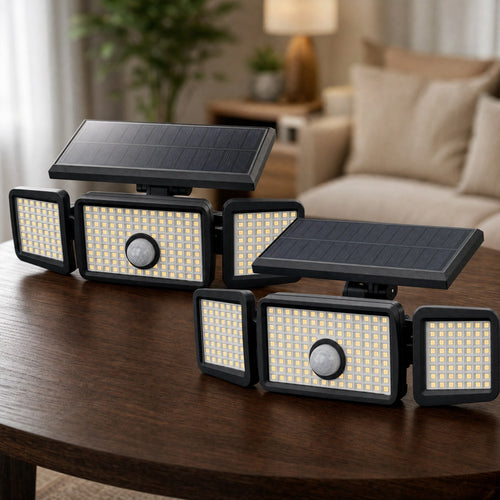
| Motion lighting on approaches | Moderate | Low; no wiring if solar | Real evidence at night, weaker alone; the studies and the caveat are below this table. |
| A real, visible camera | Moderate | Mid cost; needs mounting | The deterrent feature is visibility, not resolution; a camera nobody notices deters nobody. |
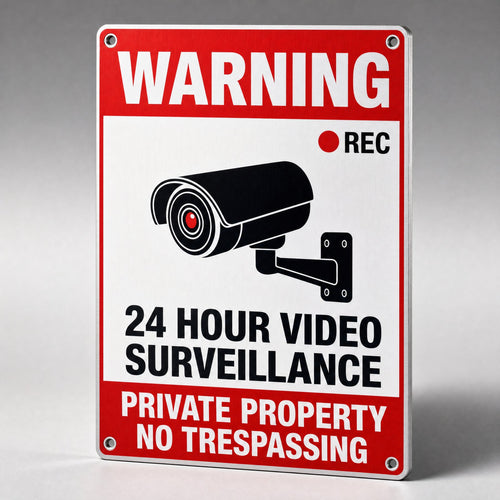
| Warning sign or decal alone | Weak | Two minutes | Reads as credible only when the rest of the house agrees with it. |
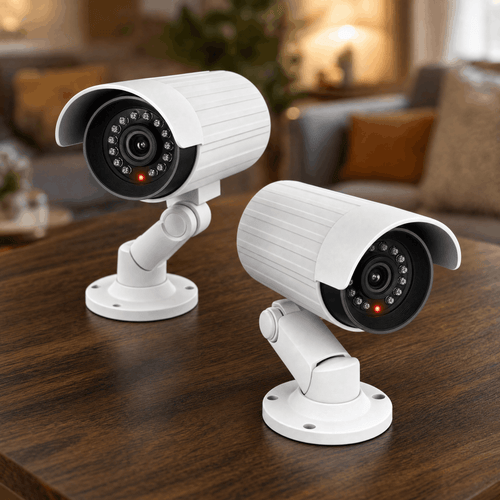
| Fake camera | Weak | Two minutes | No study supports props alone; use as trim on real layers, never as the structure. |
About that lighting row. The strongest single result is a randomized experiment in New York City public housing, published through the National Bureau of Economic Research: temporary streetlights cut serious outdoor nighttime crime in the study developments by at least 36%. Reviews that pool many lighting studies, the Welsh and Farrington line of systematic reviews, find a more modest average effect, roughly 14%, and note that the benefits are not confined to nighttime, a hint that light also works by signaling a watched, cared-for place. The practical read: light multiplies the rows above it and rarely carries a home alone. Placement specifics are in our guide to whether motion sensor lights deter burglars.
The 5-minute deterrence stack
Start with the smallest version that works: three placements, aimed at the spot where a stranger first sizes up your home.

- Stake a sign where the approach begins. Put a 24-hour surveillance warning sign at the walkway or driveway entrance, angled to face an arriving person, and add one decal at eye level on the door a stranger would most likely try.
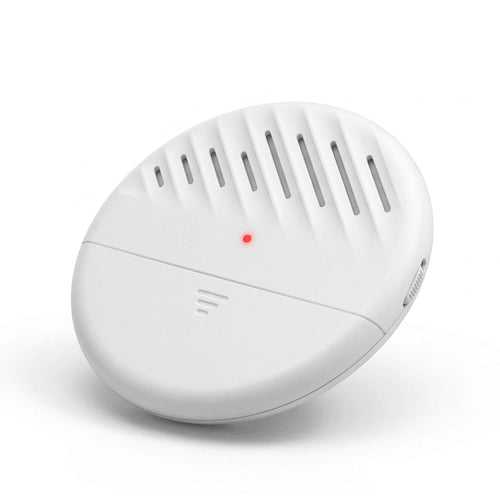
- Stick an alarm where it shows on the glass. A TremShield Vibration Alarm mounts to the inside of the window or patio door nearest that approach: a 125-decibel siren, battery powered, no Wi-Fi, no hub, no subscription. Visible from outside, it finishes the sentence the sign started. Disturbed, it makes that pane the loudest spot on the block.
- Put light on the path. Start the porch-light habit tonight, then mount a solar motion security light over the approach this weekend, so movement gets lit whether or not anyone remembers a switch.
A claim, a consequence, and a spotlight. Five minutes today, one screwdriver over the weekend, and the first impression your home makes is a different one.
What barely works on its own
Now the honest part. TremShield sells a warning sign and a fake camera, so read this twice: neither is a security plan by itself. No rigorous study has isolated yard signs or dummy cameras and found they prevent burglaries alone, and in the UNC Charlotte survey, some burglars ignored signs outright when everything else about a home said easy. Offenders read the whole property, not the lawn.
Props have one legitimate role: being the visible layer of something real. A sign backed by an actual siren on the glass is a warning. A sign backed by nothing is a bluff, and opportunists call bluffs. If the budget covers one item, buy the alarm before the sign. We took a longer look at decoys in our honest answer on fake cameras and security signs.
None of this means skipping the props. It means stacking them last, on top of something that can actually make noise.
Build the full stack in one afternoon
A complete deterrence pass on a typical house takes one unhurried Saturday afternoon, and much of it costs nothing. Work from the street inward.
- The approach (30 minutes). Sign staked, decal on the likely door, motion light mounted to cover the walkway, and the one shrub that screens a side entry trimmed back until the door is visible from the street.
- The glass (30 minutes). Alarms on the panes a stranger could reach without being seen: the patio door, the ground-floor window behind the fence. We cover the evidence in do window alarms actually work, and the interactive alarm finder matches devices to openings in about a minute.
- The driveway (20 minutes). A wireless driveway alarm chimes indoors the moment a car or person enters, so arrivals announce themselves early and the house gets the first move: a light on, a voice, a face at the window.
- The occupied look (15 minutes). A lamp on a timer in a front room, a radio for the hours the house sits empty, the car left in the driveway when possible. This automates the strongest free row in the table.
- The habit (2 minutes, nightly). In the same Bureau of Justice Statistics victim data, nearly 40% of no-force entries into unoccupied homes came through a door or window that was not locked, and another 17% through one standing open. A slow lap before bed closes the widest gap in this entire article.
The powered pieces run on batteries, with no Wi-Fi, no app, and no subscription, and they ship free in the US; you can browse the category in our burglar deterrents collection. But look back at the list: trimming, timers, locking. Most of deterrence is arrangement, not acquisition.
Frequently asked questions
Do burglar alarms deter burglars even without monitoring?
The deterrent effect comes from noise and attention, not from a monitoring contract. In the University of North Carolina at Charlotte survey, half of the burglars who discovered an alarm mid-attempt said they would stop immediately, and another 31% said they would sometimes retreat. A standalone 125-decibel siren creates the same unwanted attention the moment glass or a door is disturbed. No device can guarantee prevention; the job is to make leaving the obvious choice, early.
What is the single best burglar deterrent?
The evidence does not crown one product; it favors a cheap combination: an alarm that can be seen or heard, a home that looks and sounds occupied, and doors and windows that are actually locked. If you do only one thing tonight, lock everything before bed, since a large share of burglaries involve no force at all. If you do two, add a visible alarm to the most reachable glass.
Do dogs really deter burglars?
Dogs help. The Department of Justice's guide on residential burglary reports that most burglars avoid houses with dogs, and convicted burglars in informal surveys often name a big dog as reason enough to walk away. A dog is a family member with needs, though, not equipment, so adopt one because you want the dog. Without one, layered noise and attention (an alarm, lighting, sounds of life) cover the same job: making your home the loud, noticed option.
Do security signs and decals work without an alarm?
Alone, signs are weak: no rigorous study shows they prevent burglaries by themselves, and burglars in the UNC Charlotte survey weighed the whole property, with some ignoring signs entirely when a home looked easy. A sign earns its keep when something real sits behind it, like a siren on the glass or a motion light over the approach. Treat signs as the label on the package, never as the package.
Back to all articles