In this article
You sleep better with air moving. Someone told you the window stays shut at night, especially on a ground floor. Both are true, and the shut-window advice skips the part that decides everything: what is holding the window.
A window at night is in one of two states: shut and locked, or open and held. "Open a crack" isn't a third one. The only questions are how far it's held, and by what.
You can sleep with the window open safely when a lock holds the sash at a gap too narrow for a person, about four inches, and an alarm on the pane sounds if it's forced.
What follows is that setup: the hardware that fixes the gap, where the TremShield Vibration Sensor Alarm ($29.99, sticks to the glass, 125 dB siren) goes on a window that isn't shut, and the bedroom habits that cost nothing. We sell the hardware. The physics is free.
Is it safe to sleep with the window open?
It's safe when the opening can't grow. The worry behind the shut-window advice is fair. In the Bureau of Justice Statistics' national study Victimization During Household Burglary, a household member was home during about 28% of burglaries. So the plan can't lean on "nobody would try while I'm here." It has to lean on the sash.
Start with the factory latch. On a double-hung window, the crescent latch joins the two sashes where they meet. Raise the lower sash and they no longer line up, so the latch holds nothing. A slider's latch only catches with the panel fully closed. Vent either window an inch and the latch is out of the picture. That is why "open a crack" feels risky: a cracked window has no lock on it at all.
So the job has two halves. Something has to hold the sash at the gap you chose, hard enough that a shove can't widen it. And something has to make noise if a shove happens anyway. Hardware first, then the alarm.
How far should a window be open at night?
About four inches. That's enough to move air through a bedroom and too narrow for a person to climb through. Wider than that and you're trusting the gap instead of the hardware.
Two pieces of hardware hold that gap.
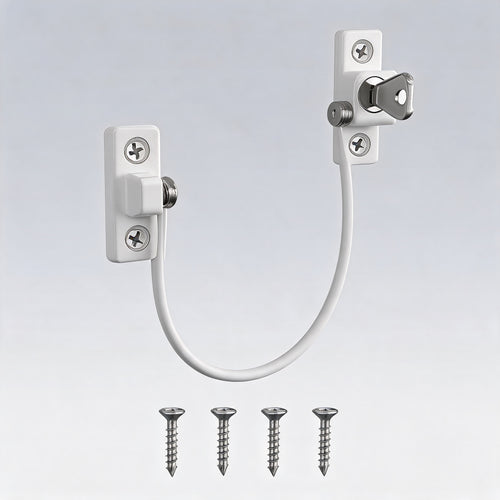
Window Restrictor Lock, $19.99. A short steel cable between two brackets: one screws to the frame, the other to the sash that moves. Open the window and the cable goes taut at roughly four inches. That is as far as it goes. It fits casement and sash windows, which makes it the pick for windows a clamp can't grip. A key releases the cable fully, so the window still opens all the way for cleaning or a hot afternoon, but skip it on an escape window. About five minutes with a screwdriver; the included screws are small.
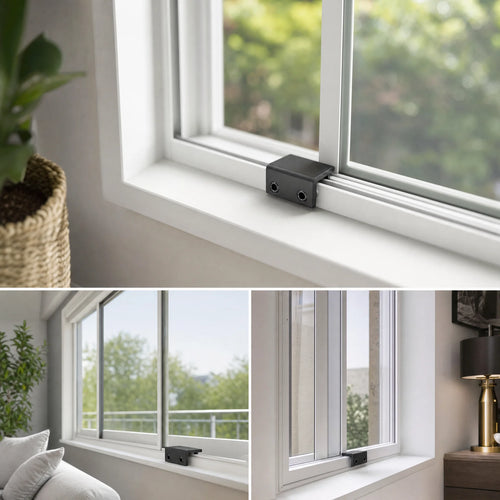
Window Sash Lock (2-Pack), $14.99. A clamp with a padded thumb-screw. On a double-hung window, raise the lower sash to your gap, clamp the lock to the frame just above it, and tighten by hand. The sash now stops there. On a horizontal slider, clamp it to the track at the same point. Nothing is drilled; it twists off when you want the window wide. The pack holds two: the bedroom window, plus the bathroom or second-bedroom window beside it. This is the one you can fit tonight.
Either way, test it once. Set the gap, tighten, then push on the sash, hard. It should not move.
Does a window alarm work on a window that's open?
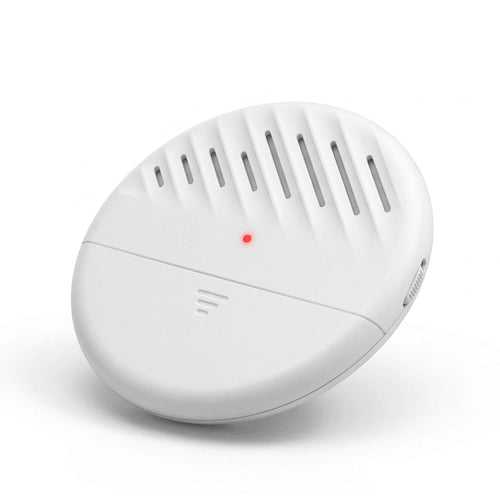
Yes, once you know what it senses. The TremShield alarm sticks to the glass and feels vibration in the pane it's stuck to. It doesn't measure the gap and doesn't know the window is open. It knows shaking.
That's why the lock comes first. The alarm's job is to sound, not to hold. On a window pinned at four inches, the only way to widen the gap is to force the sash past the lock, and force on the sash is vibration in the glass. A strike on the pane or a hard shove against the pinned sash: the siren answers at 125 dB, with the gap still at four inches.
Placement on a vented window: the glass of the sash that moves, the one the lock is holding. That's the pane that takes the force. Peel the backing, press it on, and it's working about 60 seconds later. No Wi-Fi, no app, no hub, no monthly fee.
Two habits. Set the gap and tighten the lock first, then switch the alarm on; the other way round, you'll set it off yourself. In the morning, switch it off before you touch the sash. Then tune the sensitivity dial: it sets how hard a shake has to be before the siren fires. A truck on the street sets it off? Turn it down a little. A firm shove on the pinned sash doesn't? Turn it up. One night of tuning and it stays put.
Which lock holds the gap on my window type?
Not every lock fits every window. Find the part that moves: a sash that slides up, a panel that slides sideways, a pane that swings out on a hinge, or a basement pane that tilts in from the top.
| Window type | Vent it with | Holds the gap? | Alarm sticks to |
|---|---|---|---|
| Double-hung (lower sash slides up) | Window Sash Lock, $14.99, clamped to the frame above the raised sash. Or the Window Restrictor Lock, $19.99, with its cable between frame and sash. | Yes. The sash lock stops the sash at the gap you set; the restrictor's cable stops it at roughly four inches. | The glass of the lower sash, the one that moves. |
| Horizontal slider (panel slides sideways) | Window Sash Lock, $14.99, clamped to the track. Or the Sliding Window Lock, $14.99, which clamps or sticks to the track and holds the panel at the gap you set. | Yes. Either clamp stops the panel where you set it. | The glass of the sliding panel. |
| Casement (swings out on a hinge) | Window Restrictor Lock, $19.99, a bracket on the frame and a bracket on the swinging sash. Window Sash Lock: not this one, there is no track or rail for it to clamp. | Yes. The cable holds the sash at roughly four inches of swing. | The glass of the swinging sash. |
| Basement hopper (hinged at the bottom, tilts in at the top) | Window Restrictor Lock, $19.99, only if both brackets can mount: one on the frame, one on the tilting sash. Its page lists casement and sash windows, not hoppers, so check your frame before buying. Window Sash Lock: not this one. | Only if both brackets mount. Then the cable stops the tilt at roughly four inches. If they can't, keep this window shut at night and put the alarm on the pane. | The pane itself. |
Do second-floor windows count?
If a person could reach it without a ladder, treat it like a ground-floor window. A porch roof under the bedroom window, the flat roof of a one-story extension, a fire escape: any of those makes the upstairs pane reachable, and reachable is all that matters. Our guide to how many window alarms you need walks the whole house on that rule.
A true second-floor window, with nothing under it but siding, is a low target. If you want air there, a sash lock or restrictor still holds the gap so nobody, and no gust of wind, can widen it, and an alarm on the pane covers the rest.
Bedroom door and hallway habits that cost nothing
- Close the bedroom door. A closed door is one more thing between the hallway and the bed, and a 125 dB siren is loud enough to wake you through it.
- Hang the restrictor key where you can reach it and the gap can't. A hook on the wall beside the window, not the sill. In the dark, in your hand in ten seconds.
- Vent the window the street can see, if you have a choice. A window facing a lit street is a worse target than one behind a fence. Lock the hidden one shut and let the visible one breathe.
- Keep the phone on the nightstand, not across the room. If the siren goes, the next thing you do is dial, not walk.
- Keep the path from bed to door clear. Laundry basket, chair, bag: none of it in the way.
- Make the alarm switch part of lights-out. Gap set, lock tight, alarm on. Same order every night.
What about hot nights when four inches isn't enough?
Move the air instead of widening the gap, or cool it with a window air conditioner, secured. A fan in front of a four-inch opening pulls a steady stream through it all night. A window thrown wide on a still night waits for a breeze that may not come.
Two small gaps beat one big one. A second window in the room, on another wall and held at its own four inches, gives the fan somewhere to push the air. That's two locks and two alarms for one bedroom, which is what the sash lock's two-pack is for.
While you're up, open it wide. The restrictor's key drops the cable; the sash lock twists off. Let the room cool, then set the gap back before you sleep. The rule is for the hours you're not awake to hear the sash move.
Renting? What clamps, what sticks, and what screws
Most of this leaves no trace.
- Window Sash Lock (2-Pack), $14.99: clamps. A padded thumb-screw grips the frame or track. No holes, no marks, comes off by hand.
- Sliding Window Lock, $14.99: clamps or sticks. Thumb-screw or adhesive base on the track. No drilling.
- TremShield alarm, $29.99: sticks. Adhesive backing, pressed onto the glass. It peels off clean, so it moves with you to the next place.
- Window Restrictor Lock, $19.99: screws. The one exception. Two brackets and a few small screws, frame side and sash side. The holes are small and patch over easily. Ask first if your lease is strict; if screws are out, the sash lock holds the gap on a double-hung or slider with no holes. Casements have no clamp option here, so a renter with casements needs the screws or a shut window.
Open-window nights: fire exits, kids and wind
Can I still get out in a fire with a window restrictor fitted?
Not quickly, because it takes a key to open fully. If this window is your way out in a fire, hold the gap with the Window Sash Lock, which twists off by hand, and keep the restrictor for windows nobody sleeps behind.
Is a window restrictor a child-safety device?
No. It limits how far the window opens, but it is not a tested fall-prevention device and it releases with a key. For a child's bedroom, use a tested window opening control device that releases from inside without a key.
Will wind rattling a vented window set the alarm off?
It can if the sensitivity dial is set high. Turn it down a step at a time until gusts leave it quiet, then check that a firm shove on the pinned sash still sets it off.
Hold the gap tonight, then cover the panes beside it
Pick the window you sleep next to. Set its gap at four inches with the Restrictor Lock or the Sash Lock, put an alarm on the moving sash, and switch it on at lights-out. That is the whole bedroom, done in an evening.
Then count the openings beside it: the other bedroom window, the bathroom window, the kitchen window at the back, the slider. That count is why the 6-pack at $99 is the buy for a whole floor: $16.50 per alarm, which saves $80.94 against six singles, with two free no-drill window locks in the box and the Home Security Guide as a PDF. Free shipping to the US, Canada, the UK, Australia and New Zealand, and 30-day returns if your count comes in lower. Set the gap, hold it, alarm the pane, and sleep with the air on.
Back to all articles