In this article
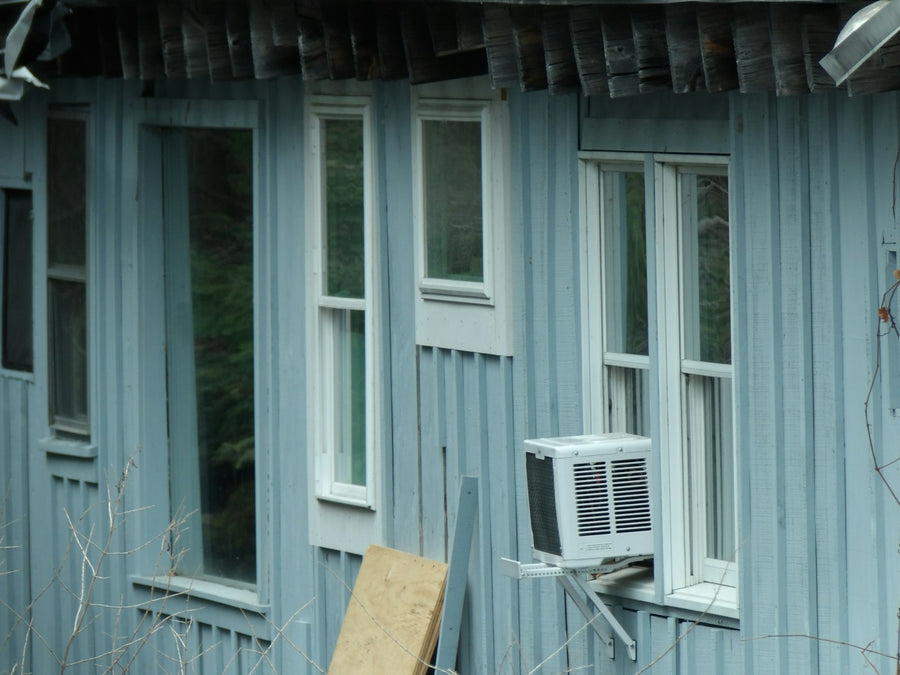
A window air conditioner turns a window into something its own hardware was never built for. The lower sash sits on top of the unit instead of on the sill. The latch in the middle has nothing to meet. Two strips of pleated plastic fill the gaps at the sides. If that setup has bothered you, the worry is fair.
It's an evening's work to fix, and none of it costs you the cold air. Below: the three weak points on an AC window, the fix for each from free to cheap, and what to do the day the unit comes out.
Secure a window air conditioner with a support bracket and screws, a clamp-on sash lock so the lower sash can't lift, a rigid panel behind the accordion sides, and a vibration alarm on the glass.
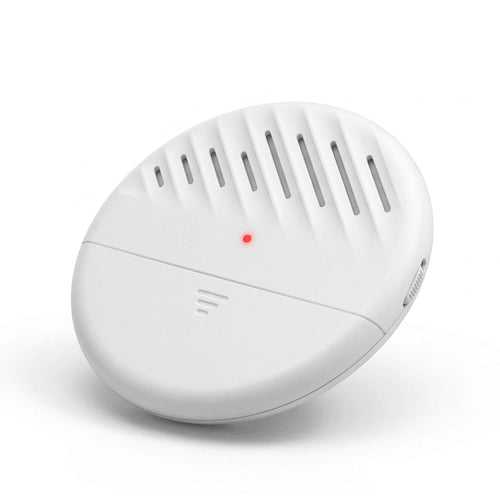
The alarm in that list is our TremShield Vibration Sensor Alarm, $29.99 for one. It sticks to the inside of the glass, picks up the vibration when someone forces or hits the window, and sounds a 125 dB siren. No Wi-Fi, no app, no monthly fee. The locks below are ours too, priced where they come up. The bracket, the screws and the panel come from elsewhere.
Why is a window with an air conditioner in it easy to open?
A double-hung window locks where its two sashes meet: the latch on the lower sash swings into the keeper on the upper one. With a unit in the window, the lower sash is raised and parked on top of the machine. The latch never reaches its keeper. Nothing is locked.
That leaves three soft spots.
- The sash above the unit. It's resting on the unit, not locked to anything. Lift it from outside and the gap above the machine opens as far as the sash will go.
- The accordion side panels. Thin pleated slats on a slide, made to keep out air and bugs. They fold under a hand and cut with a blade.
- The unit itself. If the only things holding it are its own weight and the sash resting on top, a hard shove from outside can push it inward and a hard pull can bring it out. Either way, what's left is an opening the size of the unit.
None of that takes skill. The fixes below take one evening.
How do I stop the sash being lifted above the unit?
Open your unit's manual to the install page. If it shows a sash bracket, a small piece that screws on to keep the lower sash from being raised, and yours never went on, fit it now. It came in the box.
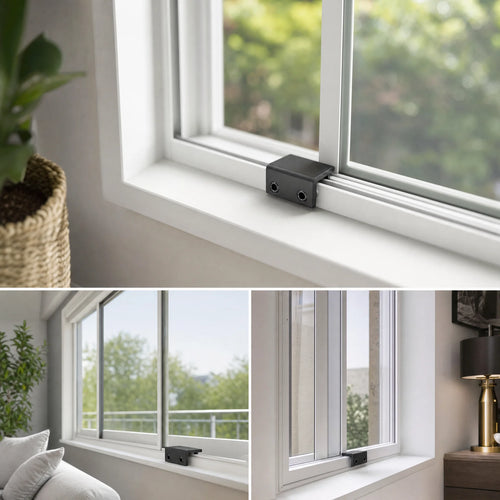
Then add a lock that doesn't depend on the unit. Our Window Sash Lock ($14.99 for a pair) is a clamp. Slide it onto the window track or frame right above the top edge of the lower sash and turn the thumb-screw by hand until it grips. The sash now has a hard stop above it and can't be raised from either side. No drill, no holes, and it twists off in seconds when the unit comes out.
Then try to lift the sash. If it doesn't move, weak point one is closed. The second lock in the pack goes on the window next to it (more on that below).
How do I keep the unit from being pushed in or pulled out?
Two parts. Start with the unit's own manual.
The mounting screws. Open the manual to the install page and put in every screw it shows. Those screws are what tie the unit to the window, and they're what a push or a pull from outside has to beat. If your install was lower the sash and hope, the screws are tonight's job.
The support bracket. A bracket mounts outside, to the sill or the wall, and carries the unit's weight from underneath: the unit rests on a brace fastened to the building instead of balancing on the sill. Buy the one your manual names, or a hardware-store bracket rated for the weight listed in the manual.
The fitting is easier to follow on screen than on paper. This one is the bracket maker's own installation video for a universal window air conditioner bracket; yours may differ, so keep your bracket's instructions open beside it.
Video: ALPINE HARDWARE 1 Piece Universal Window Air Conditioner Bracket Installation VIDEO, Alpine Hardware on YouTube.
How do I reinforce the accordion side panels?
The accordion panels seal the gap. They don't guard it. Give the guarding job to something rigid; the panels stay for the weather.
Measure each gap: from the side of the unit to the window frame, and from the sill up to the underside of the lower sash. Cut a piece of plywood or acrylic to each measurement. Fit it on the room side of the accordion panel, so the panel still seals against the outside and the rigid piece takes the push. Screw it to the sash and the sill (a snug wedge fit works if you rent, screws hold better), and run foam tape along the edges to keep the seal.
Acrylic keeps the light. Plywood paints to match the frame. Either one turns a slat a hand can fold into a panel a hand can't.
Where does a window alarm go when the AC is in the window?
Locks hold the window shut. They don't tell you when someone is testing it. That's the alarm's job, and on an AC window it goes on the glass, not the machine.
The raised sash's glass. With the unit in, the lower sash sits on top of the machine, and its glass is the pane right above it: the closest pane to reach, on the one sash that moves. Peel the backing, press the alarm onto the inside of that pane, arm it. About 60 seconds. The alarm reads vibration in the pane it's mounted on, so a lift at that sash or a hit on that glass fires the 125 dB siren before the pane gives way.
Tune it with the unit running. A window air conditioner hums, and that sash is sitting right on it. The alarm has a sensitivity dial you set by hand, made to let steady background vibration (a passing truck, wind) pass and a deliberate strike through. Turn the unit on, start the dial at its least sensitive setting, and rap the glass with a knuckle. Raise the dial until the knock trips it and the hum doesn't. If the hum trips it at every setting that catches a knock, move that alarm to the next window and let the sash lock and the panels guard the AC window on their own. A locked window that stays quiet beats an alarm you switch off.
The next window over. Someone who finds the AC window braced and locked can simply try the one beside it. The second alarm goes on that pane, and the second Window Sash Lock from the pair clamps on there. Two alarms and two locks, and the AC window and its neighbor are done.
What do I do with the window when the air conditioner comes out?
The day the unit comes out is the day that window is easiest to secure, and the day it's most often forgotten. Three things, same day.
- Drop the sash and latch it. With the two sashes meeting again, the factory latch works. Use it, and know its limit: a thin blade slipped between the sashes can work a crescent latch open from outside. A season of the sash parked on a machine can leave the latch missing its keeper; when a window won't lock runs the free checks first.
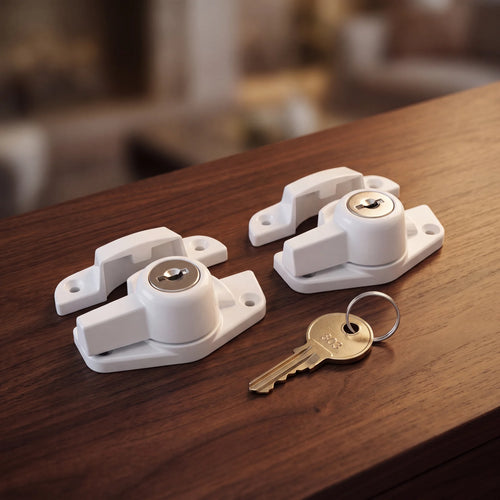
- Add a lock the latch can't match. If this is a window nobody would need to climb out of, a window lock with key ($19.99 for two, keyed alike) screws on where the sashes meet, the lock on one sash and the keeper on the other. Locked, the window stays shut, and anyone who breaks the glass and reaches in finds a keyhole where a thumb-turn would be. If it's a bedroom escape route, keep the clamp-on sash lock on instead, since it opens by hand. It pins a closed sash the same way it pinned a raised one. (Renters: the keyed lock takes a few small screws, and the holes patch over.)
- Re-test the alarm. It rides down with the sash, so it's already on the pane within reach. Arm it, knock the glass, and re-tune the dial now that the hum is gone. If you ever peel it off (to clean the glass, or move it to another window), it goes back on a fresh mounting pad ($9.99 for twelve, 40 mm squares, so measure the flat back of your alarm first): the pad it ships on is made for one application.
What are the weak points of a window air conditioner, and what fixes each one?
Costs are for the products we sell; the bracket and the panel are priced by your unit's maker and the hardware store.
| Weak point | What a burglar would do | The fix | Cost |
|---|---|---|---|
| Lower sash resting on the unit, latch not engaged | Lift the sash from outside and climb in over the unit | Clamp-on Window Sash Lock on the track just above the sash, plus the unit's own sash bracket if the manual includes one | $14.99 for two |
| Accordion side panels | Fold or cut the slats and reach through | Plywood or acrylic cut to each gap, fitted on the room side of the panel, screwed or wedged | One small sheet from the hardware store |
| Unit held only by its weight and the sash | Shove the unit inward or pull it out | Every mounting screw the manual shows, plus a support bracket outside, rated for the unit's weight | Bracket priced by the maker or the hardware store |
| The raised sash's glass, right above the unit | Break that pane and reach in | TremShield Vibration Sensor Alarm on the inside of that pane, dial tuned with the unit running; it sirens at the moment of contact, before the glass gives way | $29.99 for one, $16.50 each in the 6-pack |
| The window next to the AC window | Skip the braced window and try its neighbor | Second alarm on that pane, and the second sash lock from the pair on its track | Alarm $29.99 for one, $16.50 each in the 6-pack; the lock is the second in the $14.99 pair |
| The empty window after the unit comes out | Slip the crescent latch with a thin blade | Keyed Window Lock if nobody needs to climb out there, the clamp-on sash lock if they do; the alarm rides down on the sash, re-tune it | $19.99 for two keyed locks |
Air conditioner in the window: your questions
Can a burglar push a window air conditioner in?
If the unit is held by nothing but its weight and the sash resting on it, yes: a hard shove from outside can move it inward and a hard pull can bring it out. The fix is every mounting screw the unit's manual shows, which is what ties the unit to the window, plus a support bracket outside to carry its weight.
Will the air conditioner's vibration set off a vibration alarm on the same window?
It can, so tune the alarm with the unit running. The TremShield Vibration Alarm has a sensitivity dial: start at the least sensitive setting, knock the glass, and raise the dial until the knock trips it and the hum doesn't. If no setting separates the two, move the alarm to the next window and rely on the sash lock and rigid panel for the AC window.
How do you lock a double-hung window with an air conditioner in it?
The factory latch can't engage because the sashes don't meet, so use a clamp-on sash lock instead. Fit it on the track or frame right above the raised lower sash and tighten the thumb-screw by hand; the sash can't be raised past it. The TremShield Window Sash Lock costs $14.99 for two and needs no drilling.
Do these fixes work for a window air conditioner in a sliding window?
Mostly yes. The support bracket, the mounting screws, the rigid panel and the alarm on the glass work the same way. The clamp-on sash lock fits sliding windows too: clamp it to the track beside the sliding sash so the sash can't move past it.
Can I secure a window AC in a rental without drilling?
Mostly. The clamp-on sash lock tightens by hand, the alarm sticks to the glass and peels off, and a rigid side panel can be wedged in instead of screwed. The unit's own mounting screws and an outside bracket may need holes, so check your lease or ask the landlord before fitting those.
Cover the AC window tonight, then the rest of the house
Tick these off this evening:
The AC window, tonight
- Every mounting screw from the manual in
- Support bracket fitted outside, rated for the unit
- Sash lock clamped above the raised sash
- Rigid panel behind each accordion side
- Alarm on the raised sash's glass, dial tuned with the unit running
- Second alarm and second sash lock on the window beside it
That's two alarms. Count the rest of the ground floor here, and see what your number costs:
One alarm is $29.99. The 6-pack at $99 covers six panes at $16.50 per alarm, $80.94 less than six singles, with two free no-drill window locks in the box and the Home Security Guide as a PDF. Free shipping to the US, Canada, the UK, Australia and New Zealand, with 30-day returns. Put the first one on the AC window tonight and the rest on the other panes a stranger could reach from the ground.
Back to all articles