In this article
You’ve settled on window alarms. The question left is how many. Cover every window and a normal house turns into a fleet. Cover just the front and you’ve skipped the panes a burglar would try first.
There’s a simpler way: walk the house once, the way a stranger would read it, and count as you go. This guide is that walk.
You need enough window alarms to cover every pane a stranger could reach from the ground: walk your house and count those panes, and for most homes the total lands between 4 and 8, most often right at 6.
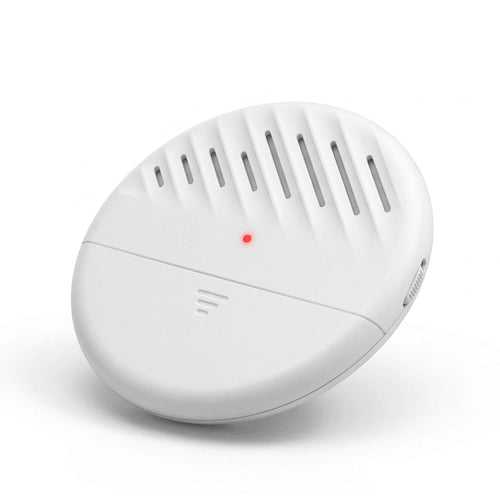
The unit this count is built in is our TremShield Vibration Sensor Alarm, a $29.99 alarm that sticks to the pane and answers a pry at 125 dB. The method works for any per-pane device, window sensors included.
One alarm guards one pane
The rule the whole count hangs on: a window alarm protects the single surface it’s stuck to. It isn’t a hub and it doesn’t watch the room. Mount it on the kitchen window and the kitchen window is covered. The pane beside it isn’t.
That sounds like a limitation until you see what it buys you. The siren fires at the exact pane being tested, while the person testing it is still outside with both feet in the flowerbed. (Our vibration sensor alarm primer explains the sensor itself.) Coverage is arithmetic: one alarm per opening you want guarded. The only question is which openings.
Walk the house the way a stranger reads it
Start on the sidewalk and go around the outside once. You’re not looking for windows. Window alarm placement comes down to reach: anything a person could touch with both shoes on the ground goes on the list.
The front of the house mostly watches itself; there’s an audience out there all day. The windows that need alarms first are the ones the street can’t see: the back, and the quiet side by the fence. A pane behind a tall hedge is the most private spot on the property. Count it.
Then pick up the ones everyone forgets. The basement window, low and half-hidden behind the hose reel (full guide: securing basement windows). The garage window you haven’t opened since you moved in. And the sliding glass door: it’s glass, it counts, and forcing one is quiet work. Our sliding door guide goes deeper.
Count the ground floor even if someone’s home most nights. In the Bureau of Justice Statistics’ national study Victimization During Household Burglary, a household member was home during about 28% of burglaries. The same report holds the calmer number too: violence of any kind occurred in just 7%. Burglars prize quiet, and a siren at the glass ends the quiet while the problem is still outside. That holds at night, too, not just for an empty house.
The second floor
Usually no. Reaching a second-story pane means a ladder, slow to set up and easy to spot from the street. Almost nobody bothers.
The exceptions are upper panes with something to stand on underneath: a porch roof, the flat roof of an extension, a fire escape. If you could reach the window in socks, count it like a ground-floor pane.
That settles the every-window question, too. Not every window. Every reachable one.
Typical counts by home type
Add it up: every ground-floor pane a stranger could reach, the basement and garage windows, the sliding door glass, and any upper pane with something to stand on beneath it. The walk usually lands in these ranges.
| Home type | What to count | Typical count |
|---|---|---|
| Ground-floor apartment | Every window a passerby could reach, plus the patio door glass | 3-4 |
| Single-story house | Ground-floor panes on every side, garage window included | 5-7 |
| Two-story house | The full ground floor, plus any upper pane reachable from a roof or extension | 5-8 |
| House with a slider and a basement | The ground floor, the sliding door, the basement windows | 6-8 |
Why cover them all? Because burglars check before they commit. In a UNC Charlotte survey of 422 incarcerated burglars, about 83% said they would try to find out whether a home had an alarm first, and 60% said an alarm would send them looking for a different target.
If you’d rather start smaller
Cover the whole count at once if you can. If you’re staging it, buy in this order.
- Rarely-opened windows first. The basement, the garage, any pane you never slide open. An alarm there gets switched on once and never thought about again.
- Then the panes the street can’t see. The back of the house and the fence side.
- Then the slider. Biggest pane in the house.
Windows you open every day come last. They ask one small habit: flip the alarm off before you open, back on when you close. Same reflex as locking the front door.
What this count doesn’t cover
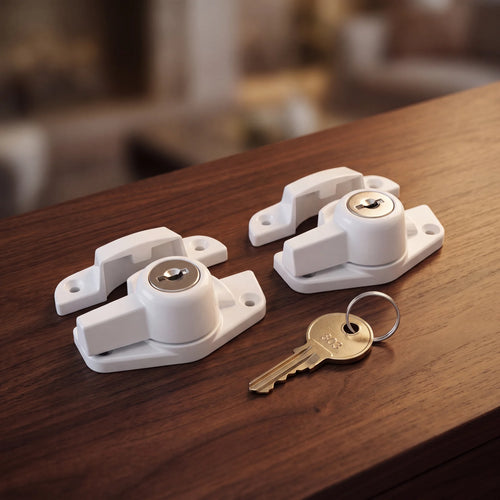
A window that’s already open. The sensor feels vibration through the pane it’s stuck to, and a window someone left open gives it nothing to feel. Open windows are a locks problem. Our guide to burglar-proofing windows without bars covers the window lock with key option and that whole layer.
Doors. A door gives at the lock or the frame, so door security starts with hardware. We took a separate look at door alarms. (The alarm sticks to a solid door panel too, so a back or side door out of sight can join the count.)

The math when the count says six
Price the walk both ways. One alarm at a time is $29.99, fair for testing the idea on your most exposed pane, expensive as a coverage plan.
The 6-pack is $99: $16.50 per alarm, which saves $80.94 against six singles. It ships with two free no-drill window locks, and our Home Security Guide reaches you by email as a PDF. The locks go on the two openings that worry you most and patch the one gap alarms leave: a lock holds the window shut, the alarm guards the glass.
Counting alarms: the edge cases
Does a window with two sashes need two alarms?
Count reachable panes, not window frames. On a double-hung window the alarm goes on the lower sash pane near the latch, and a picture window or a sidelight beside it is its own pane and its own alarm.
Do sidelights and the glass in a back door count?
Yes, if a hand could reach them from outside. Glass in or beside a door sits a short reach from the lock, so it belongs in the count with the windows, and the alarm sticks to door glass the same way.
What if my count lands at four or five?
Four or five alarms are $19.99 each, with one free no-drill window lock. Five at that price comes to $99.95, which is more than the 6-pack at $99, so a count of five is cheaper as six, and the spare goes on the next pane on your list.
Can I move an alarm to a different window later?
Yes. It peels off the glass, but the original pad will not bond twice, so it goes back up on a fresh one. The Mounting Pads 12-pack is $9.99 and re-sites six alarms twice.
Your number is one short walk away
Take the walk tonight while it’s on your mind: outside first, then the basement, then a look at what a person could stand on upstairs. Write the number down.
If it lands at six, where most walks end up, the 6-pack at $99 covers it: $16.50 per alarm, $80.94 saved against singles, two free no-drill window locks packed in with them, and the Home Security Guide sent separately as a PDF by email. Free shipping to the US, Canada, the UK, Australia and New Zealand, and returns stay open for 30 days in case your count comes down. Cover the number your house gave you, then let the subject go quiet.
Back to all articles