In this article
Yes, motion sensor lights deter burglars. Lighting is one of the few security measures tested in a randomized experiment: in New York City, added outdoor lighting cut serious outdoor crime at night by at least 36 percent. The light works by suggesting someone will notice, so pair it with something that follows through, like a chime indoors or a vibration alarm on the glass behind it.
"Leave the porch light on" may be the oldest home security advice in America, handed down with the spare key. It is only half right, because light itself is not the deterrent. Light deters when it implies eyes; a bulb shining on a street nobody watches implies very little.
This guide covers both sides: the research in plain terms, placement by zone with heights and angles, the pairings that give light real teeth, and the situations where a floodlight does close to nothing.
What the evidence says about security lighting
Lighting is one of the few home security measures that has been tested with a true randomized experiment, and it passed.

In 2016, researchers working with the University of Chicago Crime Lab randomly assigned temporary light towers to some New York City public housing developments and not others, then followed the crime data. Their finding, in the study's own careful wording: the added lighting "led, at a minimum, to a 36 percent reduction in nighttime outdoor index crimes." Index crimes are the serious categories the FBI tracks, and "at a minimum" is the researchers' phrase, not marketing. The paper is published through the National Bureau of Economic Research.
Two notes put that number in context. The experiment ran in dense developments where new light had plenty of potential witnesses, lighting's best case. And the broader literature agrees on direction while landing lower: the most recent systematic review by Brandon Welsh and David Farrington, covering a half century of street lighting studies, found roughly 14 percent less total crime in lit areas (earlier versions estimated 21). One of its details matters most for homeowners: the reductions were not limited to nighttime, so lighting appears to work partly by signaling that a place is cared for and watched, not only by lifting darkness.
Lighting helps, measurably. It is not a force field, and its power comes less from photons than from what they promise.
Why light deters: it suggests someone is watching
Burglars are not afraid of brightness. They are managing one risk above all others, being seen and remembered, and light raises exactly that risk.
A Department of Justice guide on burglary of single-family houses puts occupancy cues near the center of prevention: a house that shows lights, a vehicle in the driveway, or activity and noise inside is less likely to be burglarized. Burglary is also rarely a planned operation. In the University of North Carolina at Charlotte survey of 422 incarcerated burglars (funded by an alarm industry foundation, run by university criminologists), only about 12 percent typically planned in advance; 41 percent called it spur of the moment.
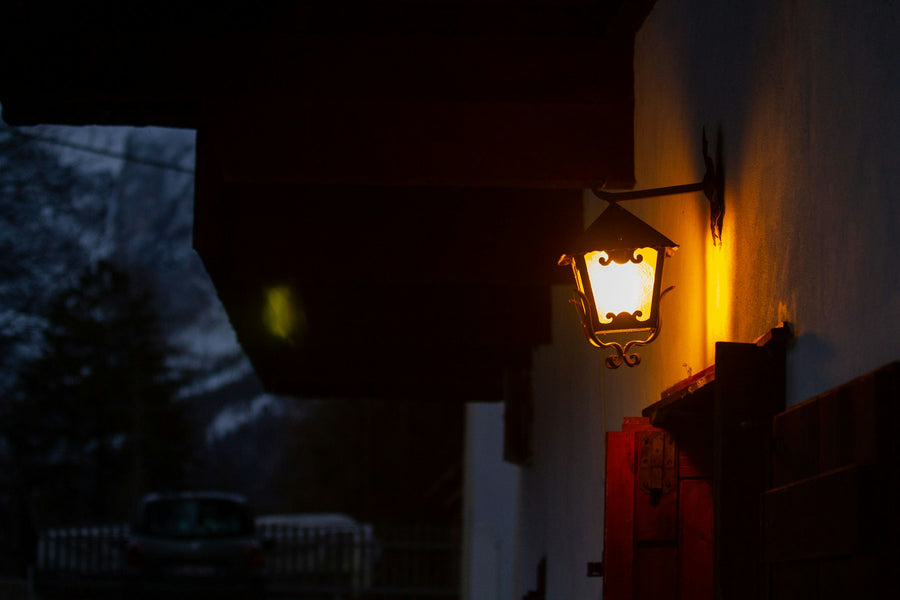
Opportunists read fast signals and move on. A dark, still exterior reads one way. A light that snaps on as someone steps onto the walk reads another: this arrival has been registered, which is exactly what an opportunist came to avoid. And the light asks nothing of you; it watches its patch on its own schedule. Where lighting ranks among alarms, dogs, and sightlines is mapped in our evidence guide to what actually deters burglars.
Motion sensor light placement, zone by zone
Placement decides whether a motion light is a deterrent or a decoration. Four rules travel everywhere, then four zones do most of the work.
Mount heads 8 to 10 feet up: high enough to be awkward to tamper with, low enough that the sensor reliably reads people rather than treetops. Aim across the likely path instead of straight down it; passive infrared sensors trigger faster on motion crossing the beam than on motion coming head-on. Where coverage areas meet, overlap the cones so no dark seam is left. And practice dark-sky courtesy: angle heads down, keep beams out of neighbors' windows, and let motion activation keep the street dark the rest of the night. A light that speaks only when something moves is a better neighbor and a better signal.
- Front approach. One head angled across the walkway, one washing the porch and door. Guests and delivery drivers will trip it constantly, and that is the point: a house that notices every arrival.
- Driveway. Mount at the garage corner or on a post, aimed across the parking pad and angled away from the road so passing cars do not fire it all evening. Anything that rolls in lights up, visible to you and the neighbors.
- Side blind spots. The narrow run between house and fence, the gate, the utility meters. Light these from both ends with overlapping cones. Side passages appeal precisely because they feel unobserved; a light that pops on removes the feeling.
- Back door and patio. Mount high under the eave and wash the light down over the slider and steps, not out into the yard. Downward aim avoids glare into your own kitchen and pools light exactly where a person would stand.

A three-head unit like the TremShield solar motion security light makes the geometry easy: the heads aim independently, so one unit on a corner covers two zones with overlapping cones. Solar charging means no wiring and no electrician, and like every TremShield device it works without Wi-Fi, apps, or subscriptions. Give the panel decent daytime sun and the battery looks after itself.
Pair each light with something that gives it teeth
A motion light says you can be seen. A good pairing completes the sentence: and something will come of it. This is where the strongest deterrence evidence points: in the same UNC Charlotte survey, burglars reported checking for signs of an alarm before choosing a house, and most said finding one would make them try another house. The pairings below put that signal inside every pool of light.
| Zone | The light's job | What gives it teeth |
|---|---|---|
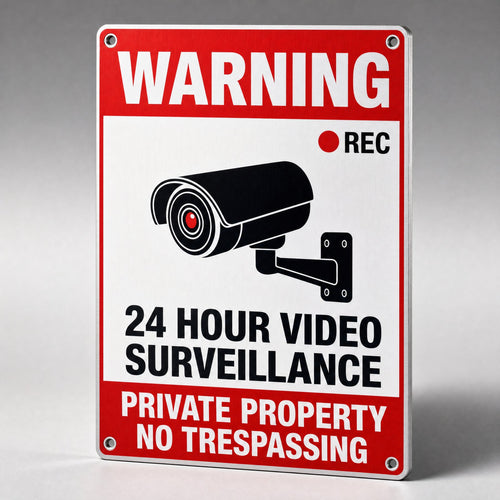
| Front walk and porch | Snap on across the approach so every arrival is noticed | A 24-hour surveillance warning sign positioned where the light catches it |
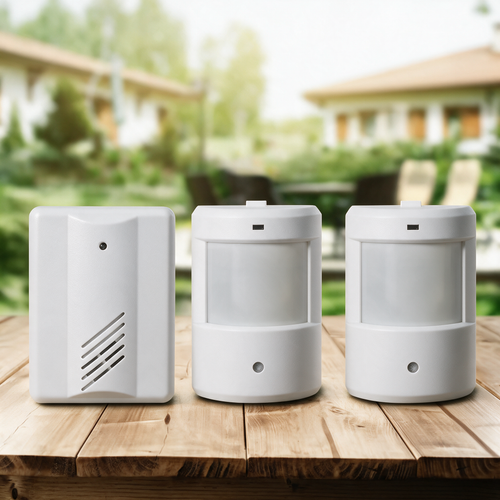
| Driveway | Light the pad the moment anything rolls in | A wireless driveway alarm so the same arrival chimes inside the house |
| Side passages | Erase the dark seam between house and fence | Trimmed shrubs and clear sightlines, so what the light reveals can be seen from a window or the street |
| Back door and patio | Wash the slider and steps in light | A 125 dB TremShield vibration alarm on the glass behind the light |
Two caveats. A sign alone is a weak deterrent, as our guide to fake cameras and security signs lays out; under a light that snaps on, in a tended yard, it reads as one visible piece of a working system rather than a bluff. And light plus a glass alarm is only the noise half of protecting a patio door; the physical half is in our sliding glass door guide.
If you are unsure which alarm belongs on which glass, the interactive alarm finder sorts it in about a minute, and the burglar deterrents collection gathers the sign, the lights, and the driveway alarm in one place.
When motion lights do little
Every product page will tell you when lights work. Here is when they do not, because knowing the limits is what lets you fix them.
- When nobody can see what they show. The New York experiment worked in dense developments full of windows and foot traffic. A flood over an empty rural yard, or a street where nothing stirs after ten, is illumination without an audience. If no household member, neighbor, or camera could plausibly notice what the light reveals, add the noticing: a chime indoors, an alarm on the glass.
- When they are aimed at nothing. A head pointed straight out at eye level blinds more than it reveals and casts deep shadow behind the glare. Aim down and across the paths a person would use: walk, driveway, gate, door.
- When they never turn off. An all-night floodlight becomes scenery: neighbors stop registering it, and it says nothing about the present moment. A motion-triggered light carries news, something moved, right now, right there, and that change of state is the entire signal. It is why motion activation beats always-on for deterrence.
- During the day. In the Bureau of Justice Statistics' household burglary study, 61.3 percent of burglaries with someone home happened between 6pm and 6am, but burglaries of empty homes happened more often in daylight. Lights work the night shift, and that is fine: locks, entry alarms, and an occupied look carry the day shift. The full picture is in our home burglary statistics guide.
Each limit has a cheap fix: re-aim the head, switch always-on to motion, add one pairing. An underperforming light does not need to be abandoned, just adjusted and partnered.
The weekend setup plan
Tonight, before bed, walk outside and look at what your fixtures light. Re-aim anything pointed at the empty middle of the lawn, angle heads down and across the walk and driveway, and switch any dusk-to-dawn flood to motion mode if it offers one. Ten minutes, zero dollars.
This weekend, mount one three-head solar unit where two zones meet (the garage corner covering both driveway and side passage is the classic spot): 8 to 10 feet up, heads overlapped, panel in sun. Add one pairing from the table: the sign out front, the chime in the kitchen, or the alarm on the patio glass. Then stop. A modest system that is mounted and aimed beats an ambitious one still in a cart, and you will feel the difference the first time the driveway lights up to announce nothing more than a friend arriving early.
Solar motion lights: setup questions
Does a solar motion light work in winter?
Yes. The panel still charges in daylight on overcast days, but shorter winter days mean less run time at night, so mount it where the panel gets a few hours of direct sun.
How far does a motion light's sensor reach?
The TremShield three-head solar light sees a 120-degree arc and reaches roughly 15 to 20 feet, enough to catch someone stepping onto a path, a driveway or a side yard.
Should a motion light stay dim or fully dark until something moves?
The TremShield solar light does both, with a dim-until-motion mode and a motion-only mode. Motion-only sends the stronger signal, because a light that snaps on from dark tells a visitor they were noticed, while dim mode keeps a path faintly lit for you.
Will deer, cats or dogs set off a motion light?
They can. A passive infrared sensor responds to warmth in motion, and a deer or a dog gives off warmth too, so point it across the walkway or gate rather than over open lawn.
The light outside, the alarm on the glass
A light covers the approach, and the glass behind it needs its own voice. One TremShield Vibration Alarm on each pane your lights wash over, the patio door and the window beside the side passage first, makes a lit approach a loud one. The six-pack covers six of them for $99, which works out to $16.50 per alarm and $80.94 under six singles at $29.99, with two free no-drill window locks and the Home Security Guide by email. It ships free to the US, Canada, the UK, Australia and New Zealand and can go back within 30 days.
Back to all articles