
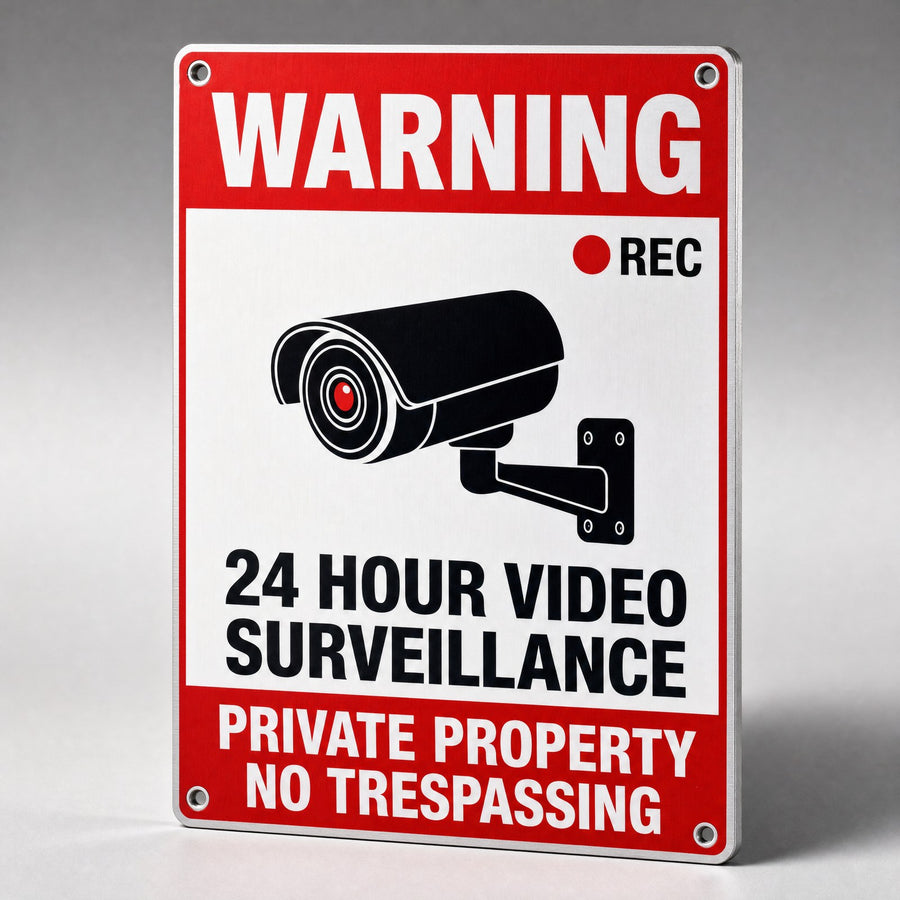
24-Hour Surveillance Warning Sign (Weatherproof Metal)
The warning that works before anyone reaches the door.
- Deters at the curbA burglar profiles the house from the sidewalk. A bold, visible surveillance warning moves you off the easy list before anyone steps onto your property.
- Weatherproof metal, not cardboardAn 8 x 12 inch weatherproof metal plate with a UV-printed face. It still reads like a live warning a year in, through sun, rain, and frost.
- Mounts where they lookFour pre-drilled corner holes. Screw it to the gate, fence, post, or porch wall in about five minutes, or zip-tie it to chain-link.
- Layers onto a real alarmSignage tells them you are protected. The alarm proves it if they test you anyway. Together they cover the decision and the attempt.
Why it works
Burglars read houses, not just locks
Talk to anyone who has worked break-ins and you hear the same thing. The person casing a street is lazy by design. They are not looking for a challenge, they are looking for the house that asks the least of them. A dark porch, a side gate left open, no sign of an alarm. The decision to skip a house is usually made in the few seconds it takes to walk past it.
That is the window this sign is built for. A clear, weatherproof warning at the gate or beside the door tells them you are not the path of least resistance. It does not have to be true to work, but the smart move is to make it true. Back the sign with the TremShield Alarm so that if someone calls your bluff at 2 a.m., the house answers.
The decision to skip a house can be made from the sidewalk.
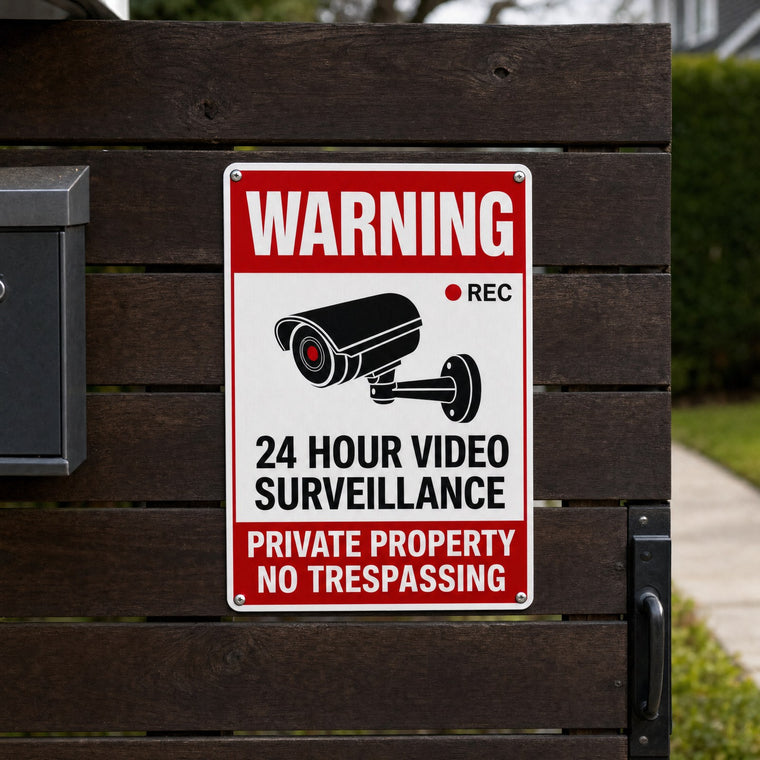
Put it where a stranger's eyes go first
Someone sizing up a house checks the approaches: the front walk, the driveway, the gate to the back. The sign works hardest at eye level on the path they would actually take, not hidden in a flowerbed.
Mount it on the front gate, the fence by the driveway, the porch wall beside the door, or the garage side entry. If you have two likely approaches, point it at the busier one and let the porch light do the rest.
Four screws and it is up
Pick the spot
Choose a surface visible from the sidewalk or driveway, at roughly eye level, on the approach to your door.
Mark the holes
Hold the sign level and mark through the four pre-drilled corner holes.
Screw it down
Drive four screws, or run zip ties through the holes on a chain-link fence, gate, or railing.
Walk the street
Cross the road and look back. If you cannot read the warning from the sidewalk, move it or raise it.
A sign is a bluff. Make it real.
Signage works because it raises doubt, but doubt only goes so far against someone determined. The point of a deterrent is to make the house look like work, cheaply, then have a real alarm for anyone who pushes past it. Use this to thin the threats, and let the TremShield Alarm handle anyone who tests the door anyway.
Make the warning true
The sign turns some people away at the curb. The TremShield Alarm handles the ones who do not stop, with a 125dB blast the second a door or window is forced. Six cover a ground floor for $99, $16.50 each.
See the alarm
Questions, answered calmly
From the security guide
Do Fake Cameras and Security Signs Actually Work?
Fake cameras and security signs can turn away opportunists but not pros, and they record nothing. How to set them up so they help, layere...
Read the guide →Stay one step ahead
Real home-security tips, first looks at new gear, and the occasional subscriber-only deal. Unsubscribe anytime.