In this article
The front door gets the money: the deadbolt, the new strike plate, the light above it. The back door still wears whatever the builder hung on it, with a pane of glass in it and a fence around the yard.
To secure a back door, make the frame hold first with a heavier strike plate and 3-inch screws into the framing, then put detection on the glass, because the back of the house is the side no passer-by can see.
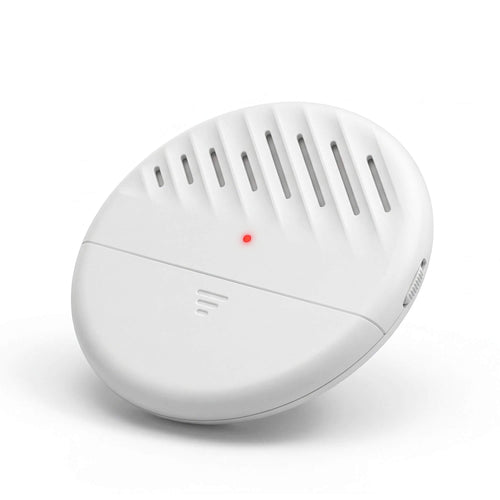
Glass is the half a lock cannot hold, and most American back doors have some: a lite in the door, a sidelight beside it, or a slider that is glass from the handle down. That pane is where the TremShield Vibration Sensor Alarm belongs: $29.99 for a siren that bonds to the glass and answers a pry or a strike on it at 125 dB. On a back door that is a solid slab, it sticks to the inside of the door instead and answers a pry or a strike on the door itself.
Last updated September 17, 2026.
Why is the back door the weak one?
The back door is the weak one because a lock buys time, and time only deters where somebody might come along. A deadbolt does not stop force; a deadbolt delays it, and a delay matters only if it is likely to be noticed by a person who is not you. The front door has a sidewalk, a street and a neighbor pulling into a driveway. The back door has a fence, a hedge and a yard nobody crosses on a Tuesday afternoon.
In the University of North Carolina at Charlotte survey of 422 incarcerated burglars, what put them off was the close proximity of other people, the lack of escape routes, and visible signs of security including alarms and dogs inside. The alarm industry's own research foundation paid for that work, and it captures stated intentions, not observed conduct. The US Department of Justice guide on false burglar alarms, by Rana Sampson, puts it in one line: "occupancy, or signs of occupancy, is the biggest deterrent".
On what force damages, the Bureau of Justice Statistics studied completed forcible entries of homes with nobody inside, 2003 to 2007. A door was damaged or tampered with in 73% of them and a window in 49%. Those numbers do not add to 100, and the Bureau says why: one household can report more than one kind of damage from a single burglary. Those figures are not slices of a pie.
What does a lock on a back door buy you?
A lock on a back door buys delay, and less of it than people assume, because the lock is rarely the part that fails. When a residential door is forced, what gives way is the strike screws, the jamb splitting along the grain, the stile around the bolt, or the hinge screws. The mechanics are in why doors get kicked in, and the shopping order is in door security devices, ranked.
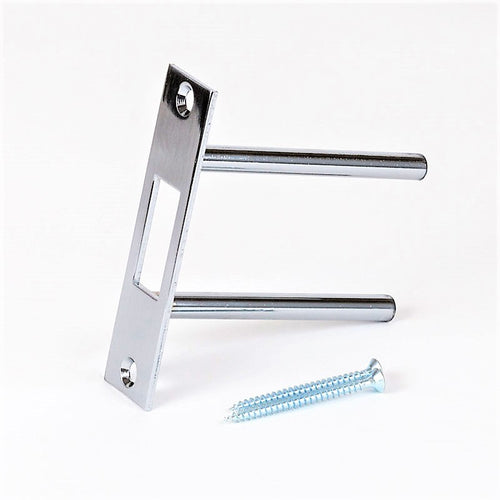
Extending that delay is cheap. Take one screw out of the strike plate and look at its length: factory screws stop inside the jamb, a thin board with an air gap behind it. Swap the screws in the strike and the hinges for 3-inch ones, and note that 3 inches is the screw's length, not how far it reaches past the jamb. Hinges sit on the opposite side of the door from the lock, and if you do only some, do the top hinge, which tears out first. Our Door Strike Plate Kit at $24.99 is that job with a thicker plate and the screws counted out.
Here is the part no product page prints. All of that delay is unobserved at the back of the house. You can double the time a door takes to force and change nothing, because the value of the time was always the chance that somebody walks past during it. Noise is the only thing you can install that creates an audience where there is none.
A stick-on siren is local: it calls nobody and it records nothing. A siren removes the assumption of privacy, tells anyone in earshot which property to look at, and reaches the one person reliably in range, which is you. In the same Bureau of Justice Statistics report, 61% of burglaries where somebody was home happened between 6pm and 6am, and 38% of the people who were home were asleep, whatever the hour.
Which back door do you have?
The solid slab. No glass in the door and none beside it, so the holding is all in the frame. For the warning, press a vibration alarm onto the inside of the door near the lock: it sounds at a blow or a pry on the slab, and because a knock trips it too, leave it off while the door is in use and switch it on at night. Most garage service doors are this shape, and how to secure a garage door covers them.
The door with a lite, or a sidelight next to it. The most common back door in American houses, and the one whose halves disagree: the frame can be made strong for a few dollars, and the pane by the handle cannot be made strong at all. That pane is where a siren belongs.
The French pair. Two leaves meeting with no post between them. The leaf you never open decides that door, and its bolts get a free check below.
The sliding patio door. Glass top to bottom behind one small factory latch. Patio door glass is normally tempered, so it fails all at once and loudly rather than leaving a neat hole, which makes the quiet attacks the pry and the lift. A panel with enough clearance above it can be lifted out of its track even with a bar in the bottom channel, and two pan-head screws in the upper channel stop that. Our sliding glass door guide has the rest.
| Back door type | Weak point | The fix | Alarm? |
|---|---|---|---|
| Solid slab, no glass | Strike screws and the jamb | Thicker plate, 3-inch screws, top hinge first | Yes, on the inside of the door |
| Door with a lite or sidelight | The pane by the handle | Long screws, then a siren on that pane | Yes, on the glass |
| French pair | The inactive leaf's bolts | Seat the flush bolts, then a handle bar | Yes, one per leaf |
| Sliding patio door | Pry and lift at the latch stile | Track bar, plus two screws in the upper channel | Yes, on the moving panel |
Where does an alarm go on a back door?
On a back door with glass, the alarm goes on the pane nearest the handle; on a solid door, place it on the inner face beside the lock. On glass, mount it near a corner of the pane, two to three inches back from each edge. Glass flexes most at the center of a pane and least at its corners, so a mid-pane sensor answers wind, the furnace starting up, and doors slamming elsewhere.
Clean the glass with isopropyl alcohol rather than a household spray, press hard for ten seconds, and give the bond a day before relying on it: fitting takes about 60 seconds, bonding does not. Set the sensitivity dial to its lowest position, then raise it just until a knuckle rapped firmly on the pane sets it off.
Most tempered panes carry a small etched stamp in one corner. Glazing in doors and sliding patio doors falls under the Consumer Product Safety Commission's safety glazing standard, 16 CFR Part 1201, so a back door's glass is normally tempered.
Three things the alarm will not do. It locks nothing, so it works beside the hardware rather than in place of it. It hears one pane only, which is why a French pair wants one per leaf. And an unheated garage is the wrong surface for adhesive through a winter.
What can you fix on a back door tonight for free?
Start with the door being locked, which is less obvious than it sounds. Close to half of all US household burglaries counted in 2011 involved no force whatsoever, and no later edition of the Bureau of Justice Statistics victim survey has published that split again. Among no-force entries of empty homes, 57% used a door or window left open or unlocked.
Next, check that the deadbolt throws all the way. Lock it with the door open and watch how far the bolt comes out, then close the door and lock it again. A bolt that stops short means the door has dropped or the strike is out of line, and a partly engaged bolt is one frame flex from open.
On a pair of French doors, check the flush bolts before the hardware in how to secure French doors. The leaf you never open is anchored by bolts that shoot up into the header and down into the threshold, and those bolts hold only if they fully seat, which they can't when the strike holes were drilled shallow or have filled with paint. Throw both bolts with the active leaf open, then push the inactive leaf. If it moves, the bolts are decoration, and clearing two holes with a drill bit is worth more than any bar sold for that door, ours included. Our French Door Security Bar at $24.99 ties the two interior handles together, which is the right answer on an outward-swinging pair.
Last, move what makes the back of the house private: the bin under a window, the ladder along the garage wall, the shrub tall enough to stand behind.
Back door hardware: bars, deadbolts, lights
Can a security bar brace a hinged back door?
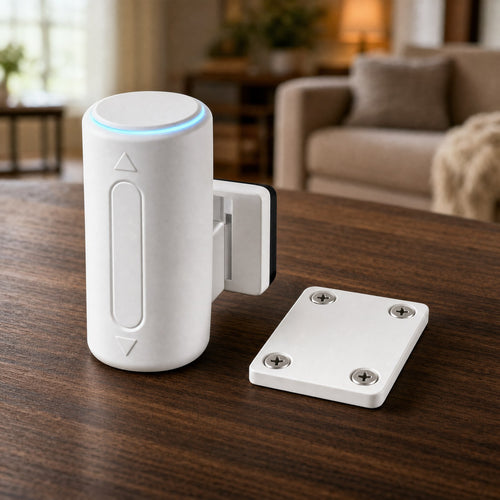
Yes, if the door swings inward. Put the padded head on and the Adjustable Door Security Bar props the door shut on a slant, top end under the handle, so a push loads the floor, not the jamb. Lifting it out takes a second when you want the door.
Should a back door with glass have a deadbolt that needs a key inside?
Think twice. A key-inside deadbolt stops a hand reaching through a broken pane to the thumb-turn, but it also means nobody leaves by that door in a fire without finding the key. If it is a way out, keep the thumb-turn and put a siren on the pane by the handle instead.
Do motion lights help at the back of the house?
They take away the dark the back of a house tends to offer. A solar motion light needs no wiring, and the TremShield one carries three heads you aim separately and reads movement out to roughly 15 to 20 feet.
Fix the frame, then cover the glass
Do the free pass tonight: the lock, the deadbolt throw, the flush bolts on a French pair. Buy screws next, because screws work whether you are home or away. Those two steps beat every product we sell.
Then cover the glass, the one layer nothing else reaches. The 6-pack at $99 brings each alarm to $16.50, which is $80.94 off what six singles cost at $29.99 each. That covers a back door's lite, a French pair, a slider and two more windows. It ships with two free no-drill window locks and the Home Security Guide, a PDF sent to your email. Free shipping to the US, Canada, the UK, Australia and New Zealand, with 30-day returns.
Back to all articles