In this article
Stand inside your French doors and look at which way they open. If they swing out onto the deck, half of what you read tonight was written for someone else's doors. A brace under the handle answers a shove into the room. An outward pair gets pulled the other way, so the brace has nothing to lean on, and the hinges sit outside in the weather.
A pair of doors carries its own answer. Each leaf stands beside something solid: the other leaf. Hold the two together from inside and swing direction stops mattering.
Short version: on French doors that open outward, lock the two interior handles to each other with a keyed handle bar (from $24.99, no screws), fit hinge bolts from a hardware store, and put an alarm on the glass, because no lock on a pair of doors does anything for the pane.
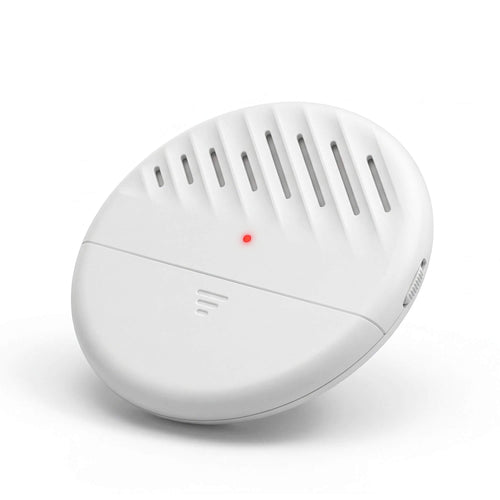
A French door is a frame around glass, and glass has no lock on it. That is why we built the TremShield Vibration Alarm. It costs $29.99, mounts on the pane itself, and turns a pry or a strike into a 125dB siren before the glass gives way.
Which French doors do you have?
Stand inside with both leaves shut and check three things: the swing, the number of interior handles, and the seam.

- Opens inward. The leaves come toward you, hinge knuckles on your side, floor in front of them. Most French door advice assumes this.
- Opens outward. Pull and nothing gives; push and they go onto the patio. Step outside and the hinge knuckles face you.
- Flush pair. Run a finger down the seam from inside. If nothing raised gets in the way, the pair is flush: no strip over the joint.
- One handle. Only one leaf has a handle. The other is the passive leaf, held by small bolts at its top and bottom edge.
- Patio pair, two handles. Both leaves open, each with its own interior lever or knob. The easiest shape to secure.
Outward doors: what the outside hinge changes
Two things change when the hinges face the yard, and only one is a problem. An outward leaf closes against its stop, so a kick drives it into the frame rather than away from it. A kick-in is not the weak point on this pair.
The problem is that the hinges are out there with the doormat. On some, the pin has a visible head and a gap under it, so a screwdriver and a tap can lift it out. Check yours in daylight. If the head is solid with no seam, or a stud on one hinge leaf drops into a matching hole as the door shuts, the builder handled it already.
If not, the hinge side is a hardware store job. Ask for hinge bolts, also sold as dog bolts or security studs: a steel pin in one hinge leaf that seats into a hole in the other, so the leaf cannot be lifted out even with the pins pulled. We do not sell them.
From inside, what works is stopping the leaves separating: they cannot swing out unless a latch releases or one leaf pulls clear of the other.
The bar that locks both handles together
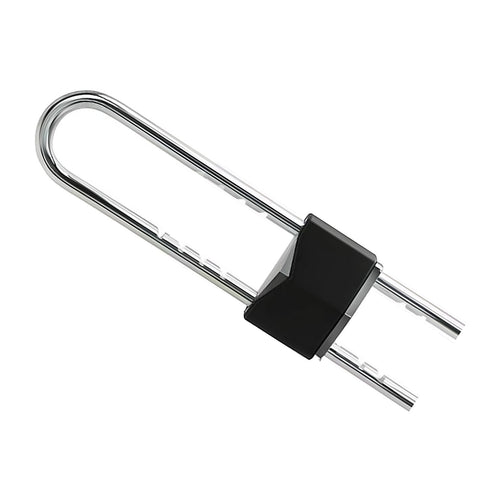
Our French Door Security Bar is a chrome U-bracket with two notched rails and a black keyed locking body. From inside, pass the curved end around one interior handle, lay the rails behind both, slide the locking body in snug against the other handle and turn the key. Neither handle turns, so neither latch can be drawn back, and neither leaf can be worked away from its partner. It comes in three sizes, picked by the handle the bracket has to pass over: Small ($24.99) usually suits slim levers, Medium ($29.99) most levers, and Large ($34.99) round knobs and thick pull handles.
Running handle to handle, it never touches the frame, the threshold or the floor. That is why it suits an outward pair: there is nothing to push against out there, and this bar pushes against nothing. Nothing is drilled, and it comes off only with the key: unlock the body, slide it back and lift the bracket off.
Two things decide it. Both leaves need an interior lever handle or knob at roughly the same height, and the size you order needs an opening wide enough to pass over your handle. If one leaf has no handle, or the two sit at clearly different heights, the bracket has nothing to close around and this is the wrong lock.
It works from inside only. You lock it on when you are home and take it off on the way out, so it covers the night, not an empty house. Hang the key near the doors, where anyone at home can reach it, and if this pair is how you would leave in a fire, unlock the bar before bed.
Flush pairs, and doors with only one handle
On many pairs a raised strip fixed to one leaf covers the seam, so anything slid in there meets the strip instead of the latch. A flush pair has no strip: the leaves meet edge to edge and the gap runs the full height, which leaves the latch as the only thing standing in a tall, thin opening. A flush pair wants a second holding point away from the latch.
One-handle doors have the same problem in a different spot. The active leaf latches into the passive leaf, which is held by those small bolts top and bottom, and in plenty of homes they are never thrown at all. Throwing them costs nothing. Swapping them for bolts that seat deep into the header overhead and into the floor is the upgrade worth doing on a one-handle pair, and our general French door guide walks through that work.
For that second point on either pair, there is the TremShield Sash Jammer, $19.99 for a keyed 2-pack. It is a pivoting arm of zinc alloy on a plate. The plate screws to the frame at the edge of the leaf, two screws per lock, and the screws are in the pack. Swing the arm over the leaf edge and the leaf has nowhere to travel. Force the latch or turn the handle from outside and the door still will not open, because the arm has nothing to do with the handle mechanism. A key locks the arm down.
One lock per leaf, so the 2-pack does one pair. This is not a no-drill lock, and the base plate wants flat, solid frame right beside the leaf, so check yours before you order. The arm has no second position, so it will not hold a door open for air.
Inward doors: where a floor brace earns its keep
If your leaves swing into the room, you have a floor to work with. The Adjustable Door Security Bar ($34.99) takes a padded head that screws on and turns it into a floor to handle brace: the fork under the handle, the foot on the floor, so a shove travels into the ground instead of the strike plate. It locks at any length between 17 and 50 inches. No tools, nothing screwed into a rental frame.
Brace mode is for doors that open inward. On an outward pair it pushes the wrong way. With the head off, the same bar lies flat in the bottom track of a sliding patio door, which matters if your doors share a back wall with a slider. Our sliding glass door guide covers that neighbor.
The glass, which is most of both leaves
Everything above holds the doors. None of it does a thing for the pane, and a French door is mostly pane. No lock is made for glass, and it can be worked from the patio without a hand touching a handle. What you can do is make the attempt loud while it is still an attempt.
That is the TremShield Vibration Alarm's job. Peel the backing, press the unit flat on the glass, and that pane is covered about a minute later. It picks up the shudder that a pry or a knock puts through the pane, and answers with a 125dB siren at the point of contact, before the glass gives way. Nothing to wire or pair, no app, no Wi-Fi, no monthly bill.
Two limits. An alarm speaks only for the pane it is pressed onto, so a pair with a pane in each leaf takes two. And it is a siren, not a lock: it holds nothing shut, which is why it sits next to the bar rather than in place of it. Our room-by-room count helps you work out how many panes to cover.
To slow the break itself, anti shatter window film ($19.99) is the optional other half: a clear 4 mil membrane that lets a pane crack but holds it together in the frame.
French door security by configuration
| Your doors | What holds them | Product | Screws? | Price |
|---|---|---|---|---|
| Opens outward, handle on both leaves | Lock the handles to each other, then fit hinge bolts on the outside hinges. | French Door Security Bar. Hinge bolts come from a hardware store, not from us. | None for the bar. Hinge bolts are drilled. | $24.99, $29.99 or $34.99 for the bar, by handle size |
| Opens outward, one handle | The passive leaf's bolts, plus an arm screwed to the frame beside each leaf. The handle bar needs a handle on both leaves, so it does not fit. | Sash Jammer, keyed 2-pack, one per leaf | Two screws per lock, supplied | $19.99 |
| Opens inward | A brace from under the handle down to the floor. Brace mode suits inward doors only. | Adjustable Door Security Bar, set in brace mode | None. Sets on a push pin. | $34.99 |
| Flush pair, leaves edge to edge | A second holding point away from the latch: an arm over each leaf edge, or the handle bar if both leaves have handles. | Sash Jammer, or French Door Security Bar | Two screws per jammer. None for the bar. | $19.99 for the jammers, or $24.99 to $34.99 for the bar |
| The glass in both leaves | No lock holds a pane. An alarm on the glass fires a 125dB siren at the moment of contact. | TremShield Vibration Alarm, one per pane | None. Adhesive pad. | $29.99 each, six for $99 |
French doors that swing out: more questions
Does the handle bar work on double doors that are not French doors?
Yes, on any pair whose two interior handles, levers or knobs, sit at roughly the same height. It holds the handles to each other rather than to the frame, so the type of door matters less than the handles.
How do I measure for the French Door Security Bar?
Measure the handle where the bracket will pass over it, not the gap between the handles, since the rails adjust to the spacing. Then pick the size whose opening is larger: about 1.0 inch for Small, 1.3 inches for Medium, 1.7 inches for Large. If the size turns out wrong, returns are open for 30 days.
How do you open the passive leaf on a one-handle French door?
Open the active leaf first, then release the small bolts at the top and bottom edge of the passive leaf and swing it open. Throw both bolts again when the pair closes, since they are all that holds that leaf.
Will an alarm on French door glass go off when we open the doors?
It can, because opening a leaf moves the glass, so switch it off before you open the doors and back on after. The sensitivity dial lets wind and passing traffic go unnoticed while a pry or a knock on the pane still sets it off.
Bar the handles, then cover the panes
Do the free part tonight: throw the passive leaf's bolts, and look at your hinges in the morning. Then the two jobs that need hardware. The bar locks the handles together so the pair holds itself shut, and the alarms speak for the glass.
A back wall is rarely just two panes. Count the leaves, the window beside them and the rooms along that wall, and if that count reaches six, the 6-pack at $99 is the one to take: $16.50 per alarm against $29.99 for a single, a saving of $80.94 on six singles, with two free no-drill window locks and the Home Security Guide (a PDF, emailed to you). Free shipping to the US, Canada, the UK, Australia and New Zealand, with 30-day returns. Hold the handles, cover the glass, and the back of the house stops being the easy side.
Back to all articles