

Adjustable Door Security Bar
One bar. It fills a patio track, or braces a hinged door from the handle to the floor.
- Blocks the slideLaid in the bottom track, the bar fills the space the panel needs to travel. Even if the factory latch is picked or pried, the door has nowhere to go.
- Two doors, one barHead off, it lies in a patio track. Head on, it braces a hinged door from under the handle down to the floor.
- Adjusts to your doorTelescopes from 17 to 50 inches, so one bar fits most sliding glass and patio openings with no cutting and no measuring guesswork.
- In and out in secondsLifts straight out when you want to use the door and drops back in when you're home. No tools, no drilling, nothing screwed into a rental frame.
Why these two doors go first
The lock is rarely what fails. The door is.
Walk the perimeter of most homes and the front door is the one people reinforce. Deadbolt, strike plate, maybe a camera. Then you reach the back of the house and find a six-foot sheet of glass held shut by a thin plastic latch that flexes when you push on it. That slider is the door they check first, because it faces the backyard, it's out of view of the street, and the lock is the weakest one you own. On many patio doors the latch can be pried with a flat tool in a few seconds, without breaking any glass.
The front door fails a different way. A solid kick doesn't pick the deadbolt, it splits the frame around the strike plate. The bolt stays locked while the door swings open, because nothing was bracing the door itself against the force. Two very different doors, and in both of them the lock is not the part that gives.
One bar answers both, in two positions. Laid in a patio track it fills the space the panel needs to travel, so working the latch gets a burglar nowhere. Stood under a handle with the padded head on, it sends a shove down into the floor instead of into the frame. The one thing it can't do is hold a patio panel down, so a door with enough clearance can still be lifted off its track. That's the job an alarm on the glass does.
Lock the door, then brace it. One holds the bolt, the other holds the door.
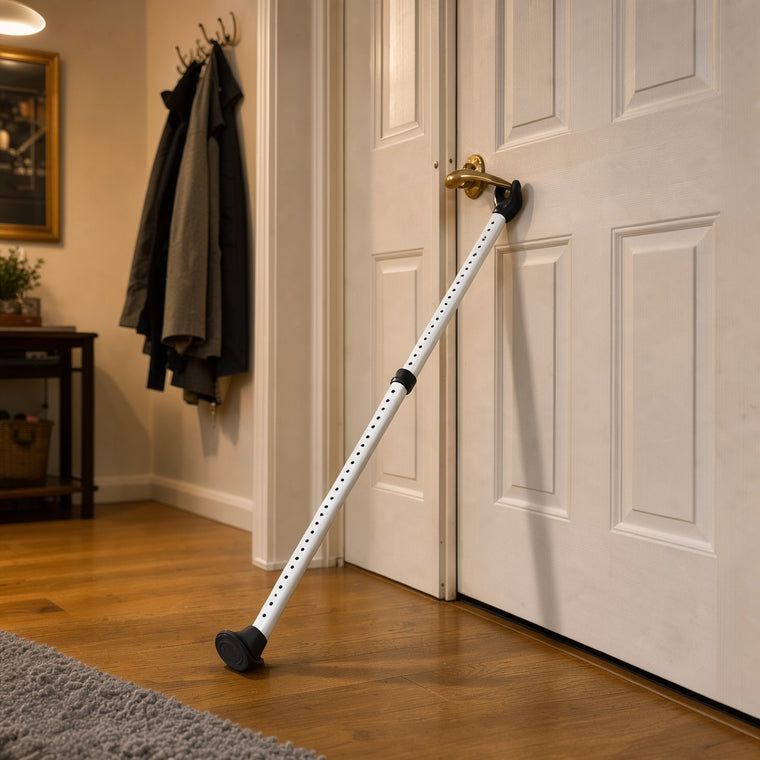
Head off for the track. Head on for the handle.
Take the padded head off and the bar lies flat in the bottom track of a patio door, filling the gap the panel would slide into. Screw the head back on and it stands under a door handle with the foot on the floor, so a shove drives down into the ground rather than into the frame and strike plate, which is where a kicked door normally fails.
It telescopes from 17 to 50 inches and locks at length with the push pin, so you set it to your door by hand. That locked length is the difference between this and a cut dowel or a broom handle, which is one fixed size and a guess at your opening. Nothing screws into the frame, so it's a clean fit for rentals, and it lifts straight out in one motion when you want to use the door.
Set in under a minute, either way
Pick the door
For a patio slider, measure the gap along the bottom track from the fixed panel to the jamb with the door closed. For a hinged door, measure from under the handle down to the floor.
Adjust the length
Extend or collapse the telescoping sections until the bar matches that measurement snugly, then lock it at length with the push pin. No tools, no cutting.
Set it in place
Head off, lay it flat in the bottom track against the closed panel. Head on, wedge the padded fork under the handle with the foot planted on the floor.
Test the door
Try to slide or push the door. It shouldn't budge. Lift the bar straight out whenever you want to use the door.
Whichever door is your weakest
If you have a ground-floor patio slider, that's the one to secure before anything else, because it's the door a burglar tests first. In an apartment, it's usually the front door, and that's the one that gets kicked. The bar covers whichever you point it at, and it comes apart to travel to a hotel room. Pair it with a vibration alarm on the glass and you've covered the quiet pry and the loud smash both.
A bar stops the slide. An alarm stops the silence.
The bar keeps the panel physically shut. The TremShield Alarm sticks to the glass and fires 125dB the instant someone rattles, pries, or smashes it, so a forced patio door is loud instead of quiet. Six cover the patio glass and the ground floor for $99, $16.50 each.
See the alarm
Questions, answered calmly
From the security guide
Patio Door Security: The Bar, the Track Lock and the Glass
A patio door comes open three ways: the latch is sprung, the panel is lifted out of its track, or the glass goes. Here is the fix for eac...
Read the guide →Stay one step ahead
Real home-security tips, first looks at new gear, and the occasional subscriber-only deal. Unsubscribe anytime.