In this article
Last updated September 17, 2026.
You are renting, the lock is not yours to change, and you would like the front door settled before tonight. Most of what settles it sits on your side of the door.
You secure an apartment door from the inside by throwing the deadbolt every time you are home and adding one brace that holds the door without touching the lock, such as a floor-to-handle security bar, a wedge alarm, or a portable travel lock that seats in the existing strike.
One rule decides which of the three suits your door, and it is a fire rule rather than a security one. Anything you put across a door you sleep behind has to come off from the inside in one movement, with no key and no tool, by feel.
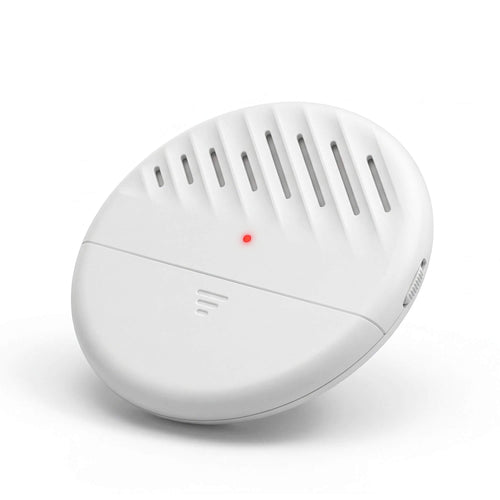
The full renter-safe list of door upgrades lives in our guide to apartment door security. This page stays on the entry door and on the balcony slider, which is what the TremShield Vibration Sensor Alarm is for. The alarm is $29.99, presses onto the glass or the door itself, and fires at the first strike or pry.
Why does an apartment door feel like the weak point?
Renter households are burglarized more often, so the feeling is not imagination. The Bureau of Justice Statistics report Household Burglary, 1994-2011 put the 2011 completed burglary rate at 32.7 per 1,000 renter households. The rate for owner households was 18.3 per 1,000. Read that as an association with tenure rather than a cause, since renting travels with income, building type and neighborhood.
A doorman or a reception desk helps a little. In the same report, buildings with restricted access recorded 22.3 completed burglaries per 1,000 households against 24.7 per 1,000 without, so your own door decides most of the rest.
What can you do tonight that costs nothing?
Nearly half of US household burglaries in 2011 did not involve force. The Bureau of Justice Statistics counted 47.7% of household burglaries as completed entries made without force that year, and 2011 is the latest year that report covers.
Across 2003 to 2007, the Bureau of Justice Statistics report Victimization During Household Burglary recorded 39.5% of no-force entries into empty homes using a door or window left unlocked, and 17.2% coming through one that stood open, 57% between them. A further 7.9% of offenders had a key.
- Throw the deadbolt, not just the latch. A spring latch closes itself when the door shuts, which is convenience rather than security.
- Watch the door finish closing. A door on a closer can rest against the frame without the bolt seating.
- Lock the slider and the bathroom window, upper floors included. A balcony is reachable from the balcony beside it.
- Ask in writing whether the unit was rekeyed. That 7.9% is the figure a renter can act on.
Those four cost nothing. Our ground-floor guide covers the windows.
What can you brace an apartment door with from the inside?
Three kinds of device hold a rental entry door shut without a single hole. Each carries a fit condition that decides whether it works.
A floor-to-handle bar puts the force of a push into the floor rather than the frame. The Adjustable Door Security Bar is $34.99 and adjusts to your opening. Its foot has to grip, so tile, laminate and a rug over a hard floor want a shallow angle and a hard shove to test it. Its head wants to sit under the handle rose, because a shove against a lever handle can bend the lever instead of loading the bar.
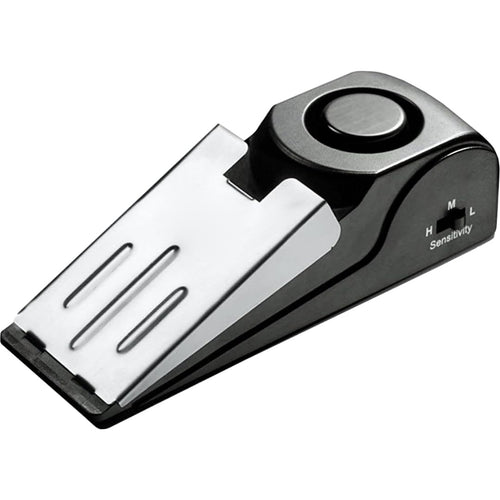
A wedge alarm does the holding job with noise attached. The Door Stop Alarm is $16.99 and sounds a 120 dB siren when an inward-opening door presses on it. It needs roughly three quarters of an inch of gap underneath and a 9V battery that is not in the box. The condition nobody prints is carpet: on medium pile the wedge skates, on deep pile it will not fit under the door, and most bedrooms are carpeted.
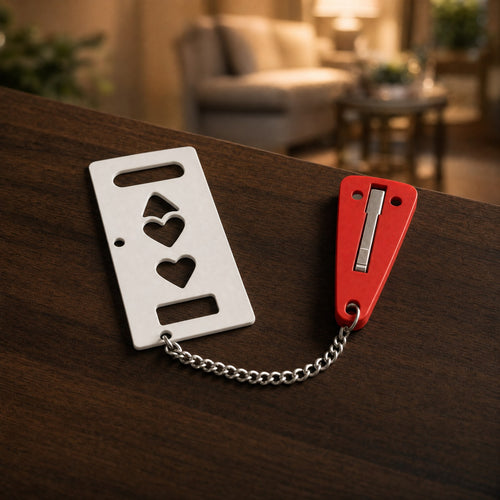
A portable travel lock settles the question of how many keys exist. The Portable Travel Door Lock is $19.99 and sets in about 5 seconds, and while it is set a working key in the hallway does not open the door. Its fit condition is the strike pocket: a deep commercial strike box, an electric strike or a raised lip will refuse the plate.
None of the three works while you are out, and none is a lock. No-drill devices cover the rest of the apartment.
How do you get out fast if the door is braced?
A bar, a wedge and a portable lock all make the door harder to open from outside, and in a fire you need it open from inside, quickly, possibly in the dark, and possibly for a firefighter reaching you. The test comes from the building code for a bedroom escape window. Section R310 of the International Residential Code, as published by Jersey County, Illinois, requires that such an opening be "operational from inside without the use of keys, tools or special knowledge". That clause was written about windows. The reasoning does not stop at the window frame.
Four rules follow.
- Nothing on this door takes a key. A key has to be found in the dark by somebody who has just woken up.
- One brace, not three. A bar and a wedge and a travel lock on one door is three releases to remember at three in the morning.
- Rehearse it once with the light off. A telescoping bar lifts straight out, a travel lock arm lifts and its plate slides free, a wedge comes back with a foot. Longer than a few seconds means the wrong device for this door.
- Keep the floor in front of the door clear. A bar's foot stands on the strip of floor you will cross on the way out.
One trade-off, said once. A braced door cannot be opened by anybody outside it, including a paramedic, a fire crew or a neighbor holding your spare key. For most people that is a fair exchange for the hours they are asleep. For somebody living alone with a health condition it is a real decision, and our checklist for living alone takes that further.
The safety device that matters most in an apartment is not on this page. It is a working smoke alarm, and a carbon monoxide alarm where there is gas or a garage below. We do not sell either. Test yours this month.
Which brace comes off fastest from the inside?
| Device | What it stops | Off from inside, in the dark | Price |
|---|---|---|---|
| Adjustable Door Security Bar, floor to handle | A shove on an inward-opening door | Yes, lifts out in a single motion | $34.99 |
| Door Stop Alarm wedge | A push, and adds a 120 dB siren | Yes, pull it back with a foot | $16.99 |
| Portable Travel Door Lock | A working key used from the hallway | Yes, lift the arm, slide the plate | $19.99 |
| Any keyed device on this door | Not worth the exit it costs you | No, a key is a tool to find | Skip it |
| Vibration alarm on balcony slider glass | Nothing, it warns at first contact | Nothing to release, it is not a lock | $29.99 |
What about the apartment's other door, the one made of glass?
A balcony or patio slider is the second exterior door in a lot of apartments. The Consumer Product Safety Commission puts sliding patio doors inside the scope of its safety glazing standard, 16 CFR Part 1201, and leaves ordinary windows outside it, so that panel is normally tempered glass. Tempered glass leaves no neat hole when it fails, so the quiet approaches to a slider are the pry and the lift rather than the break.
That is where the TremShield Vibration Sensor Alarm earns its place in an apartment. The unit costs $29.99, sticks to the pane, reads the vibration running through it, and replies with a 125 dB siren. No hub, no app, no subscription. On a slider it goes on the moving panel, inside face, a hand span in from the stile that carries the latch.
Two limits. Nothing about the alarm holds the door shut, so it belongs next to a track bar or a clamp lock rather than in place of one, and our sliding glass door guide covers the locking half. And on the entry door you walk through every day, it also hears the door closing, a knock and a delivery, so switch it on when you lock up for the night or head out.
Renter questions beyond the front door
Can I put an extra lock on a rental door without asking the landlord?
Devices that do not alter the door sit outside most lease alteration clauses, because nothing is drilled, screwed or rekeyed. A security bar, a wedge alarm and a portable travel door lock all qualify; anything that screws into the frame needs written permission, so check your lease.
What if my apartment door opens outward?
Then none of these three braces fits it: the bar and the wedge need a door that swings into the room, and the portable travel lock works only on inward-swinging doors. Throw the deadbolt and ask the landlord about the frame and hinge side.
How do I secure the rest of the apartment from burglary?
After the entry door, cover every opening a stranger could reach: the balcony slider, and any window off a balcony, a fire escape or the ground. A bar or clamp in the slider track, a lock on each of those windows and a vibration alarm on each pane do it without drilling; six alarms are $99, $16.50 each.
What to do before you go to bed tonight
The free pass comes first: deadbolt thrown, door watched all the way shut, slider locked. Then pick one brace and practice taking it off with the light out.
Then the glass, because no bolt and no brace protects a pane. The 6-pack at $99 comes to $16.50 a pane instead of $29.99, and the pack is listed Save $80.94. It ships with two free no-drill window locks and the Home Security Guide, a PDF we email you. Free shipping to the US, Canada, the UK, Australia and New Zealand, with 30-day returns. That is the balcony slider, the bedroom window and the panes a stranger could reach.
Back to all articles