In this article
You back out of your parents' driveway, wave, and watch the porch light shrink in the mirror. Somewhere past the first stoplight it lands: the house that raised you still relies on the brass deadbolt it had when you left for college. The worry is love with nowhere to go.
So give it somewhere to go. The best home security for elderly parents is a small set of loud, single-purpose, battery-powered devices installed together in one afternoon: entry alarms on the doors they use daily, a door stop alarm for the bedroom, a keychain personal alarm, a driveway alert, and a motion light. Not one of them needs an app, a hub, or a monthly payment.
The rest of this guide walks through the reassuring numbers, what senior-friendly means in hardware, the 90-minute setup, and three scripts that raise the subject without treading on their independence.
The reassuring numbers about seniors and burglary
Households headed by someone 65 or older are burglarized at the lowest rates of any age group. That comes straight from the Bureau of Justice Statistics' long-running federal victimization data: burglary rates for 65-and-over households run roughly half the rate of American households overall, and about a fifth the rate of the youngest household heads.
The bigger picture points the same way: property crime in the US has fallen over the past decade (FBI), and an empty house is overwhelmingly what a burglar wants. A retired household is rarely one, and the Department of Justice's guide to residential burglary notes that homes appearing occupied, lights on, a car in the driveway, are less likely to be targeted. Their ordinary daily presence is already quiet security.
So set the frame before you set a single alarm: this isn't a response to danger closing in. It's upgrading an already safe house into a confident one, and much of the benefit lands on you, as quieter drives home.
What makes a security device senior-friendly
A senior-friendly security device does one job, loudly, without asking anyone to learn anything new. That standard rules out most of the smart-home aisle. A camera that needs an app, a hub that needs Wi-Fi, a doorbell that needs a firmware update: each one appoints you the family IT department, then becomes a dead gadget the first time it asks for a password nobody wrote down.
- Nothing to charge nightly. Replaceable batteries or a solar panel beat a charging cable; a device that begs for power every evening ends up switched off.
- No app, hub, or account. If it works the moment the battery goes in, nobody ever has to call anybody for support.
- One loud, obvious function. A door opens, a siren sounds. Nothing to interpret, nothing to misconfigure.
- Big, physical switches. Controls you can feel and see beat touchscreens and menus. That's just good design, for their hands and for yours when you visit.
- Installs at reach height. Adhesive strips, a wedge on the floor, a few screws no higher than a step stool. Nobody's security plan should include a ladder.
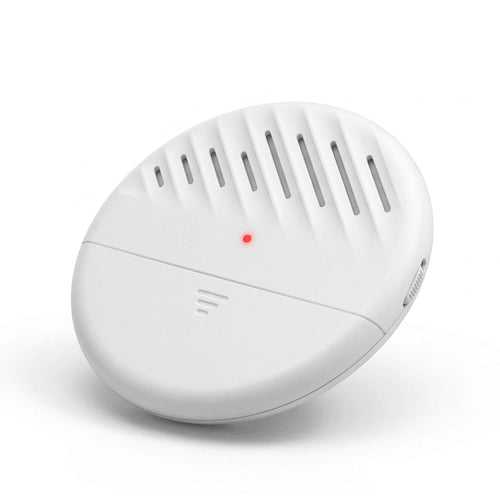
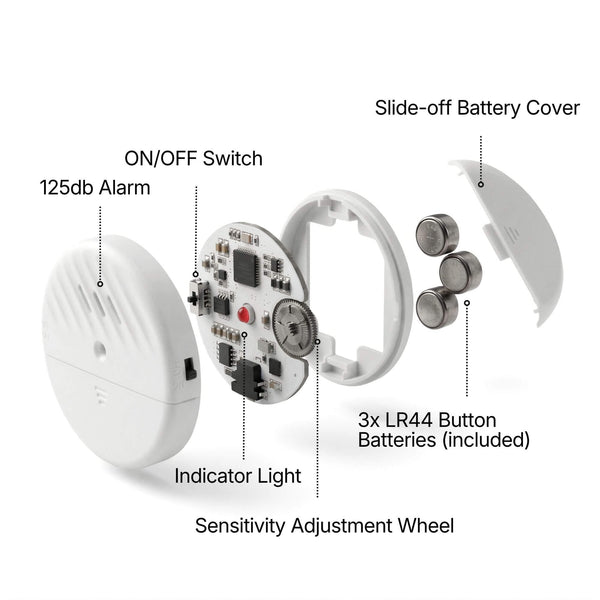
Those five rules describe a short list of hardware, and on glass the one that fits is a stick-on vibration alarm. It goes on the inside of the pane, switches on in a second, and answers the moment that glass is struck: no app to install, no account in anybody's name, nothing to keep updated. A patio slider or the bedroom window over the back yard is where it belongs, at standing height, no ladder involved.
Price structure matters as much as hardware. On a fixed income, a monitoring subscription is a permanent bill competing with groceries and prescriptions, while battery-powered devices are bought once and owned outright. That trade is the whole argument of our guide to home security without Wi-Fi, apps, or a monthly bill.
The one-afternoon setup (about 90 minutes)
Five devices, one visit, about 90 minutes of actual work. The logic behind all five is noise and light, and the evidence for noise is blunt: in a University of North Carolina at Charlotte survey of 422 incarcerated burglars, about 60% said an alarm would send them looking for a different target. Our guide to what actually deters burglars digs into that research; here is what it looks like installed.
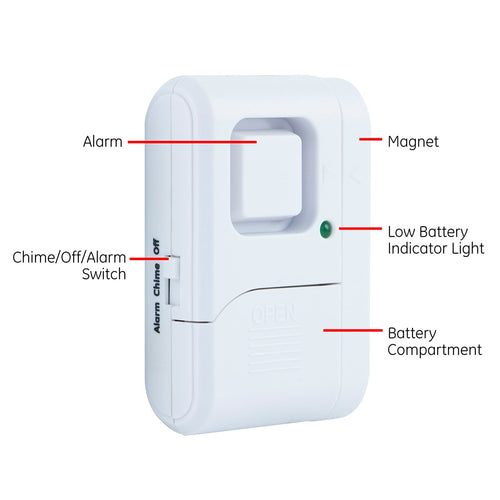
- Entry alarms on the doors they really use (20 minutes). Skip the formal front door nobody touches; cover the kitchen door, the garage entry, the patio slider. A magnetic entry alarm 4-pack covers all three with one spare for a ground-floor window or the shed. The two halves mount with adhesive, no drill, and a loud siren sounds when they separate. Trigger each one on purpose during install so the sound becomes familiar instead of startling.
- A door stop alarm behind the bedroom door (5 minutes). The door stop alarm is a wedge with a 120-decibel voice. Set against the bedroom door at night, it wedges the door shut and sounds if the door is pushed. Its real product is permission to stop listening to the house.
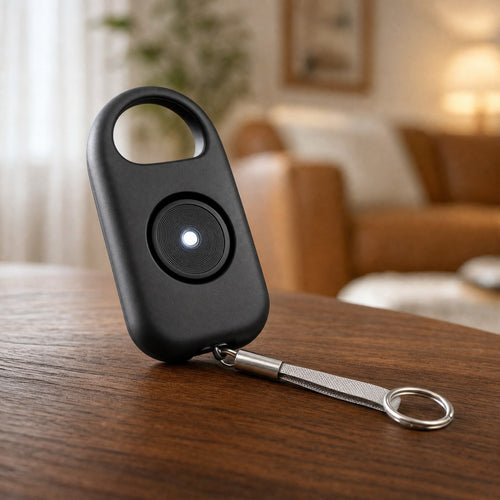
- A personal alarm that lives where they already reach (10 minutes). The 130-decibel personal safety alarm needs no installing at all; the ten minutes are for placement, the step families skip. Clip it to the keys they already carry or the bag that goes on every walk, because a safety device in a junk drawer is decoration. Pull the pin for the siren; push it back for silence. It earns its keep far beyond the house: the mailbox, the parking lot, trips.
- A driveway alarm at the head of the drive (25 minutes). The wireless driveway alarm pairs a weatherproof motion sensor outside with a receiver that chimes indoors (no Wi-Fi; the sensor talks straight to the receiver). Aim the sensor across the driveway and put the receiver where the day happens, usually the kitchen. Now arrivals announce themselves: the mail carrier, a neighbor, the grandkids. Nobody reaches the door unannounced, which is half security, half convenience.
- A solar motion light over the dusk path (30 minutes). Map the route they walk after dark: trash bins, mailbox, the car, the garage side door. Mount the solar motion security light over that route, on a fence post or wall within step-stool reach. It charges itself in daylight and needs no wiring, so it goes where the path needs it rather than where an outlet happens to be.

Before you leave, do one full walkthrough together: open each armed door, pull the personal alarm once, drive in past the sensor, and if you can stay until dusk, let the motion light catch you. Then tape an index card inside a kitchen cabinet listing each device and its battery size. If a glass slider or ground-floor window needs covering too, the interactive alarm finder matches device to door in about a minute.
How to bring it up without taking over
The setup only sticks if the conversation lands well, and it lands well when it's about your worry, not their competence. Never open with crime stories or anything close to "you are not safe here." The numbers don't support it, and it recasts a person who has run a household for fifty years as a problem to be managed. Three scripts that work better:
Frame it as a favor to you. "Dad, this one is for me. I sleep better knowing your doors are loud. Call it a gift for my nerves." You're not claiming they need protecting; you're asking them to indulge your worry, something parents have always done for their children.
Install together, on their terms. "I put one of these on my own back door and liked it. Want me to bring two over on Sunday? You pick the doors." Their house, their placement calls, your labor. Working side by side keeps this a project between adults rather than a service call.
One device at a time. "It's not a system, and there's nothing to subscribe to or learn. One alarm on the kitchen door, and if it annoys you, I take it home next visit." Then honor that. If the answer is no, the no stands. Autonomy respected this year is trust available next year.
What this setup will not do
Said plainly: these devices deter and alert. They don't monitor, and they call no one. A siren depends on someone hearing it and acting, and a deterrent only shifts the odds; nothing makes a home burglar-proof, and anyone promising that is selling something else. If your parents want a service that calls for help when an alarm sounds, that's what monitored systems and their monthly fees buy, and for some families it's a fair trade. Start simple either way; more can be added later.
Just as plainly: none of this is medical equipment. A door alarm cannot detect a fall, and a personal alarm helps only if it's carried and pulled. If falls or medical response are the real worry underneath your worry, that conversation belongs with their doctor, and no product in this article substitutes for it.
Making it stick after you drive home
Devices stick when they attach to habits that already exist. Batteries get checked when the clocks change, the same weekend the smoke detectors get theirs. The door stop joins the nightly locking-up round your parents have done for decades. Testing becomes a sixty-second ritual at the start of each visit, done with them, never an inspection of them.
If one parent lives alone, send along our calm security checklist for living alone, which is written to the person in the house, not about them. When they ask for one more device, browse the home protection collection together and let them choose. The afternoon you spend on this pays out every visit after: you wave, the porch light holds steady in the mirror, and the drive home is just a drive.
Setting it up for a parent: practical questions
Will the alarms go off when my parents open their own doors?
An entry alarm sounds whenever its two halves separate, so on a door they use all day it gets switched on at night and when they go out. The vibration alarm on the glass has a sensitivity dial, so passing trucks and wind can be tuned out while a strike on the pane still sets it off.
What batteries do the five devices take?
Each entry alarm ships with its button batteries, which typically last about a year, and the door stop alarm takes a 9V you buy separately. The personal alarm uses a small replaceable battery, the driveway sensor runs on batteries while its receiver plugs into an outlet, and the solar light charges itself.
Which device should we start with if they only agree to one?
An entry alarm on the door they use most, since it covers the way people come and go and asks for nothing but a switch. The pack holds four, so the spares can go on a second door or a ground-floor window later.
Will my parents hear the driveway chime from another room?
The receiver has several chime tones and adjustable volume, and it works up to about 400 feet from the sensor in line of sight, with walls and metal shortening that. Put it in the room where they spend the day and test it from the far end of the house before you leave.
What to bring on the next visit
Those five devices cover the doors they use and the path they walk after dark. If the walkthrough turns up a sliding glass door or a window someone could reach from the yard, its lock keeps it shut but does nothing about the glass. One alarm for it is $29.99, and a six-pack is $99.00, so each lands at $16.50 and the pack shows Save $80.94 beside the single price, with two free no-drill window locks included and the Home Security Guide sent to your inbox as a PDF. Free shipping to the US, Canada, the UK, Australia and New Zealand, 30-day returns, and no account and no monthly bill on any of it, which is the part that matters on a fixed income.
Back to all articles