In this article
Numbers on a spec sheet are hard to feel. An alarm can promise 125 decibels, but unless you spend your days around sound meters, that figure floats free of any real-world meaning. You want to know one thing: is it loud enough to actually protect anyone?
That is a fair thing to want certainty about, so let's make the number concrete. By the end of this article you will know exactly where 125 decibels sits on the ladder of everyday sounds, why it hits harder than the math suggests, and what it actually does in the moment that matters.
Short version: 125 decibels is louder than the front rows of a rock concert, in the territory of an emergency siren heard up close. Coming from a device the size of your palm, at arm's length from an intruder's head, it is an event.
The decibel ladder: where 125 sits
Decibels make the most sense in context, so here is the ladder from quiet to painful, using commonly accepted reference points:
- 30 dB: a whisper across a quiet room
- 60 dB: normal conversation
- 70 dB: a vacuum cleaner running nearby
- 85 dB: heavy city traffic, and the level where workplace rules start requiring hearing protection for all-day exposure
- 95 dB: a motorcycle pulling away
- 110 dB: a rock concert near the stage, or a car horn at close range
- 120 dB: an ambulance siren heard up close, or a nearby clap of thunder
- 125 dB: this alarm
- Around 130 dB: a jet at takeoff heard from roughly a football field away, and the zone where sound becomes physically painful for most people
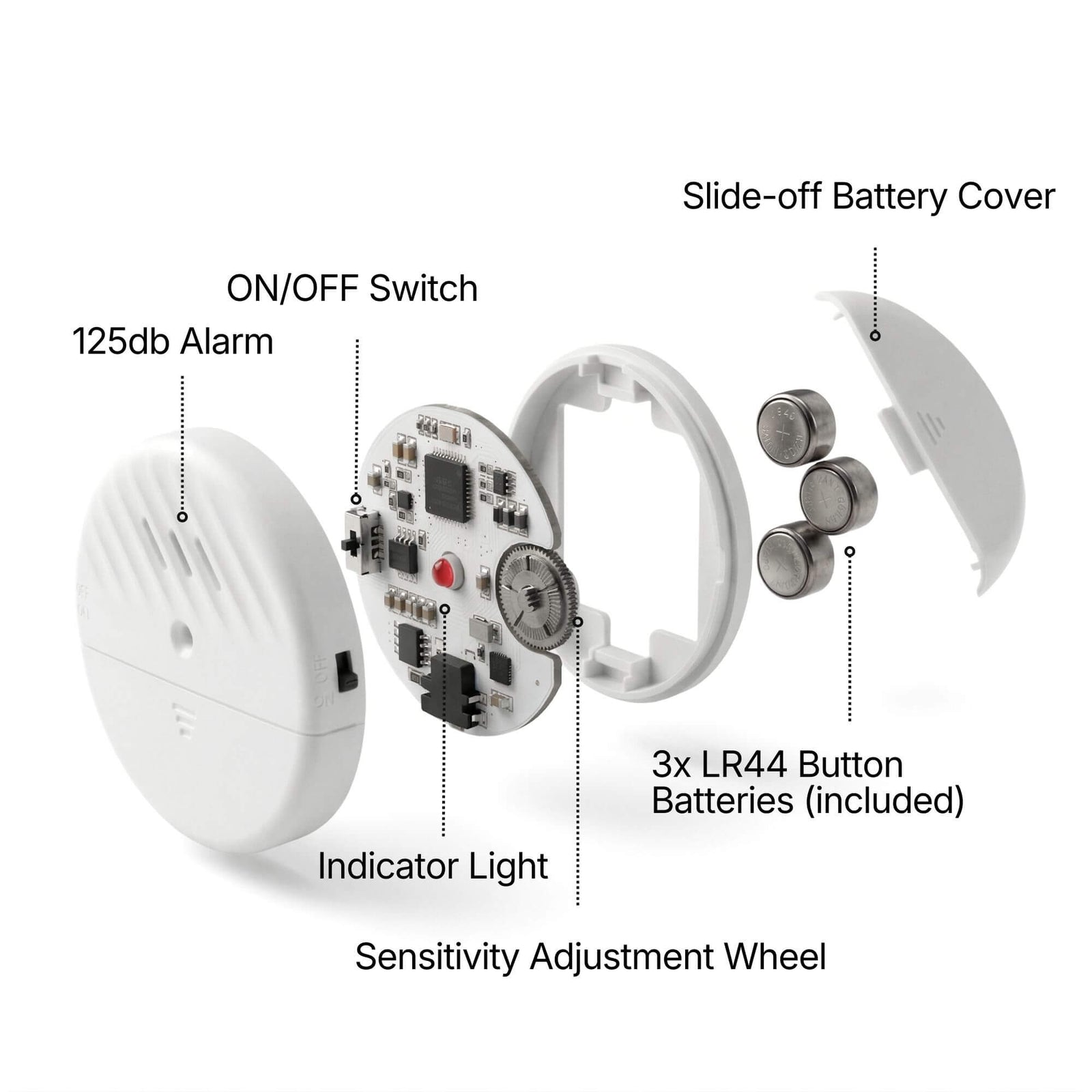
So 125 decibels lives above the concert, above the siren passing on the street, just below the point where sound stops being noise and starts being pain. That is the register a TremShield vibration sensor alarm operates in.
One footnote about all decibel ladders, including this one: distance changes everything. A jet at takeoff is quoted at wildly different numbers depending on whether you are standing near the runway or a few hundred meters back, because sound falls off quickly as it spreads. Alarm ratings describe the sound close to the device. That is not fine print working against you; it is the whole design. The alarm is loudest precisely where the intruder's hands and ears are.
Why 125 is far louder than it sounds on paper
Here is the part most spec sheets skip: decibels are logarithmic, not linear. Every 10 decibel step multiplies the sound energy by ten, and our ears register each step as roughly a doubling of loudness.
Run that math and the gaps get dramatic. The jump from a 110 decibel concert to a 125 decibel alarm is not a 14 percent increase. It is more than thirty times the acoustic energy, which your ears experience as several times louder. Compared to the 60 decibel conversation an intruder might hear inside a sleeping house, 125 decibels is a different physical category of event.
Distance matters too, and it works in your favor. Sound fades as it travels, so a siren that is merely attention-grabbing across the street is overwhelming at half a meter. The person prying at your window is the closest human being to the alarm. Whoever triggers it gets the loudest version of it.

What 125 decibels does to a burglar
The value of loudness is not really about volume. It is about what sudden, extreme noise does to a person who is somewhere they should not be.
First comes the startle reflex. A sound this loud, this close, triggers an involuntary flinch before any conscious thought happens. Hands come off the window. The task is abandoned mid-motion, not by decision but by reflex.
Then the thinking brain catches up, and the news is all bad. Concealment is gone: the one thing every burglar counts on, staying unnoticed, ended the instant the siren started. The sound also marks their exact location, not a vague "somewhere on the block" but this window, this door. And stress does the rest. It is genuinely hard to plan, communicate, or work methodically while a siren is screaming at arm's length.
Every second of noise raises the odds of being seen and remembered, and nothing has been gained yet that would justify staying. Interviews with convicted burglars consistently point the same direction: noise and attention are what they avoid most, and they would rather leave than gamble. The siren does not have to fight anyone. It just has to make staying unbearable.
Will the neighbors actually hear it?
A reasonable question, and the honest answer is yes, with physics worth understanding.
Walls and closed windows absorb sound, typically knocking somewhere in the range of 20 to 30 decibels off what passes through. A 125 decibel siren at your window can still arrive in the neighbor's living room at roughly the level of a loud alarm clock going off, hard to ignore and clearly wrong for the hour. Outdoors, with no walls in the way, it carries down the street.
Context does a lot of the work here. At two in the morning, against a background of near silence, an unfamiliar siren stands out the way a single light stands out in a dark field. Neighbors may not know exactly what it is, but "something is wrong over there" is exactly the reaction you want, because attention is the one thing an intruder cannot work around.
A brief note on hearing safety
A tool this loud deserves one plain safety paragraph, so here it is, minus any alarm of its own.
At 125 decibels, safe exposure is measured in seconds, not hours. The brief burst you hear while crossing a room to disarm a unit is not the kind of exposure hearing experts worry about; sustained close-range listening is. So follow two simple rules. Do not hold a sounding alarm directly against your ear, and mount units on glass and door panels rather than inches from a pillow. Placed where it belongs, at the entry point, the alarm is at its loudest exactly where the intruder is and comfortably survivable everywhere else.
That is also the quiet advantage of a device with no monthly fees or apps: you place it once, at the right spot, and it simply waits.
Loud where it counts
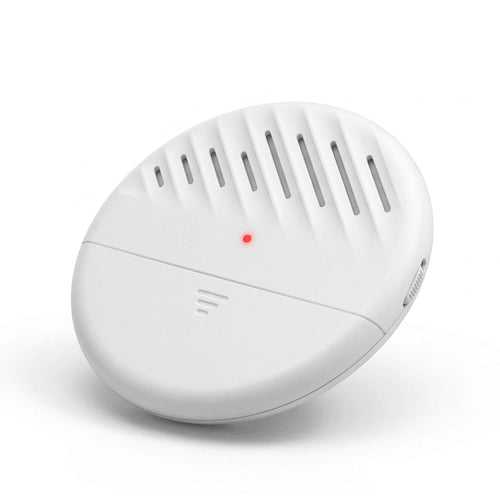
Volume is only useful when it is standing guard at the actual point of attack. That is the thinking behind the TremShield lineup: the vibration sensor alarm puts 125 decibels directly on the glass or door being tampered with, arms in seconds, and runs on batteries with no Wi-Fi, hub, or subscription. For coverage across several doors and windows at once, a 4-pack of entry alarms spreads the same principle around the home, and a personal safety alarm puts it on your keychain.
If you are matching devices to specific doors and windows, the alarm finder sorts it out in about a minute, and the full protection collection shows everything in one place. Every piece works the day it arrives: peel, stick, arm.
Frequently asked questions
Is 125 decibels louder than a rock concert?
Yes. Concert sound near the stage is commonly measured around 110 decibels. Because decibels are logarithmic, 125 decibels carries more than thirty times the acoustic energy of 110, which your ears register as several times louder. It sits between a close-range emergency siren and the threshold where sound becomes physically painful.
Can a 125 decibel alarm damage my hearing?
Not in normal use. Hearing damage at this level comes from sustained close-range exposure, while a triggered alarm gives you brief seconds of sound from across a room as you disarm it. The practical rules are simple: never hold a sounding unit against your ear, and mount alarms at entry points rather than beside your bed.
How far away can a 125 decibel alarm be heard?
Through closed walls and windows, which absorb roughly 20 to 30 decibels, the siren still reaches adjacent homes at a level that is hard to ignore, especially at night when background noise drops. Outdoors it carries well down a residential street. Exact distances depend on layout and conditions, but "the neighbors will notice" is a fair expectation.
Is a louder alarm always better?
Only up to a point, and placement beats raw volume. An alarm needs to be loud enough to startle an intruder at the entry point and alert people nearby, and 125 decibels comfortably clears that bar. Beyond that, what matters is that the alarm sits where the attack actually happens and that arming it is easy enough to become a habit.
Back to all articles