In this article
To feel safe at home at night, give your brain proof instead of reassurance: run the same five-minute routine at the same time every evening (lock, light, alarm, plan, close), so the house is handled before you lie down and 2 a.m. you inherits a decision instead of a question. Repetition, not willpower, is what quiets the jolt when the house makes a sound.
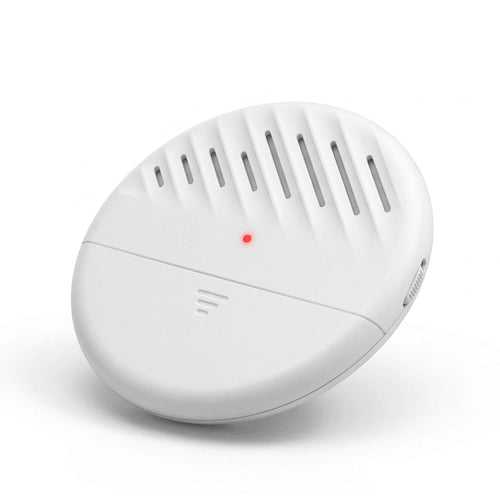
It is 2 a.m. and your eyes are open. That sound was almost certainly the house cooling, wood and metal shrinking as the night air drops. The routine below is how your body learns to believe that. It uses the locks you already own, plus one thing most homes are missing: something on the glass that makes noise if a window is tested. For us that is the TremShield Vibration Alarm, a thin disc that sticks to the pane and fires a 125 dB siren at the first pry or strike. No Wi-Fi, no app, nothing to log into at midnight.
The 2 a.m. math: your fear runs ahead of the odds
Night fear is not a malfunction. In the dark, lying still, your hearing takes over the watch, and hearing flags everything. A brain doing this is working correctly. It just has almost no information to work with, which is what the routine fixes.
Burglars work more by day. The FBI's 2024 crime summary counted more daytime burglaries than nighttime ones, 387,405 to 362,238 among offenses where the time was known, and daytime came out ahead every year from 2020 through 2024. Federal victim surveys point the same way: the Bureau of Justice Statistics found that burglaries of homes with no one there happened far more often in daytime hours, 6 a.m. to 6 p.m. (43 percent), than overnight, 6 p.m. to 6 a.m. (26 percent). A US Department of Justice guide for police explains why in one line: burglars want empty houses, so they work when houses are empty.
One more number. In the Bureau of Justice Statistics' Criminal Victimization, 2024 report, about 99 percent of US households went through the entire year with no burglary and no trespassing. An occupied home at night, lights on, ordinary sounds inside, is the kind burglars avoid.
Statistics won't argue a startled body down at 2 a.m., and they don't need to. Their job is to shape the plan you make at 10 p.m. Here it is.
The 5-Minute Close, step by step
Five steps, same order, same time, every night. The sameness is the active ingredient: consistency is what lets a nervous system stop re-checking. Pick your time now, for most people right after the last kitchen task.
- Perimeter pass (90 seconds). One lap of the ground floor, same route every night: front door, back door, sliding door, reachable windows. Touch each lock as you check it. A lock your hand touched is a lock your brain won't re-litigate at midnight. A window that won't latch? Fix it before bed, not on the lap.
- Light the approach (60 seconds). Porch light on, motion lights confirmed. You are making the approach to your home a place where nothing happens quietly, and telling your brain the outside is covered.
-
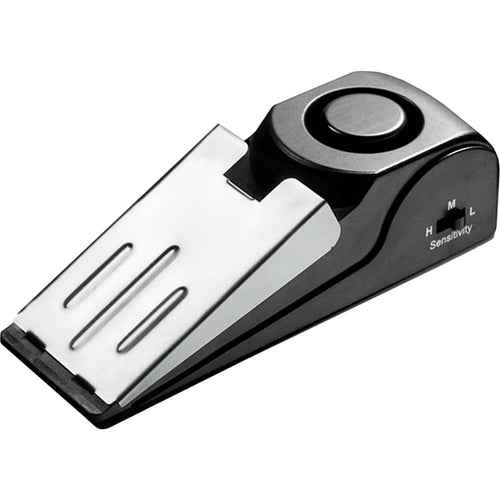
Switch on the alarms (90 seconds). A vibration alarm on each pane you think about at night, entry alarms on the doors and windows that should stay shut, a door stop alarm wedged behind an inward-opening door if you want the door held too. In a University of North Carolina at Charlotte survey of 422 incarcerated burglars, 60 percent said an alarm would make them look for another target. So this step makes your home a worse pick and hands the night watch to something that never dozes. The siren is 125 decibels (how loud 125 decibels is).

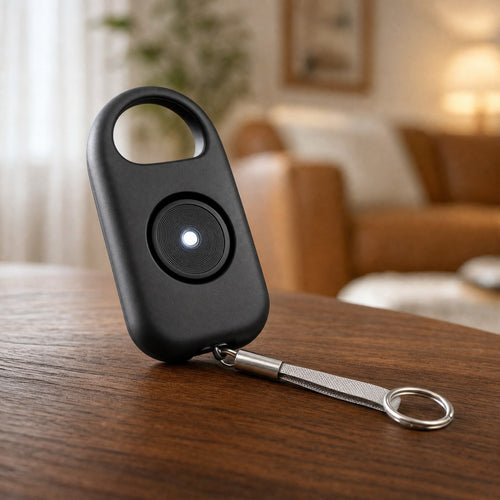
- Phone charged, plan in one line (60 seconds). Phone on the charger, within reach of the bed. Then say your plan line, decided once and never re-decided: "If I hear an alarm, I turn on every light, stay in my room, and call 911." Yours can differ. What matters is that it was settled at 10 p.m., by a rested you. Some people add a personal safety alarm on the nightstand, a 130-decibel keychain siren that sounds with one pull, simple enough to use half-awake.
- Close the loop (10 seconds). Say it, out loud or silently: "The house is closed." It feels unnecessary. It isn't. A spoken ending is a completion cue that tells your brain the job is finished instead of reopening it at 1:40. Same words every night.
Tick it off the first few nights, until the order is automatic. The list keeps your ticks in this browser.
The 5-Minute Close
- Front door locked and touched
- Back door and sliding door locked and touched
- Ground-floor windows latched
- Porch light on, motion lights working
- Window and door alarms switched on
- Phone on the charger, within reach of the bed
- Plan line said: lights, stay put, call
- "The house is closed."
Why houses pop and creak at night
Houses make more noise at night because they are cooling, and cooling means shrinking. All day, sun and warm air expand the materials a home is built from: wood framing, drywall, metal fasteners, ductwork. After sunset, each contracts at its own pace. Where wood meets metal or drywall meets a joist, that uneven shrink releases in tiny slips, and a tiny slip in a quiet house reads as a knock.
Home-inspection references like InspectApedia trace these sounds to thermal movement of roof and framing components. Ducts add their own ticking as they cool and again when the furnace cycles. Tonight's pop is the same pop the house made last night, when nothing was wrong.
The 60-second reset for the middle of the night
If you wake up listening, run this before your thoughts pick a direction. It works lying down.
- Name three sounds. Silently label what you hear: refrigerator, wind, a far-off car. Labels turn raw noise into information.
- Press your feet into the mattress, or set them flat on the floor. Weight and contact tell your body where it is.
- Exhale longer than you inhale. One slow breath out, then two more.
- If a sound repeats, listen for its pattern. Random, irregular, settling: a cooling house. A sound with rhythm that keeps progressing is the only kind that earns an action, and the action is your phone, not the hallway. Lights on, plan line, 911 if it continues.
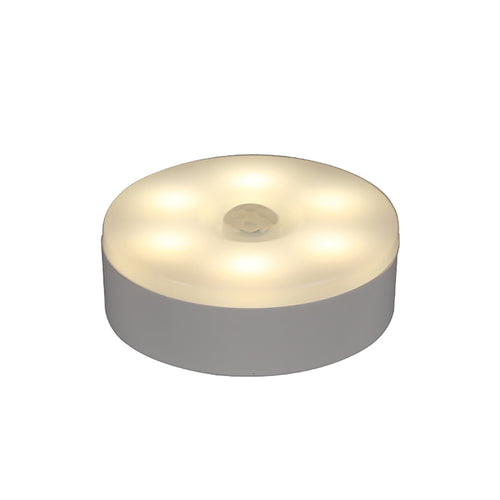
If you do get up for water or the bathroom, a lit floor helps more than a lit room. The motion sensor night lights (three for $24.99) stick low on the hallway wall, come on only when it's dark and something moves, and switch off again after 15 to 60 seconds.
Most nights the reset ends at step one, because the sounds have names and the alarms are on watch. You put a siren on the glass at ten, and it has said nothing. Silence from an alarm is information too.
Making the routine stick
Attach the Close to a cue you already have: the dishwasher starting, the last kitchen light, brushing your teeth. Then protect the sameness. Same time, same route, same words. If travel or a couch nap breaks the streak, nothing is lost. Run it again the next evening.
Be clear about what the routine can't do. It can't take the odds to zero; nothing can. Locked doors remove the easy version of the problem. Light and alarms remove the quiet version. And the ritual changes the one thing fully in your control: how fast your body stands down after lights out.
If you live alone, the Close carries a little more weight, and our living-alone security checklist extends it room by room. Every device named here is battery powered and works without Wi-Fi or an app; why that matters at midnight is in security without Wi-Fi, apps, or a monthly bill.
Lying awake at night: what people ask
Is it normal to feel anxious at night in my own house?
Yes, and common. Darkness removes visual information, quiet makes small sounds stand out, and lying still leaves your hearing in charge, so ordinary pops get flagged as important. A routine you repeat every evening gives that alert system real evidence; if night anxiety regularly costs you sleep, raising it with a doctor or therapist is a normal step.
What should I do if I hear a noise at night?
Stay where you are and listen for a pattern, not the volume. Random, irregular, settling sounds are a house cooling; a sound with rhythm that keeps progressing is the rare kind that earns action: lights on, phone in hand, and 911 if it continues. Moving toward the sound is never the job.
How long until an evening routine helps me sleep?
The security part works the first night: doors locked, lights on, alarms switched on. The sense of safety builds through repetition over weeks, so a missed evening doesn't reset anything; run the routine again the next night.
Which windows should have an alarm on them at night?
Start with the glass you sleep behind and any pane someone could reach standing outside, then the back door and the slider. A vibration alarm guards the one pane it's stuck to, so count one per reachable pane.
Will a 125 dB alarm wake me up?
It is made to: at 125 dB the siren is loud enough to carry through the house. Closed doors and distance soften any sound, so put an alarm on the glass nearest where you sleep and test it once at a sensible hour.
Put the night watch on the glass
The routine is free. The one purchase that changes what happens at a window while you sleep is a siren on the glass. One TremShield alarm is $29.99; the 6-pack at $99 makes each one $16.50 and the set $80.94 cheaper than six singles, with two free no-drill window locks and the Home Security Guide included. Free shipping to the US, Canada, the UK, Australia and New Zealand, and 30 days to send it back. Stick the first one on the bedroom window, the rest on the ground-floor panes, and switch them on as step three tonight.
Back to all articles