In this article
Sending a kid off to college, or packing for your own first semester, comes with a quiet undercurrent of worry. A dorm has shared hallways, doors that get propped open, and a laptop on a desk holding an entire academic life.
Here is the useful part: dorm security is a small, solvable problem. The risks are mostly opportunistic, an unlocked door or an unattended bag, and the fixes are cheap, light, and allowed under the rules. You don't need to fortify a dorm room. You need about five small devices and two habits.
The short list: a door stop alarm for nights, a portable travel lock, a personal safety alarm for the walk home, a portable combination safe and a diversion safe for valuables, and the habit that matters most, locking the door every time you step out. In a ground-floor room, add a stick-on vibration alarm to the window glass: it sounds at 125 dB if the pane is struck or pried, and it comes off at move-out.
Below, the kit comes piece by piece, flags what campus rules typically allow and forbid, and covers the part no gadget solves: living with a roommate.
Dorm rules first: know what you are working with
Every campus publishes housing policies, and they shape this kit more than any product review does. Three rules show up almost everywhere:
- No drilling or permanent modification. Walls, doors, and frames have to go back the way they came. Everything in this kit is freestanding, adhesive, or wedge-based for that reason.
- Fire safety overrides everything. Nothing may permanently obstruct the door, and devices like chain locks or installed barricades that could slow an evacuation are typically banned. A wedge-style device you place at night and remove in the morning is a different category, but check your housing handbook's exact wording.
- Residence staff keep access. RAs and facilities staff can enter for inspections and emergencies, so devices that lock staff out entirely can violate the housing agreement. One more reason removable beats installed.
Ten minutes with the housing handbook, usually under a heading like prohibited items, saves you from buying anything twice.
The core kit: three small devices
A door stop alarm for nights
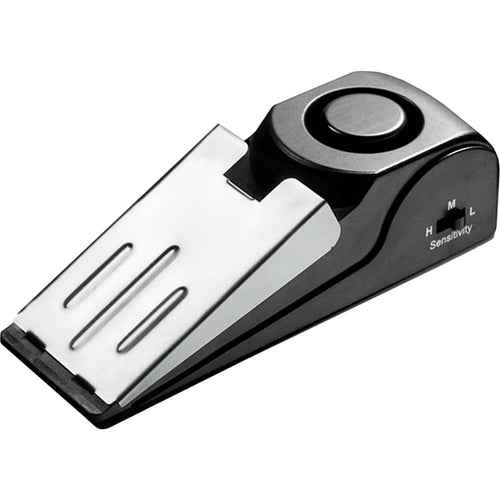
The door stop alarm is the anchor of the kit. It wedges behind the door while you sleep; if the door starts to open, the wedge resists and a loud siren fires at the same time. It's freestanding, needs zero installation, and sits under the door only while you're in the room, which keeps it clear of typical fire rules. It's the piece of the kit that does the listening overnight, so you're not the one keeping half an ear on the hallway.
A portable travel lock for privacy
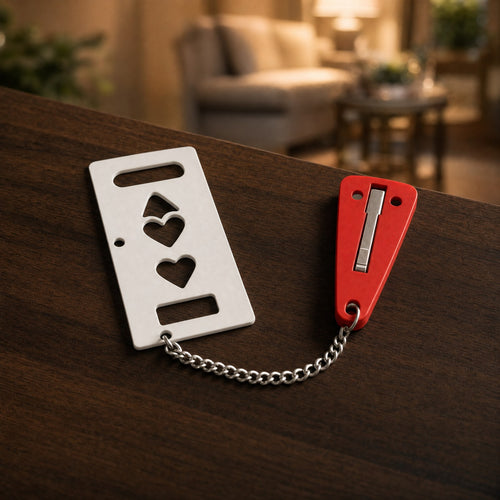
The portable travel lock adds a temporary second lock to an inward-opening door with no tools and no trace, and it works in hotels and study-abroad housing later. One caution: because it prevents entry entirely, use it while you're inside and awake, and skip it if your housing agreement requires staff access at all times.
A personal safety alarm for the walk home
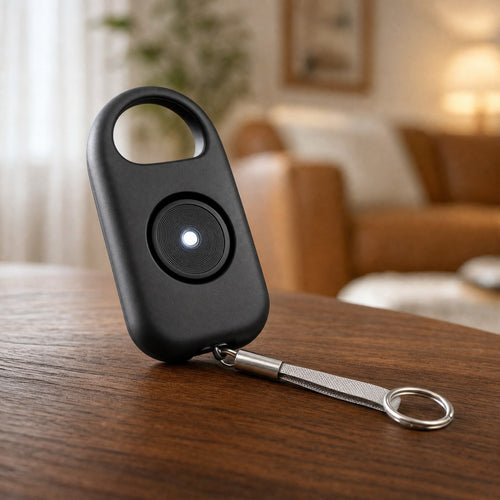
Campus life happens at night: labs, libraries, the long walk from the parking structure. A personal safety alarm clips to a keychain or backpack and fires an ear-splitting siren when the pin is pulled. It's rarely restricted by housing policy, requires no skill under stress, and produces the one thing trouble hates most: attention.
Protecting the valuable stuff
Dorm theft is overwhelmingly casual: an open door, a visible wallet, thirty unattended seconds. The counter is to make grabbing your things slow and unrewarding.
- A small locked box for the irreplaceables. Passport, spare bank card, medication, emergency cash. A portable combination safe slides into a desk drawer or tethers to a bunk rail with its steel cable, and a combination beats a key you'd lose by October.
- A diversion safe for everyday cash. A diversion safe looks like an ordinary book on a shelf of ordinary books. A casual thief with thirty seconds doesn't stop to browse a library.
- Laptop habits over laptop hardware. Lock the screen every time you stand up, turn on device tracking and disk encryption, back work up to the cloud, and never leave the laptop holding a library table for you. In a dorm, the habit of taking it with you outperforms any cable lock.
- One insurance phone call. Many family homeowners or renters policies extend to a student living on campus. Five minutes before move-in tells you what's already covered.
Move-in day: set it up in ten minutes
The whole kit deploys faster than the mini fridge. While the boxes are still stacked, do a quick pass:
- Test the door stop alarm once so the siren isn't a surprise at 2 a.m., then park it by the bed where your foot can find it at night.
- Fit the travel lock to the door once so you know it seats properly on this particular strike plate; some dorm doors are quirky, and better to learn that in daylight.
- Set the safe's combination to something that isn't a birthday, load the passport and spare card, and slide it into a drawer rather than leaving it on display.
- Clip the personal safety alarm to the keys or bag you carry every day, not the one that stays in the closet.
Ten minutes, no tools, and the room is quietly squared away for the year.
Roommate etiquette: the lock nobody sells
The best lock on a dorm room is a roommate who also uses it. Have the two-minute conversation in week one, not after something goes missing: we lock the door when the room is empty and when we sleep, we don't prop the hall door, guests stay out of each other's stuff, and nobody shares the room code or lends the key. Frame it as a shared standard rather than an accusation and it almost always sticks. Locking the door on the way out is the single highest-value habit on this page; every device above is a backup to it.
What to skip, and what to check first
- Pepper spray: check before you pack. Rules vary, and not a little. Some campuses allow it, others prohibit it in residence halls or campuswide, and state rules differ on top of that. Read your student handbook and campus safety page before buying anything. A personal safety alarm delivers the attention-drawing effect without the policy question.
- Anything that installs into the door or frame. Reinforcement locks and strike plates are excellent for houses and off-campus rentals, and almost always prohibited in dorms.
- Barricade devices marketed as unbreakable. If it could slow a fire evacuation or lock out emergency staff, housing rules likely ban it, and the door stop alarm already covers the nighttime job.
- Gadget overload. A dorm room has one door and usually one window. Five small devices and two habits cover it. The leftover budget is better spent on the carry-on version of this kit for breaks and study abroad.
When you eventually move off campus, the picture changes: real ground-floor windows, an older door, and a landlord's no-drilling clause. That's the moment for a vibration sensor alarm on the reachable windows: 125 dB at the first impact, peel-and-stick install, battery powered with no Wi-Fi or fees, and it moves with you at every lease.
Dorm packing list: what fits, what's allowed
Which personal alarms are allowed in university housing?
Freestanding, battery-powered alarms usually are: a door stop alarm that sits under the door only while you are inside, a stick-on window alarm that peels off at move-out, and a keychain personal safety alarm. Anything screwed into the door or frame usually is not, so check your housing handbook's wording on door obstructions before move-in.
What kind of door does a door stop alarm need?
An inward-opening door with about a 0.75 inch gap underneath. It runs on one 9V battery, which is sold separately, so pack one with it.
Will a portable travel lock fit a dorm room door?
Usually, since most dorm doors swing inward into a standard strike plate, which is what it needs. It will not work on a door that swings outward or slides, and while it is set, a key or keycard from the hallway will not open the door.
How loud is a personal safety alarm, and does it need charging?
The TremShield one sounds at 130 decibels when you pull the pin and stops when you push the pin back in. It runs on a small replaceable battery with no charging and no app, so test it now and then.
Is a portable combination safe a real safe?
No. It is a portable lock box meant to stop opportunist theft, with a steel cable that ties it to a bunk rail or desk. It carries no anti-theft, fire or water rating, which suits the usual dorm risk: something picked up from an open room.
When the room comes with glass to cover
A ground-floor dorm room, an off-campus apartment or a shared house brings windows a stranger could reach, and each pane takes one TremShield Vibration Alarm at $29.99. For a place with several, the 6-pack at $99 comes to $16.50 per alarm and saves $80.94, with two free no-drill window locks and the Home Security Guide in the deal. Free shipping to the US, Canada, the UK, Australia and New Zealand, with 30-day returns.
Back to all articles