In this article
Last updated September 17, 2026.
Your windows lock and you have checked them. The question now is what the next upgrade is worth buying.
The next $30 spent on a window buys one of five things: delay while the glass is being attacked, a hard limit on how far a sash opens, a warning that reads from the sidewalk, a latch that holds, or a siren that tells the house an attempt is under way. No upgrade wins two of those jobs, so the purchase is decided by which one your windows are missing.
The five are anti-shatter film at $19.99, a window restrictor at $19.99, twelve alarm decals at $14.99, a sash lock at $14.99 for two, and the TremShield Vibration Alarm at $29.99, a stick-on siren rated at 125 dB. Our alarm wins one row of the table below and loses four.
When the answer is to buy nothing
Before spending a dollar, walk the house and try every sash, because the most common way into a US home uses no force at all. The Bureau of Justice Statistics counted 3.4 million household burglaries in 2011, the last year the federal survey broke the method out this way, and 47.7% were completed unlawful entry, meaning no force was used.
A second Bureau of Justice Statistics report, Victimization During Household Burglary, took no-force entries of homes with nobody inside, averaged over 2003 to 2007. Of those, 39.5% got in by way of an unlocked door or window, and 17.2% through one standing open, which is 57% between them. Ten minutes beat $30 here. Try the sash above the porch roof and the one behind the couch.
What is the best extra security for windows?
No single upgrade is best for every window. Each of the five below wins one job and gives up the rest.
| Upgrade | Price | The one job it wins | Where it belongs | What it will not do |
|---|---|---|---|---|
| Anti-shatter window film | $19.99 | Delay: the broken pane stays in the frame | Small panes near a latch, glass in a door | Make glass unbreakable, or report anything |
| Window restrictor lock | $19.99 | The vented sash: a hard stop at about four inches | A window nobody sleeps behind, never an escape window | Serve as child fall prevention |
| Alarm warning decals | $14.99 for twelve | Price per window, and visible from the street | Ground-floor panes, the alarmed ones first | Stop anybody by itself |
| Window sash lock | Two for $14.99 | The latch itself, when the factory catch is loose | Double-hung and sliding windows, no drilling | Protect the pane |
| TremShield Vibration Alarm | $29.99 | Telling you: the only one that reports the attempt | The pane, in the corner nearest the latch | Hold a sash shut, or call anyone |
The five, one by one
Anti-shatter film, $19.99: the only one that buys time
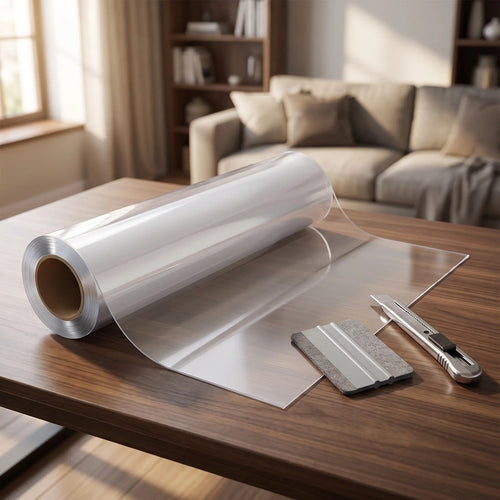
Anti-shatter window film is a clear sheet about four mils thick, applied wet to the inside of a pane. The glass still breaks. The film holds the broken pieces in the frame, so a fast quiet smash becomes a slow noisy struggle. Film does not make a window unbreakable.
Film bonded to the glass face, with nothing attaching it to the frame, can be pushed out of the glazing bead as one sheet. That is the argument for small panes beside a latch rather than a wide picture window. Our Anti-Shatter Window Security Film is $19.99 for the 2 m roll and $24.99 for the 4 m roll. Check your window warranty first: on a sealed double-glazed unit, film can cause thermal stress cracking.
Window restrictor, $19.99: the win on a sash you want vented
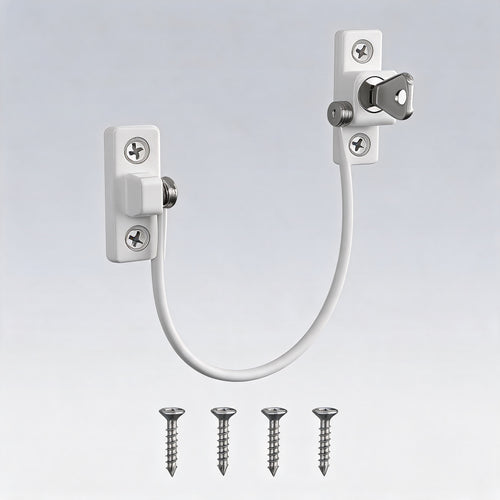
A window restrictor lock is a short steel cable between two screw-on brackets, capping the opening at roughly four inches so a room can vent. Fit it only on a window nobody sleeps behind, because an emergency escape window has to open from the inside with no key, no tool and no special knowledge, and the cable on this one releases with a key. A stair landing, a hallway or a bathroom is where you want the Window Restrictor Lock at $19.99.
Do not treat a restrictor as child fall prevention. A restrictor limits how far a window opens, which is not the same thing. If the worry is a small child and a height, that job belongs to a tested window opening control device, and we do not sell one.
Alarm warning decals, $14.99 for twelve: cheapest per window by a distance
An alarm on the glass works at the window, where nobody on the sidewalk can see it, and the decision to try a house is made at that distance. In a University of North Carolina at Charlotte survey of 422 incarcerated burglars, about 83% said they would try to find out whether a home had an alarm, and 60% said an alarm would send them looking for a different target. The alarm industry funded it, and the answers are stated intentions from men and women in prison, not observed behavior. The same survey lists visible signs of security, alarm signs included, among the things offenders said put them off.
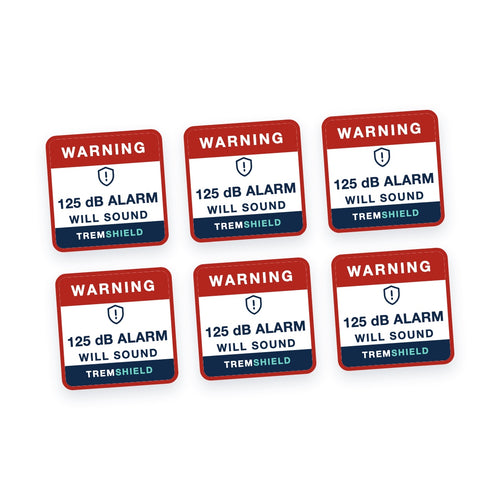
Twelve Alarm Warning Window Decals cost $14.99, about $1.25 per pane, the cheapest line here. A sticker stops nobody by itself. A claim is worth something only when the house can back it up.
Window sash lock, two for $14.99: the win when the latch is the problem
A factory window catch is built to pull a sash snug and line it up, not to resist somebody pushing it from outside. The Window Sash Lock is $14.99 for two and pins the sash where you set it: clamped to the rail above a double-hung lower sash, or into the track of a horizontal slider. A padded thumb-screw does the holding, so there is no drilling and no hole at move-out. Snug, not hard: wound down tight on a vinyl sash rail, a thumb-screw can emboss it permanently or crack it in the cold. For which clamp fits which window, see our guide to window security locks.
The vibration alarm, $29.99: the only one that tells you
Every other upgrade on this page is silent. Film, a restrictor, a decal and a sash lock work while you are home, asleep or away, and none reports that anything happened.
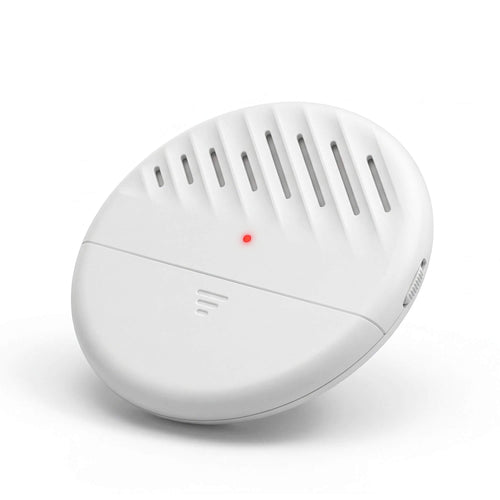
The TremShield Vibration Alarm presses onto the glass with adhesive and fires a 125 dB siren when the pane is struck or pried. A sensor bonded to the pane responds to contact with that pane, and contact comes before the glass gives way. Nobody can say how many seconds that ordering buys, because no study measures the gap between contact and entry. A sensitivity dial sets how much movement counts as an attack: too high and a careful pry may go unreported, too low and a slammed door sets it off. Fix the unit near the corner closest to the latch, two to three inches clear of both edges, where the pane flexes least.
Three limits. The alarm holds nothing shut, so it pairs with a lock and never replaces one. The alarm covers one pane, the one it sits on, so a second window needs its own unit, and our room-by-room count works out how many. The alarm calls nobody: no radio, no app, no hub and no monthly fee, so a message while you are at work is a job for a connected camera we do not sell.
Which windows must never get keyed hardware?
An emergency escape window must open from the inside with no key, no tool and no special knowledge. That is section R310 of the model residential code used across most of the US, and it covers every sleeping room and the basement. A keyed window lock, a keyed sash jammer and a key-released restrictor all fail it there. Keyed hardware belongs on basement, garage and shed windows nobody would climb out of, and codes vary by state, so check locally.
If you only buy one, which is it?
Pick by the gap, not by the price:
- The latch is loose, broken or missing. The $14.99 sash lock, because nothing else here holds a sash.
- A small pane sits beside a latch or a door handle. The $19.99 film, because reach-through is the attack there.
- Everything locks and the glass is the last gap. The $29.99 alarm, on the panes a stranger could reach.
One purchase beats all three if the front door frame has never been touched: 3-inch screws, a few dollars' worth, through the deadbolt strike and every hinge into the framing behind the jamb. For the window-by-window version, see burglar-proofing windows without bars.
Spending the next $30 on a window: follow-ups
Which size of anti-shatter film do I need?
The 2 m roll (about 6.5 ft, $19.99) suits a few small panes or sidelights, and the 4 m roll (about 13 ft, $24.99) covers more windows or larger glass. A typical window takes about half an hour to apply.
Can I take the film off when I move out?
Yes, though it is made as a long-term application, so removal can take some effort and an adhesive cleaner. If you rent, ask your landlord before you apply it.
What does it cost to put alarms on six windows?
Six alarms are $99 as a pack, $16.50 each, against $29.99 for one, and four or five are $19.99 each. The six-pack adds two free no-drill window locks and the Home Security Guide, so a window that needs a lock and an alarm gets both from one order.
Lock it tonight, then cover the glass
The free lap of the house comes first. If the gap you find is the glass, six panes come to $99 in the TremShield Vibration Alarm 6-pack, which works out at $16.50 an alarm and $80.94 below six singles at $29.99. It ships with two free no-drill window locks and the Home Security Guide, a PDF that arrives by email. Free shipping to the US, Canada, the UK, Australia and New Zealand, with 30-day returns.
Back to all articles