In this article
When a window alarm goes off, the siren sounds at the pane it is stuck to, and it calls nobody. No signal leaves the building and no dispatcher is listening. The response comes from whoever is inside the house and whoever is close enough outside to hear it.
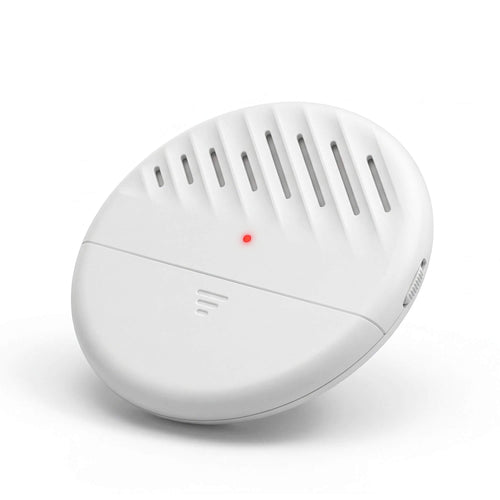
The device in question is the TremShield Vibration Alarm, a $29.99 stick-on siren rated at 125 dB that mounts on a window or a door and fires when the glass or the door is struck or pried. Every limit below applies to it.
Last updated September 17, 2026.
What happens in the first minute after a window alarm goes off?
Three things happen at once, none of them on a phone network. The siren starts at the pane that moved, with nothing between it and whoever is standing there. Anyone inside who hears it knows which window, because the sound has an address. Anyone outside within earshot learns which property to look at.
A vibration alarm does not know why the glass moved, because it reads mechanical energy against a threshold and only the sensitivity dial separates a deliberate strike from a slammed door. Our guide to a window alarm that keeps going off works through the causes.
Your next move is worth settling in advance. Stay in the room you are in, put a light on, and call 911 from there. Do not go and look. The value of noise is that you do not have to meet anybody.
How the siren stops is a per-unit detail, so check the sounding time and reset behavior before you buy. Many US cities do cap how long an alarm audible outside a building may sound. The City of Portland, Oregon writes 15 minutes into its city code, and Los Angeles allows 30. Local law varies, so check yours.
Does a window alarm call the police?
No. A standalone window alarm has no radio, no account and no monitoring center, so nothing reaches a dispatcher. Police attend because a human being called them.
Monitored systems do dispatch, and the federal guidance is unflattering. The US Department of Justice Office of Community Oriented Policing Services, in its guide False Burglar Alarms, reports that between 94% and 98% of burglar alarm calls to US police are false. That guide dates from 2011, on data mostly from the 1990s and 2000s, and it describes monitored systems, not standalone sirens.
Arrest is rare as well. The FBI reports that 15.9% of property crimes reported to police in 2024 were cleared by arrest or exceptional means, across all property crime rather than burglary alone. The Department of Justice guide notes that one study found police more likely to catch burglars in the act at premises without alarms, because the report there came from a neighbor, and an eyewitness beats an alarm signal. That is one study, and alarmed premises differ from unalarmed ones in many ways.
Who responds when a window alarm goes off?
Neighbors, and the people already inside the house. The people inside are the reason to own a siren at all. The Department of Justice guide names occupancy, or signs of occupancy, as the biggest burglary deterrent, with cameras, bars, dogs and motion lights also effective.
Acting on the neighbor half costs nothing. Tell the households whose windows face yours that you have alarms on the glass, so the siren means something. A neighbor who knows what the sound means is the cheapest upgrade a siren can get.
Why a siren that calls nobody still changes the outcome
The best evidence comes from asking burglars. Researchers at the University of North Carolina at Charlotte surveyed 422 incarcerated burglars in North Carolina, Kentucky and Ohio. About 83% said they would try to find out whether a home had an alarm, and 60% said an alarm would send them looking for a different target. Among those who found an alarm partway through an attempt, half said they would stop, 31% said they would sometimes retreat, and 13% said they would always continue.
Two disclosures belong with those figures. The study was funded by the Alarm Industry Research and Educational Foundation, which is the alarm industry's own research body, and the answers are what offenders said they would do rather than behavior anyone observed. Neither point makes the finding worthless. Both make "burglars avoid homes with alarms" a misquote of it.
The result is narrower than the version on most product pages. Half is not almost all, and one in eight said an alarm would change nothing. The same survey lists what offenders weighed: other people close by, no route out, and visible signs of security. An alarm is one item on that list, not the list.
A limit sits on the other side. The Department of Justice guide finds no evidence that rising alarm ownership caused the long US fall in burglary since the early 1980s. Our article on whether window alarms work takes the evidence further.
Who does a local window alarm help most?
A household member was home during about 28% of burglaries, in the Bureau of Justice Statistics study Victimization During Household Burglary, averaged over 2003 to 2007. Of the burglaries where somebody was present, 38% found that person asleep, and 61% happened between 6pm and 6am.
A sleeping person's only useful warning is an audible one. A phone alert reaches a sleeper only if the phone is charged, loud and in the room. A camera helps only if somebody is watching at 3am. Somebody home, asleep, after dark is a measured subset, and it is what a siren on the glass is for.
Will a window alarm wake you if your bedroom door is closed?
Maybe not, and the fix is a unit on the window in the room where you sleep.
Three findings stack against a siren in another room. Sound pressure from a point source falls about 6 dB each time the distance doubles, so the level printed on a box is not the level that reaches a pillow. Fire-safety researchers Dorothy Bruck and Ian Thomas at Victoria University found that an alarm in the hallway rather than the bedroom arrives about 12 dBA lower with the door open and 15 to 20 dBA lower with it closed. And volume is not waking, for adults or children: in the same work, children slept through 43% of presentations of a standard alarm delivered at 89 dBA right at the pillow.
Those studies looked at smoke alarms rather than intrusion alarms. The acoustics carry across; the context does not. They support a placement rule and nothing grander: a siren in the room with you and one down the hall are not the same product. Keep the unit on the window, not at head height beside a pillow.
The 125 dB figure is a rating, and the distance it was measured at is not published, as with most sirens of this kind. Our piece on how loud 125 decibels is sets it against everyday sounds.
When a window alarm is the wrong thing to buy
Three buyers should walk away from this product.
- Anyone who wants a phone alert. The TremShield Vibration Alarm has no radio and no app, so it tells you nothing while you are at work. A connected camera or a monitored system does that job, and TremShield sells neither. A siren also records nothing.
- Anyone who wants police dispatched. A local siren contacts nobody, and the route to a dispatch is a monitored contract plus an alarm permit where the city requires one.
- Anyone whose house will stand empty for months. A siren with no listener does very little, for the eyewitness reason above. Locks, a neighbor who walks past and signs of occupancy are the better spend.
Two more cases. A solid entry door takes the alarm too, which goes off when that door is hit or pried; it holds nothing shut, though, so longer screws through the strike and the hinges still come first. It hears a knock as well, so on a door in daily use, arm it at night and when you are away. An unheated garage or a pane that condenses in winter is a poor surface for adhesive.
What does a window alarm give you, and what does it not?
| What you want | Does a local siren do it? | What delivers it |
|---|---|---|
| To be woken while someone is still at the glass | Best chance when the unit is in the room where you sleep. Volume alone does not guarantee waking | The job this product was built for |
| An alert on your phone at work | No. There is no radio in it | A camera or monitored system. TremShield sells neither |
| Police sent to your address | No. Nothing leaves the building | A monitored contract, plus a permit if your city requires one |
When the siren sounds: practical questions
What happens if the alarm goes off and nobody responds?
The siren still sounds at the pane, and the noise is the main thing it does: whoever is at the glass loses the quiet they were counting on. Nothing is dispatched, so for a house that sits empty, ask a neighbor to treat the sound as a reason to call.
How do I test a window alarm?
Switch it on and tap the glass near it, at a sensible hour, and turn the dial down a step if a passing truck would set it off. Tell the people you live with first, because 125 dB is loud on purpose.
Will a pet set off a window alarm?
Not by walking past, because it reacts to vibration in the glass, not to movement in the room. A pet that jumps against the pane can trip it, and the sensitivity dial sets how hard a knock it takes.
Does a window alarm work in a power cut or a Wi-Fi outage?
Yes. It runs on LR44 button cells and has no Wi-Fi connection to lose, so a power cut or an internet outage changes nothing about how it sounds.
Cover the glass you sleep behind first
The first window to cover is the one in the room where you sleep, because that is where the research points. If the answer for your home is a camera, a monitored contract or a heavier front door, buy that instead. If the worst has happened already, our guide to what to do after a break-in is the calmer next step.
One TremShield Vibration Alarm is $29.99. For a whole ground floor, the 6-pack at $99 works out at $16.50 per alarm and saves $80.94 against six singles, with two free no-drill window locks and the Home Security Guide, which arrives as a PDF by email. Free shipping to the US, Canada, the UK, Australia and New Zealand, with 30-day returns. The siren still calls nobody. It wakes the person who can.
Back to all articles