In this article
Most burglary maps answer how common it is where you live. The question before you spend anything is different: if you add locks, an alarm or a camera, does a break-in become less likely to start, or do you mostly get footage and an insurance claim afterwards? Below: your state's 2025 number, then the prevention evidence, including the part that does not flatter alarms.
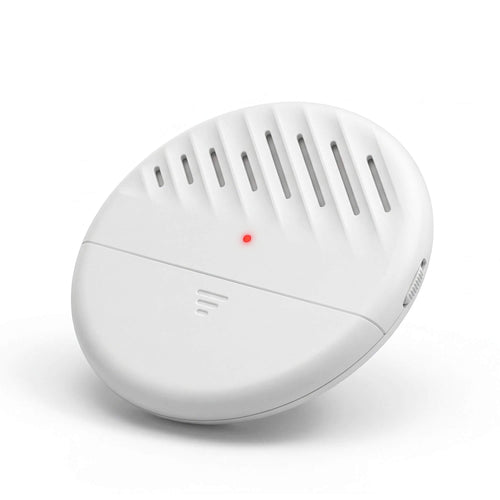
We sell one of these layers, the TremShield Vibration Alarm, a stick-on unit for glass and solid doors that hits 125 dB at the first blow or pry, while the person is still outside. The research says it is one layer among several, not the first, and the advice here is built that way.

Tap the map to open it full size.
Nationally, police-reported burglaries ran at 195.2 per 100,000 residents in 2025, down from 231.7 in 2024 and 253.4 in 2023, a fall of about 23% in two years (FBI Crime Data Explorer). From 2024 to 2025 the reported rate fell in 47 states; Alaska, Hawaii and New Hampshire rose.
| Highest, 2025 | 2025 | 2024 | Change |
|---|---|---|---|
| New Mexico | 419.5 | 522.5 | -103.0 |
| Oklahoma | 367.9 | 415.3 | -47.4 |
| Washington | 318.5 | 406.3 | -87.8 |
| Nevada | 318.2 | 368.0 | -49.8 |
| Louisiana* | 306.3 | 382.6 | -76.3 |
| North Carolina | 301.9 | 327.9 | -26.0 |
| Kansas | 289.8 | 296.1 | -6.3 |
| Colorado | 288.9 | 352.8 | -63.9 |
| Arkansas | 286.1 | 357.1 | -71.0 |
| California | 279.7 | 307.6 | -27.9 |
| Lowest, 2025 | 2025 | 2024 | Change |
|---|---|---|---|
| New Hampshire | 51.6 | 48.4 | +3.2 |
| Maine | 79.8 | 100.0 | -20.2 |
| Connecticut | 82.4 | 135.4 | -53.0 |
| Rhode Island | 85.8 | 91.2 | -5.4 |
| Virginia | 88.2 | 109.9 | -21.7 |
| Idaho | 90.8 | 123.7 | -32.9 |
| Vermont | 94.4 | 133.4 | -39.0 |
| Wisconsin | 98.7 | 129.4 | -30.7 |
| Pennsylvania | 107.5 | 118.4 | -10.9 |
| Massachusetts | 111.9 | 130.7 | -18.8 |
Police-reported burglaries per 100,000 residents covered by reporting agencies; change in rate points, 2024 to 2025. *Louisiana: agencies covered 78.0% of residents in 2025.
How to Read Your State's Number
- It counts only what reached the police. In the federal victim survey, just 40.7% of US burglaries in 2024 were reported to police (Bureau of Justice Statistics). There is no reporting rate per state: treat every number on the map as a floor.
- It is worked out per covered resident. Where some agencies sent no data, the rate rests on the residents the others cover. Six states fell under 90% coverage in 2025: Louisiana 78.0%, Mississippi 81.5%, Florida 84.7%, Indiana 88.2%, West Virginia 88.2%, South Dakota 89.7%.
- "Safest state" means lowest reported rate. New Hampshire's 51.6 was still 729 reported burglaries in 2025.
- Your street is not your state. In 2011, renting households had a completed-burglary rate of 32.7 per 1,000, against 18.3 for owners (BJS, Household Burglary, 1994-2011). In 2003-07 data, buildings of two to four units had higher burglary rates than single-family houses or buildings of ten or more units (BJS).
A low state number is no reason to skip the basics, and a high one is no proof your house is next. Your openings are what you can change. National patterns by time and entry point are in our burglary statistics.
Nobody Tracks Home Security by State
We looked for a second layer for this map, how many homes in each state have an alarm or security system, and found no government survey that measures it, and no independent one large enough per state to rank anything. The "security adoption by state" rankings we found come from polls by companies that review or sell security products. So the map shows burglary only. A claim that states with more alarms have fewer break-ins has no public data behind its alarm half.
Before, During or After: What Each Layer Changes
A break-in has three moments: choosing the house, the attempt at an opening, and everything after. Only the first two can stop one starting.
| Layer | Acts when | What it changes |
|---|---|---|
| Locked doors and windows, strike plates, window locks | Before entry | Slows entry, or makes it need force. In UK crime-survey data, door deadlocks were among the top two single devices; window plus door locks cut the odds of burglary with entry to about 1/13. |
| Outside lights, a lived-in look | Before: the choice of house | External lights were among the most effective single devices in UK crime-survey data. |
| Alarm warning decal | Before: the choice of house | Signals an alarm from the path. Only worth it over a real one: in UK survey data, dummy alarms gave no protection against attempts. |
| Alarm on the glass or door | During the attempt, before entry | Sounds when the surface is struck or pried, while the person is outside. Holds nothing shut; makes a quiet attempt loud. |
| Camera | Mostly after | Records evidence. In UK crime-survey data, a camera on its own gave some protection against burglary with entry and none against attempts. |
| Home insurance | After | Pays for the loss. Changes nothing about whether a break-in starts. |
What Burglars Say About Alarms
In a University of North Carolina at Charlotte survey of 422 incarcerated burglars, about 83% said they would try to find out whether a home had an alarm, and 60% said an alarm would send them looking for a different target. It was funded by the alarm industry's research foundation, and only 28% of inmates invited took part (full report). On finding an alarm after starting, half of those who answered said they would stop, 37% would sometimes carry on and 13% always would.
Home Office Findings 249 (2004) interviewed 82 burglars in southern England. 84% rated a visible alarm as a deterrent, the same share as rated the belief that someone was home; 82% named a camera nearby, 55% strong-looking locks.
Portland TV station KGW mailed questions to 86 Oregon inmates without saying how many replied (the report). Most who did said they would leave at once if an alarm went off; views on security signs were mixed.
All three record what burglars say they would do (what deters burglars ranks the full list). What changes real break-in rates shows up in victim surveys.
What the Crime-Survey Data Says
The best independent test we know of is the Crime Survey for England and Wales, a large UK government household survey.
A study of survey years 2008 to 2012 by Andromachi Tseloni and colleagues found that a burglar alarm with no other security gave less protection than no security at all. The authors' unproven explanations include that an alarm only protects when set. Door and window locks with external lights or security chains gave at least 20 times greater protection against burglary with entry than no security; window plus door locks, roughly 13 times; window locks plus an alarm, roughly 5.
A second paper, covering 1992 to 2011/12, found strong evidence that security caused the fall in burglary there, a fall solely in forced entries. Alarms were not identified as contributing.
US evidence is thinner. A 2008 Rutgers study of Newark, also alarm-industry funded, found falling burglary closely associated with rising alarm installations, and no sign of burglaries pushed onto neighbors (summary). One city, a correlation, not proof.
For your house:
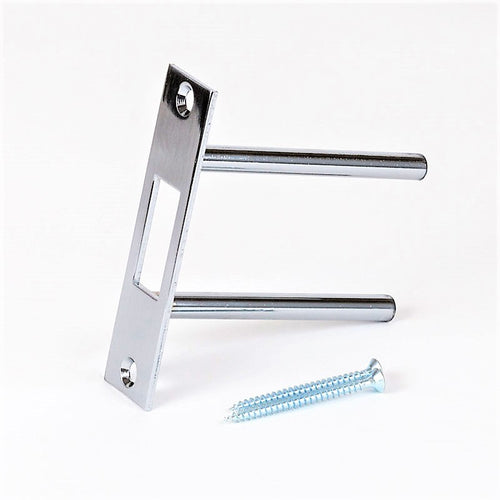
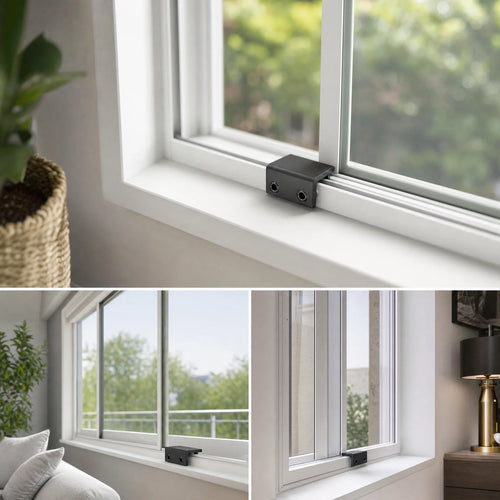
- Locks first, starting with using them. In US data for 2011, 47.7% of burglaries were entries without force, through an unlocked door or open window (BJS). Then make them hard to force: the Door Strike Plate Kit ($24.99) replaces the factory plate with steel anchored to the stud; it needs a drill, so ask first if you rent. The Window Sash Lock pair ($14.99) clamps onto double-hung or sliding windows, no drilling.
- Then an alarm on the glass someone can reach, switched on. A lock holds the sash, not the pane. The alarm sounds while the attempt is still outside, needs no Wi-Fi or subscription, and a dial lets you tune out passing traffic.
- Then light on the dark side, and a decal where an alarm stands. Alarm Warning Decals ($14.99 for 12) say a 125 dB alarm will sound. Use them only where that is true.
Your three layers, in order
- List every ground-floor door, window and glass panel reachable from outside
- Lock test: each one locks, and you lock it every night and whenever you leave
- Doors: look at each strike plate; short screws that only bite the jamb are the first upgrade
- Windows: any loose or broken latch gets a clamp-on or keyed lock
- Mark the glass someone could hit or pry from the ground: each pane and glass door there gets an alarm, switched on
- Tap each alarmed pane to test it, then set the dial so a passing truck stays quiet
- After dark, check the side you can't see from the street: no light there means a light goes there
- Walk up from the street: a decal on each alarmed pane, readable from the path
- Write today's date here; replace alarm batteries within 12 months
Where the 6-Pack Fits
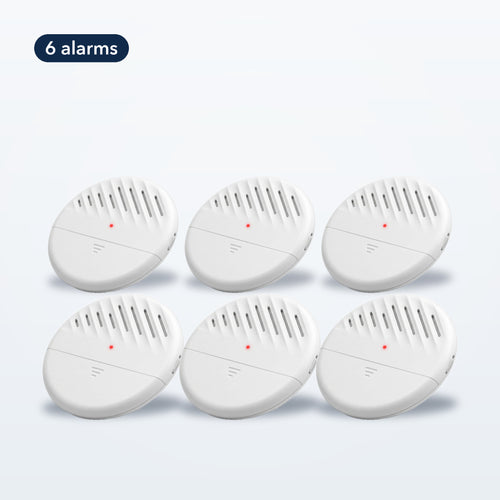
The evidence puts an alarm on top of locks, not in place of them. The TremShield 6-pack is six alarms for $99, $16.50 per alarm against $29.99 for one, saving $80.94 against six singles, plus 2 free no-drill window locks for two of your windows. In the England and Wales survey, homes with window locks and a burglar alarm had roughly 5 times lower odds of burglary with entry than homes with no security (a household alarm in 2008-12, not a test of ours), while window plus door locks reached about 13 and window locks plus outside lights about 18. Treat the alarms as the noise layer over door locks and lights, not the whole plan. The Home Security Guide is an emailed PDF. Free shipping to the US, Canada, the UK, Australia and New Zealand, 30-day returns; most orders arrive 1 to 3 weeks after you order.
Burglary by State and Home Security: Common Questions
Which state has the highest burglary rate?
New Mexico, with 419.5 reported burglaries per 100,000 residents in 2025, then Oklahoma at 367.9 and Washington at 318.5, per the FBI Crime Data Explorer.
Which state has the lowest burglary rate?
New Hampshire, with 51.6 reported burglaries per 100,000 residents in 2025, then Maine at 79.8 and Connecticut at 82.4, per the FBI Crime Data Explorer. A low reported rate is not zero risk.
Do burglar alarms deter burglars?
Burglars say so: 60% in an alarm-industry-funded survey of 422 inmates said an alarm would send them elsewhere. But in England and Wales crime-survey data, homes with only an alarm fared worse than homes with no security; alarms plus locks did better.
Do alarms work without monitoring?
A local alarm makes noise where the attack is, and nobody is dispatched. Most burglars who answered a TV station's questionnaire said they would leave at once if an alarm went off.
Is my state's burglary number the real total?
No. State figures count burglaries reported to police, and only 40.7% of US burglaries were reported in 2024, per the Bureau of Justice Statistics.
Back to all articles