
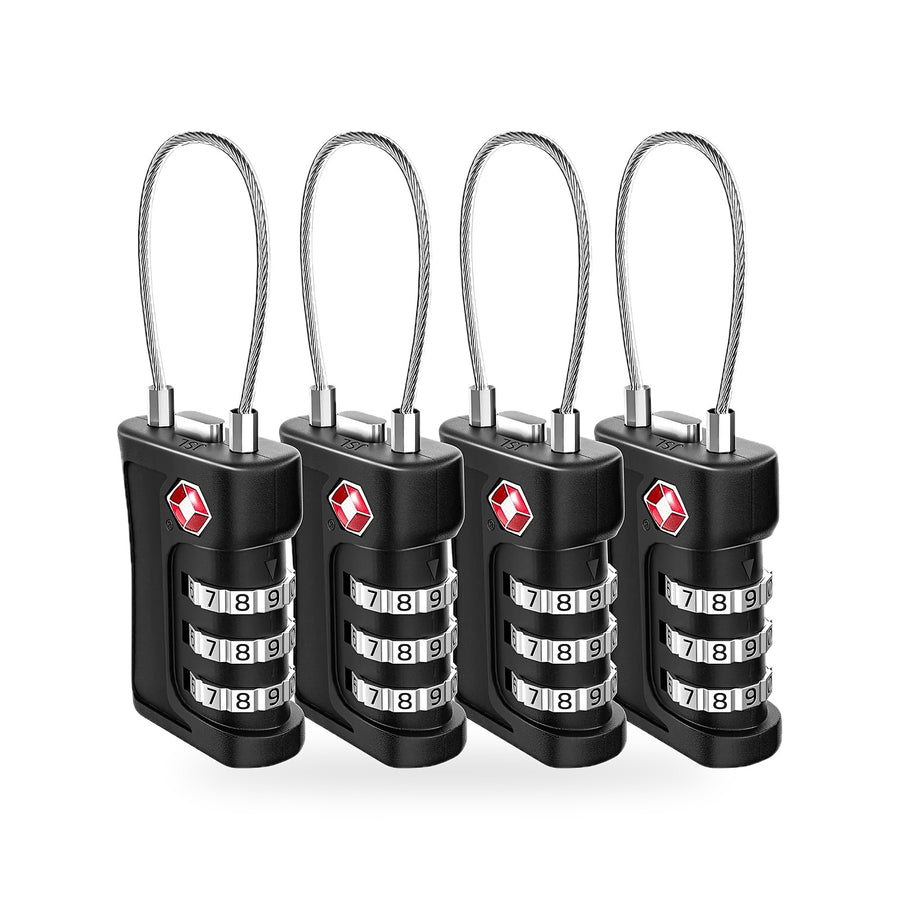
TSA Luggage Locks (4-Pack)
A code only you know, and a lock security can open without cutting.
- TSA-acceptedAgents can open these with their master key for an inspection, so the lock doesn’t have to be cut off your bag.
- Your own 4-digit codeEvery lock starts at 0-0-0-0. Set your own four digits before the trip, one code for all four or a different code for each.
- Flexible steel cableThe cable shackle bends to thread through zipper pulls, bag loops and locker hasps with holes 3 mm and up.
- Four in the packTwo suitcases, a carry-on and a backpack on a trip, or a gym locker on ordinary weeks.
Why lock the bag
The bag goes one way. You go another.
Travel is a run of handoffs. The suitcase goes onto a belt, into a hold, onto a carousel, into a hotel luggage room, and for most of that you can’t see it. Nothing bad usually happens. A lock is for the stretches when the bag is out of your hands and the zipper is the only thing keeping it shut. A closed zipper with a lock on it is simply less tempting than one without.
The reason people skip locks is the worry of arriving to a cut one, or a bag that couldn’t be inspected. A TSA-accepted lock answers both. Security keeps a way in through the master key, and you keep a code nobody else has. The bag gets checked if it needs to be, and stays shut the rest of the time.
The other thing about a trip is what stays behind. Lock the bags, then give the house a minute before you leave. A week with nobody home is worth planning for, and it takes less time than packing a toiletry bag. Bags locked, house covered, and the trip is just a trip.
Lock the bags for the trip. Look after the house for the week you’re gone.
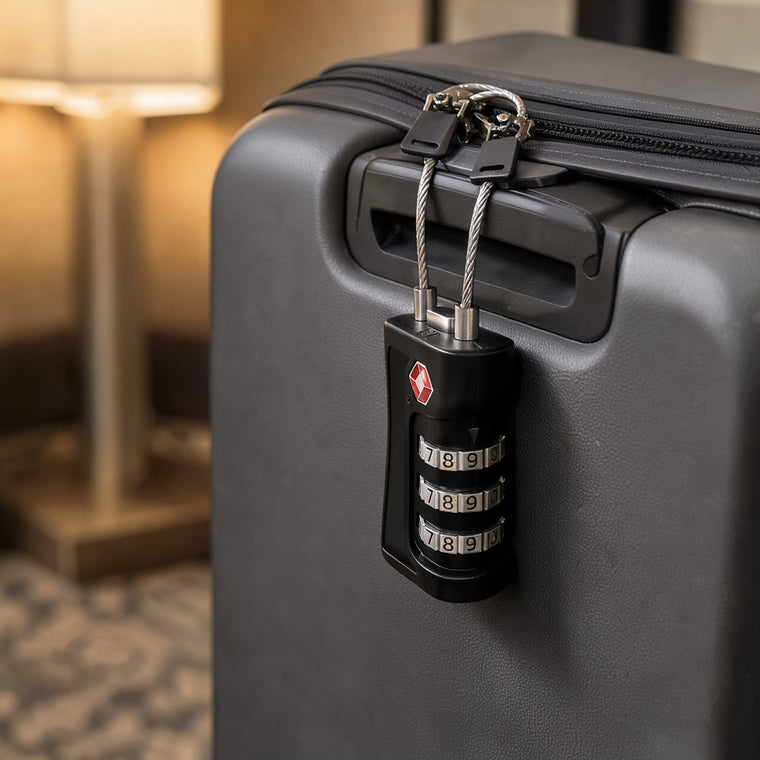
Two for the suitcases. Two for everything else.
On a checked bag, the cable goes through both zipper pulls so they can’t be slid apart, and the lock rides along at about 0.1 lb. If security pulls the bag, the agent uses the master key, looks, and locks it again. You open it at the other end with your own code.
The other two earn their keep between trips. A gym locker every morning, a backpack on a hostel shelf, a bag in the trunk with the zips tied together. Because the cable bends, it fits hasps and loops a rigid padlock won’t, as long as the hole is 3 mm or wider.
Setup is setting your code
Open it at 0-0-0-0
Every lock ships set to 0-0-0-0. Line up the zeros and the shackle opens.
Set your own code
With the lock open, reset it to four digits you’ll remember. Write the code down somewhere that isn’t the bag.
Test before you pack
Close the lock, scramble the wheels, then open it with your new code. Do it twice at home, not at the check-in desk.
Thread and lock
Pass the cable through both zipper pulls or the bag loop, snap it shut, and spin the wheels off your code.
Anyone who checks a bag or uses a locker
Family trips with several suitcases, a gym bag that sits in a locker every morning, a backpack on a shared shelf. It is $25.99 for four locks, and there are no keys to keep track of. Order before the trip leaves time to set the codes. If it doesn’t do what you just read, send it back inside 30 days. Shipping to the US, Canada, the UK, Australia and New Zealand is free and tracked, and most orders arrive 1 to 3 weeks after ordering.
The locks travel with the bags. The alarm stays with the house.
While you’re away the house sits empty for days, with nobody inside to notice a back door or window being tested. The TremShield Alarm sticks onto that door or glass and fires a 125 dB siren the moment someone forces it, so the house is loud even with nobody home, and there’s no Wi-Fi or subscription to set up before you go. One alarm is $29.99; six are $99, which is $16.50 per alarm (Save $80.94).
See the alarm
Questions, answered calmly
Stay one step ahead
Real home-security tips, first looks at new gear, and the occasional subscriber-only deal. Unsubscribe anytime.