
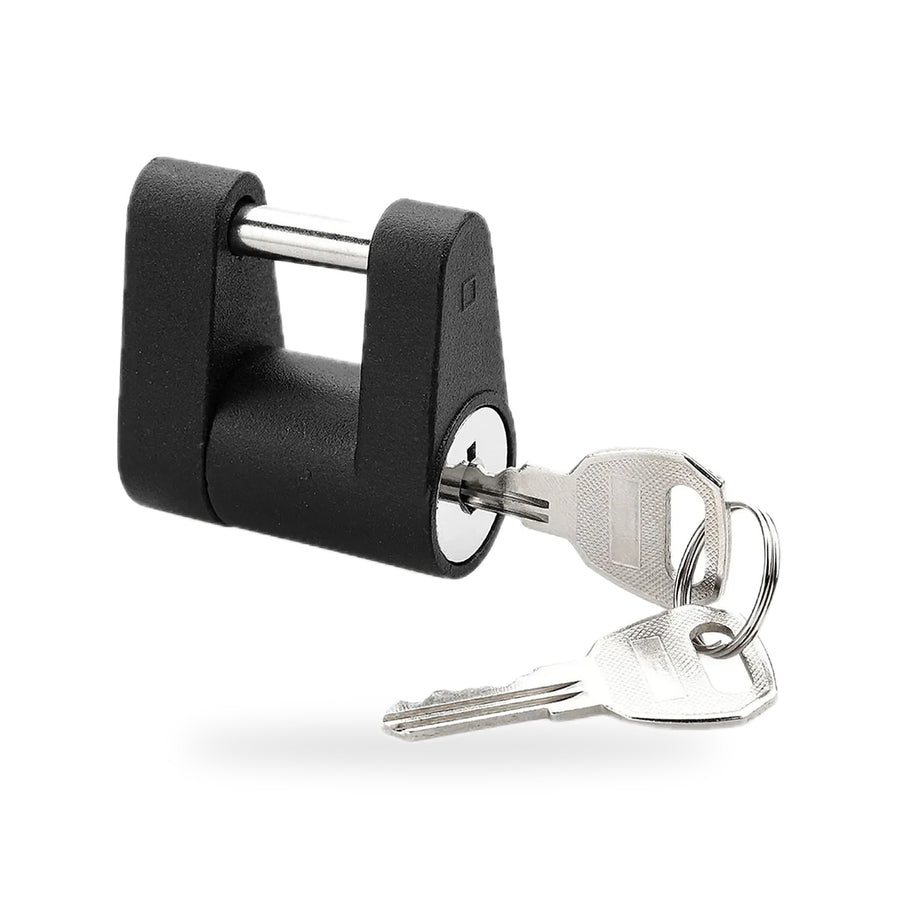
Trailer Hitch Coupler Lock (Keyed)
The latch stays locked, so the trailer stays where you parked it.
- Locks the coupler latchThe 1/4 in pin passes through the latch on a ball-hitch coupler and locks there. With the latch blocked, the trailer can’t be dropped onto someone else’s ball.
- Zinc alloy, anti-pick keywayThe body is zinc alloy and the keyway is anti-pick, so the lock itself isn’t the easy part to get past.
- Two keys in the boxOne key rides on your key ring. Keep the second at home, so a lost key never leaves the trailer locked to nothing.
- Nothing to installNo drilling, no bolts, no tools. It goes on when you unhitch and comes off when you hitch up again.
Why lock the coupler
A trailer is the one thing you own that’s built to leave with a stranger.
Most of what we lock up is hard to move. A trailer is the opposite. It sits on its own wheels with a coupler on the front that is designed to drop onto any ball and roll. That’s what makes it useful on a Saturday, and it’s what makes it easy to take on a Tuesday night while it waits in the driveway or the storage lot.
Nobody has to break anything. The coupler latch is the whole connection between a trailer and whatever truck is in front of it. If the latch can close on a ball, the trailer can go. If it can’t, the trailer stays a heavy object on wheels that someone has to deal with in plain view.
A coupler lock takes the latch out of play. The pin goes through it, the lock closes, and the one quick way to hitch up is gone. It’s a small piece of hardware for a gap that’s easy to miss, because the trailer looks parked and safe. The habit is the only part that takes effort: lock it every time you unhitch, including the short stops.
If the latch can’t close on a ball, the trailer can’t roll away on one.
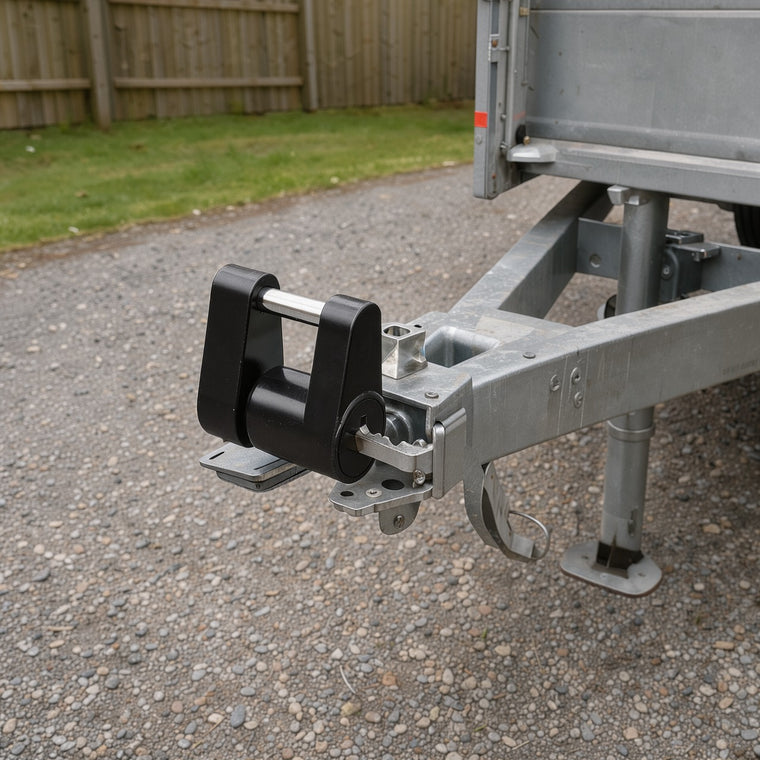
Same lock at home and wherever the trailer waits.
At home, the trailer sits where you can see it from the kitchen, most of the time. The lock covers the hours you can’t: overnight, the weekend you’re away, the afternoon everyone is out. Unhitch, pin through the latch, lock, and the coupler is out of play until you come back with the key.
At a storage lot, the trailer sits among dozens of others for weeks. A locked coupler there does the same job without you around. It’s one more thing standing between a stranger’s truck and your trailer, and it’s visible to anyone who walks up to the hitch.
Setup is part of unhitching
Check your coupler
Before the first use, look at the latch on your ball-hitch coupler and check it has a hole a 1/4 in pin can pass through.
Unhitch as usual
Lift the coupler off the ball and set the trailer down the way you always do.
Pin through the latch
Push the pin through the hole in the coupler latch and close the lock body over it.
Lock it and store the spare
Turn the key, pull on the lock to check it’s closed, and keep the second key somewhere other than the truck.
Any trailer that spends nights unhitched
An RV in the side yard, a boat trailer at the storage lot, a utility trailer behind the garage: if it sits unhitched with a ball-hitch coupler, this is the cheapest way to take the quick hitch-and-go off the table. It’s $24.99, there’s nothing to install, and you can check the fit by looking at your own latch. If it doesn’t fit or doesn’t do what you just read, send it back inside 30 days. Shipping to the US, Canada, the UK, Australia and New Zealand is free, and most orders arrive 1 to 3 weeks after ordering.
The lock covers the trailer. The alarm covers the garage.
The coupler lock keeps the trailer from being hitched, but it can’t tell you when someone is working the garage or shed door where the tow gear and tools live. A TremShield Alarm is a thin stick-on alarm for that door or its window, no Wi-Fi and no subscription, and it fires a 125dB siren the moment it’s forced. One alarm is $29.99; six are $99, which is $16.50 per alarm (Save $80.94).
See the alarm
Questions, answered calmly
Stay one step ahead
Real home-security tips, first looks at new gear, and the occasional subscriber-only deal. Unsubscribe anytime.