
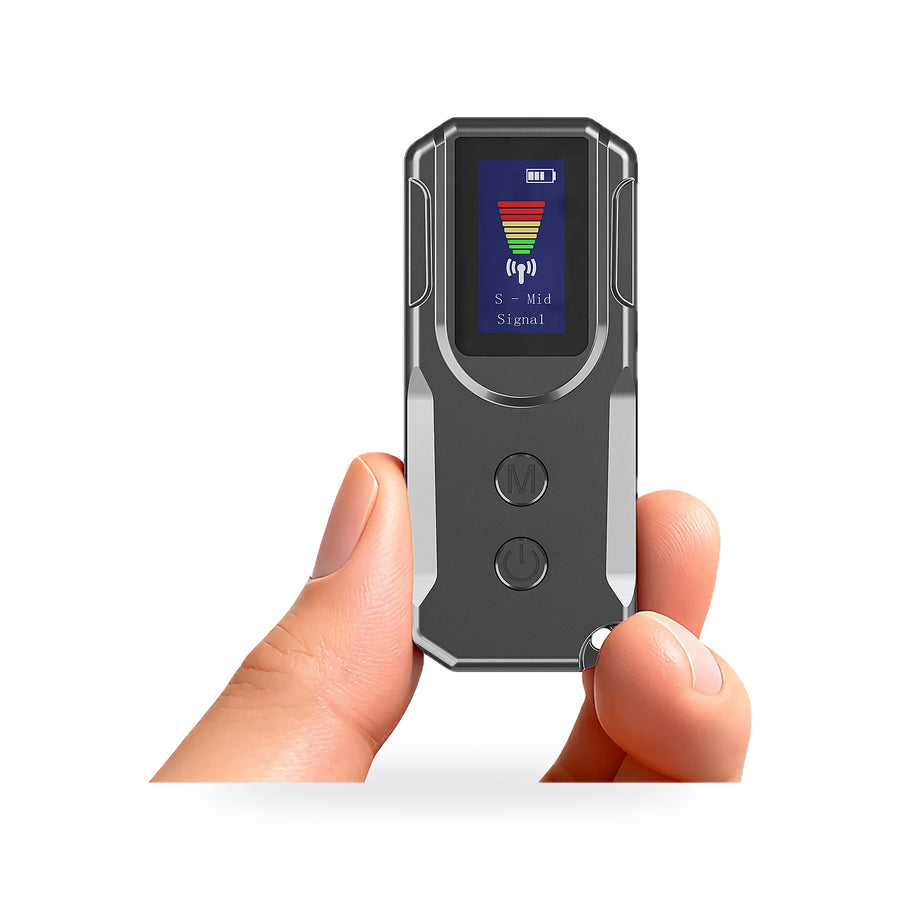
Hidden Camera Detector (RF Signal Scanner)
Sweep the room before you unpack. It flags what transmits.
- Finds what transmitsThe RF scan picks up wireless signals from hidden cameras, GPS trackers and listening bugs that send what they record. The display climbs as you close in on the source.
- Catches a lens with lightInfrared lens mode looks for the small glint a camera lens gives back, so it has a chance at a camera that isn’t sending a signal.
- Checks a car for trackersMagnetic mode reacts to the magnets that hold a tracker in place. Run it along the wheel arches and under the bumpers.
- Lives in the travel bagPocket size, rechargeable, about 30 hours of use per charge and about 30 days on standby. Charge it at home and it’s ready at check-in.
Why sweep a room
The room looks fine. You’d just like to know.
A short-term rental is somebody else’s house, with somebody else’s gadgets in it. Smart speakers, chargers, smoke detectors, a clock on the dresser. Nearly all of them are exactly what they look like. A small camera can be built into any of those shapes, though, and from across the room you can’t tell which is which. So most people unpack and try not to think about it.
Many hidden cameras send what they see somewhere, and sending means a radio signal. That signal is what an RF scanner hears. Carry it slowly around the room and the reading rises as you get closer, which turns a vague worry into a specific spot to check. For cameras that aren’t sending, the lens is the weak point: glass catches light, and a quick pass with the lens mode can show it as a small glint.
None of it takes long, and none of it needs you to be an expert. It’s a few minutes with the lights low, the same way you’d check the locks on a new front door. The honest trade is that no handheld scanner sees everything. It narrows the search to the places worth a closer look, and that’s usually enough to unpack and get on with the trip.
Unpack after the sweep, not before.
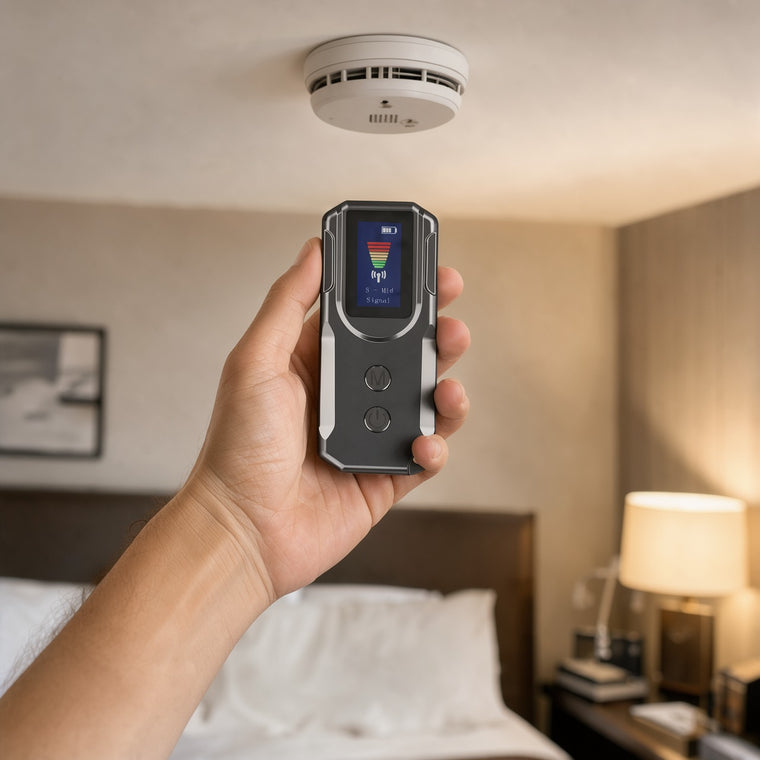
Radio for what transmits. Light for what doesn’t.
The signal scan is the fast pass. Phone off, then walk the room at a slow pace, holding the detector near anything that faces the bed, the shower or the couch. When the reading climbs, slow down and move it around that spot until it peaks. A router or a smart TV will register too, so a peak means look closer, not panic.
The lens check is the careful pass. Dim the lights, switch to infrared lens mode and scan the same spots, watching for a small, sharp glint where there shouldn’t be glass. It’s the mode that gives you a chance at a camera that is recording without sending. In a car, the magnetic mode does the third job: wheel arches, bumpers and under the seats.
Setup is a charge and a slow walk
Charge it at home
Top up the battery before you travel. A full charge gives about 30 hours of use, so one charge covers a long trip of room checks.
Switch your phone off
Your own phone transmits, and so do smartwatches. Put them out of the way so the reading you see comes from the room.
Walk the room slowly
Go wall by wall: smoke detectors, clocks, chargers, vents, shelves and anything aimed at the bed or shower. Slow down wherever the reading climbs.
Dim the lights for the lens check
Switch to lens mode and scan the same spots again. A small, sharp glint from a clock face or a vent is the place to look closely.
Rentals, hotel rooms, changing rooms and cars
It earns its place on any trip where you sleep somewhere you didn’t set up: a short-term rental, a hotel room, a guest house. It fits a changing room check and a quick sweep of a car you share or just bought used. It’s $79.99, it needs no app and no setup beyond a charge, and a full room check takes a few minutes. If it isn’t what you just read, send it back within 30 days. Shipping is free and tracked to the US, Canada, the UK, Australia and New Zealand.
The detector checks the room. The alarm guards the way in.
A sweep tells you what’s inside the room, but nothing about who tries the door at night. The TremShield Alarm is a thin stick-on alarm for the door or the sliding glass, with no Wi-Fi and no subscription, and it fires a 125 dB siren the moment someone forces it. One alarm is $29.99. Six are $99, which is $16.50 per alarm (Save $80.94).
See the alarm
Questions, answered calmly
Stay one step ahead
Real home-security tips, first looks at new gear, and the occasional subscriber-only deal. Unsubscribe anytime.