
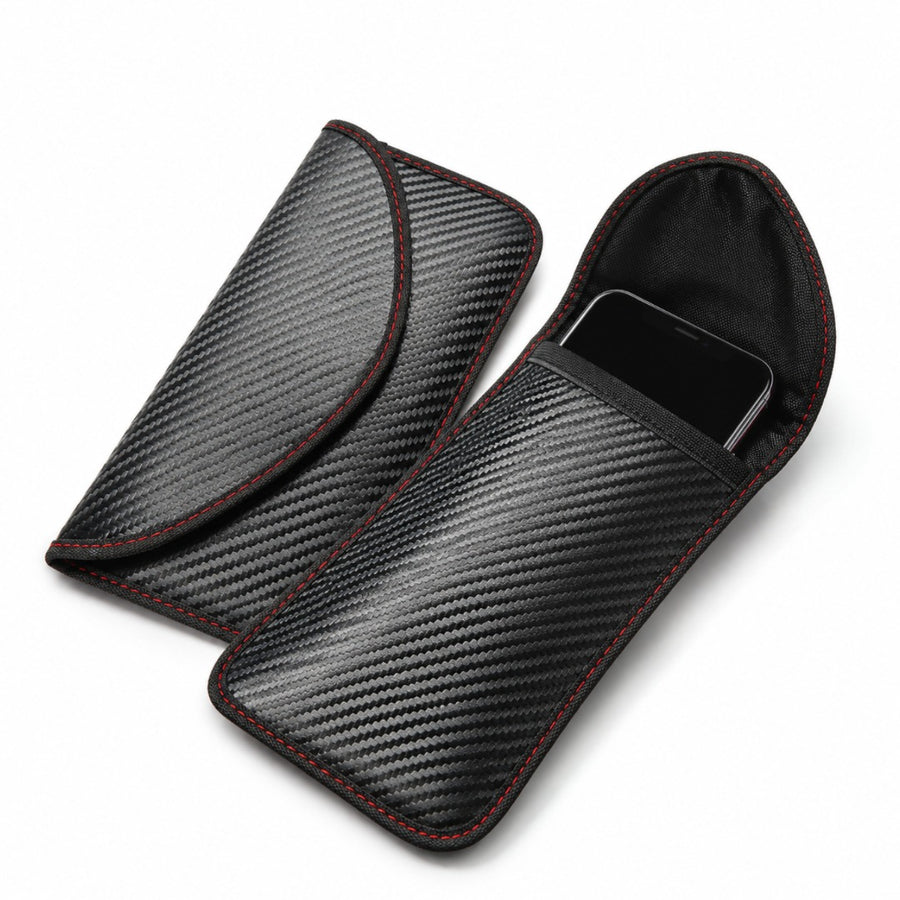
Faraday Bags for Phones (2-Pack)
Seal your phone inside, then call it. That’s the test.
- Proof in one phone callSeal your phone and call it from another phone. It should show as unavailable, so you know the pouch is working for you.
- Phone, key fob or cardsIt fits phones up to 6.5 in, plus car key fobs and cards. There’s a card slot inside.
- Two pouches in the packKeep one for your phone and one for your car key, or give the second one to someone else at home.
- Light enough to carryEach pouch weighs 42 g and is about 7.75 x 3.9 in, so it’s easy to keep in a bag.
Why test it yourself
You can’t see a signal stop. You can hear a phone not ring.
Plenty of people get curious about signal pouches for a simple reason. Maybe the car key hangs on a hook by the front door, and you’ve read about keyless cars and started to wonder. Maybe you’d like your phone to be out of reach for an hour, without powering it down. Both are fair things to want, and both come down to the same question: does this pouch really do it?
The answer is yours to check, and you don’t need any tools. A sealed pouch has one job, so one call will show it. If the call goes through, the flap is the first thing to look at. Half closed doesn’t count. Press it down along its full length, then try again.
Once you’ve seen it work, it turns into a small habit. The car key goes in the pouch when you get home. The phone goes in when you want quiet. You’ve run the test yourself, so you aren’t taking anyone’s word for it. Repeat it now and then, the same way you’d try a door you locked.
Trust the call, not the label.
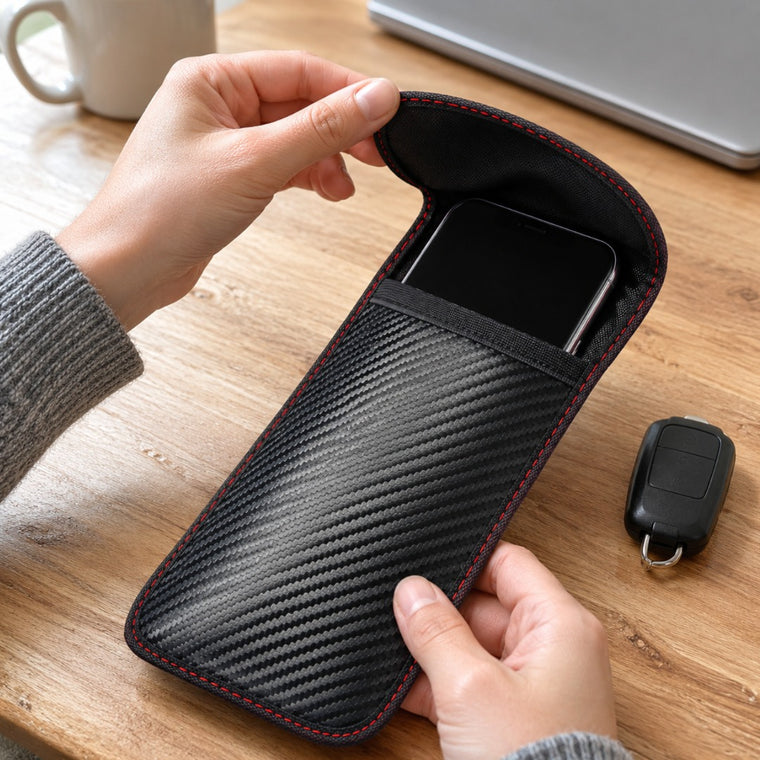
Check your phone, your case and your car.
Start with your phone. The pouch fits phones up to 6.5 in, and it’s about 7.75 x 3.9 in (19.7 x 10 cm) on the outside. If your phone is larger, or lives in a thick case, measure it against those numbers first. What matters is that the flap closes all the way with the phone inside.
Then think about your car key. If your car unlocks as you walk up to it, here’s a quick check. Seal the fob in the pouch, walk up to the car and try the handle. If the car doesn’t respond, the pouch is blocking the fob’s signal. Take the fob out when you’re ready to drive. Cars vary, so the test on your own car is the one that counts.
Run the call test the day it arrives
Slide your phone in
Put your phone in the pouch. If a thick case stops the flap from closing, take the case off.
Close the flap fully
Press the velcro flap down along its full length. The pouch blocks signal only when the flap is fully closed.
Call your phone
Use another phone to call it. It should come up as unavailable. If it rings, reseat the phone, close the flap again and retry.
Try your car key
Seal the fob in the second pouch, walk up to your car and try the handle. If the car doesn’t respond, you’re set. Take the fob out to drive.
For a key on a hook, or a phone you want quiet
Use it at home for a car key by the door. Use it on a trip for your phone and cards, or any time you’d like your phone unreachable without switching it off. You get 2 pouches, and the only setup is one phone call. If that call still gets through with the flap fully closed, send it back inside 30 days. Shipping to the US, Canada, the UK, Australia and New Zealand is free and tracked, and most orders arrive 1 to 3 weeks after ordering.
The pouch handles the signal. The alarm handles the door.
A sealed pouch looks after what’s inside it. The next layer is the way into your home. Stuck onto a door or window, the TremShield Alarm fires a 125 dB siren the moment it’s forced. It needs no Wi-Fi and no subscription. One alarm is $29.99; six are $99, which is $16.50 per alarm (Save $80.94).
See the alarm
Questions, answered calmly
Stay one step ahead
Real home-security tips, first looks at new gear, and the occasional subscriber-only deal. Unsubscribe anytime.