
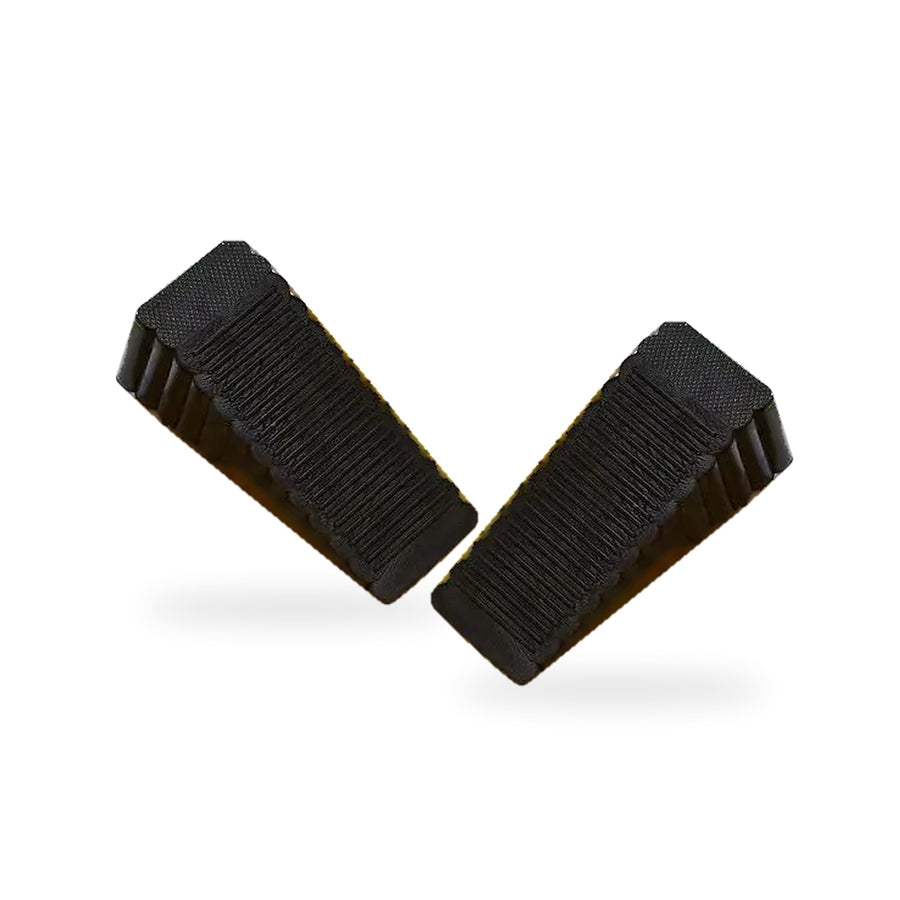
Door Stopper Security Wedge (2-Pack)
Slide it under the door from your side, and a push meets rubber instead of open air.
- Resists the door being pushedSlid under an inward-opening door from inside, the wedge sits in the door’s path, so a push on the door runs into it instead of swinging the door open.
- Fits gaps from 0.3 to 2.7 cmThe wedge shape covers door gaps from 0.3 to 2.7 cm, and the ribbed grip helps it stay where you put it.
- Nothing to installNo drilling, no screws, nothing left behind on a door that isn’t yours. It goes down at night and comes up in the morning.
- Two in the packOne for the front door, one for the bedroom. Or one at home and one in the suitcase.
Why a wedge
When you can’t change the lock, add something on your side of the door.
A lot of nights are spent behind a door someone else chose. The hotel room with a key card that a dozen people have held. The short-term rental with a code that went out to every guest before you. The bedroom in a shared house with a lock that’s more of a suggestion. None of those are yours to replace.
A door that opens inward has to swing through the space in front of it. Put a wedge in that space, under the bottom edge, and the door has to get past rubber before it gets past you. It’s a simple fix, and it works because it doesn’t depend on the lock at all.
The trade is that it only works while you’re inside and only on doors that open toward you. That’s fine. It’s built for exactly those nights: you close the door, slide the wedge under, and the room you’re sleeping in has one more thing between it and the hallway.
It doesn’t depend on the lock. It depends on the floor.
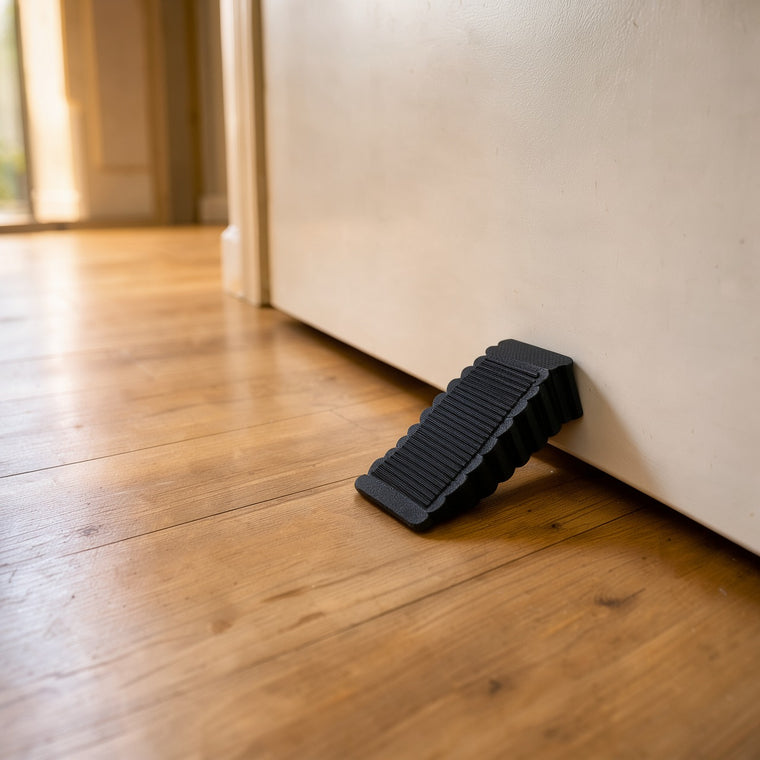
One by the bedroom door. One in the suitcase.
At home, a wedge lives by the door you close at night, whether that’s the bedroom, the front door of an apartment or the door to the back hall. Close the door, slide it under from inside, and pull it out in the morning. In the daytime it’s a plain doorstop that keeps a door open in a draft.
Away, the second wedge rides in the carry-on. At about 3.7 x 1.6 x 1.1 in, it fits in a pocket of the bag. In a hotel or a rental, check the door opens inward, close it, slide the wedge under, and you’ve added something of your own to a lock you didn’t choose.
Setup is sliding it under the door
Check the door opens inward
The wedge works on a door that swings toward you, into the room you’re in. It won’t hold a door that opens outward.
Close the door
Shut the door fully and lock it as usual.
Slide the wedge under
From inside, push the thin end of the wedge under the bottom edge of the door until it’s snug in the gap.
Give it a test push
Unlock the door and pull gently toward you. It should stop against the wedge. Lock it again and you’re set.
Every door you sleep behind but didn’t choose
Travelers, renters, students and anyone in a shared house: if the door opens inward and the lock isn’t yours to change, this is the cheapest thing you can add tonight. It’s $14.99 for 2, there’s nothing to install, and it goes in a pocket. If it doesn’t do what you just read, send it back inside 30 days. Shipping to the US, Canada, the UK, Australia and New Zealand is free, and most orders arrive 1 to 3 weeks after ordering.
The wedge holds the door. The alarm wakes the house.
A wedge resists the door, but it makes no sound, so nobody knows someone is trying it, and it only works while you’re home. A TremShield Alarm sticks to the same door or a nearby window, no Wi-Fi and no subscription, and fires a 125dB siren the moment it’s forced, home or away. One alarm is $29.99; six are $99, which is $16.50 per alarm (Save $80.94).
See the alarm
Questions, answered calmly
Stay one step ahead
Real home-security tips, first looks at new gear, and the occasional subscriber-only deal. Unsubscribe anytime.